Every year on August 10, stakeholders worldwide celebrate World Lion Day to raise awareness about declining lion populations in the wild. The story of lion conservation in Africa highlights threats such as habitat loss, poaching, and human-wildlife conflict, which must be addressed in broader landscape conservation efforts. In contrast, lion conservation in India, particularly in the Gir and Greater Gir landscapes of Gujarat, stands out as one of the most notable successes among the world’s big cats.
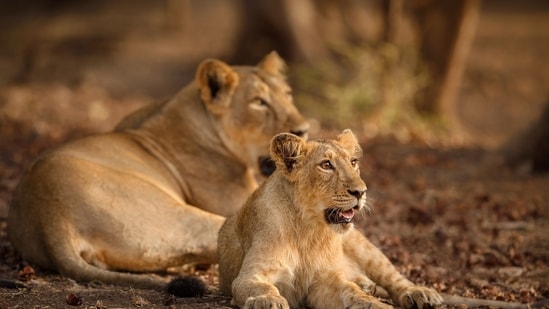
Historically, the Asiatic lion inhabited regions across Asia, spanning from Persia and Mesopotamia to the Indian subcontinent. Overhunting and habitat loss diminished their numbers, leaving only around 40-60 lions in the Gir forests and nearby areas by the early 1900s. The princely State of Junagadh was among the first to protect the species, offering it a better chance of survival. In 1965, India established its first protected area for lions: the Gir Wildlife Sanctuary. As numbers rose, lions expanded into new territories, which prompted the creation of further protected zones, including Gir National Park and wildlife sanctuaries such as Girnar, Mitiyala, Pania, and Barda.
The 16th Asiatic lion population estimates (May 2025) reveal there are 891 lions in India, a 32% rise from 674 in 2020. Under the environmentally sensitive leadership of Prime Minister Narendra Modi, the lions’ range has expanded from around 30,000 sq. km in 2020 to nearly 35,000 sq. km, covering 11 districts. In comparison, in 1990, their range was only about 6,600 sq. km, representing over a 400% increase. The current population seems robust, with 196 adult males, 330 adult females, and 225 cubs, indicating that lions are thriving, breeding, and raising their young across the area.
Several factors have contributed to this recovery. The main element is the strict legal protection that has eliminated poaching, except for a 2007 incident. Additionally, the revival of wild prey populations — such as spotted deer, sambar, blue bull, and wild pig — has been crucial. Wild prey now constitutes about 74% of the lions’ diet, compared to only 26% in 1974.
{{/usCountry}}Several factors have contributed to this recovery. The main element is the strict legal protection that has eliminated poaching, except for a 2007 incident. Additionally, the revival of wild prey populations — such as spotted deer, sambar, blue bull, and wild pig — has been crucial. Wild prey now constitutes about 74% of the lions’ diet, compared to only 26% in 1974.
{{/usCountry}}The landscape approach’s expansion has been equally significant. Rather than restricting conservation to Gir protected areas, India extended it to the broader Asiatic lion landscape, encompassing protected areas, forests, grasslands, seacoasts, and multi-use landscapes. This broader focus offers lions more space to find new territories.
Asiatic Lions return to Barda sanctuary
A truly inspiring part of this story is the return of Asiatic lions to Barda Wildlife Sanctuary in Gujarat. By 1879, lions were extirpated from the Barda area, and for more than 144 years, the forest lost their roar. Yet, in January 2023, a male lion naturally dispersed into Barda and was soon followed by female lions. By 2025, Barda was home to a population of 17 lions, marking a remarkable natural comeback after almost 150 years.
This achievement was not accidental; it resulted from deliberate, science-based conservation strategies, habitat restoration, protected corridors, prey population enhancement, and community involvement.
Today, Barda is celebrated globally as an example of big cat recovery. I was fortunate to witness this historic event during last year’s World Lion Day celebration at Barda, commemorating lions’ return to this stunning landscape.
A central element of India’s success in lion conservation is the active support and engagement of local communities. These communities not only admire lions but also accept their presence. Many pastoral and agricultural groups hold the lion in high regard, considering it an integral part of their culture, and tend to view livestock losses as a natural consequence rather than responding with retaliation
This goodwill has been cultivated over generations and upheld through various programmes.
For instance, the Gir Samvad Setu initiative, started in 2019, regularly brings forest staff and villagers together to discuss wildlife conservation, resolve conflicts, and address concerns directly.
Additional community stewardship is provided by honorary wildlife wardens, local aagevaan (community leaders), and hundreds of trained eco-guides and safari vehicle drivers. Members of eco-development committees and sarpanchs are also involved whenever possible, to encourage community participation. Farmers have also started seeing lions with admiration. Many say lions help keep crop-damaging animals such as nilgai and wild pigs in check, acting as a natural population control species. Farmers in lion territory often say, in the local idiom, that they sleep more peacefully hearing a lion roar.
India’s lion conservation strategy combines prevention, rapid response and community partnership. Over 55,000 open wells have been secured; machans help farmers monitor crops safely; and timely compensation builds trust with local communities. Measures such as trained loco pilots, trackside watchtowers, caution orders and patrolling have nearly eliminated lion deaths on railways over the past two years.
Dedicated rescue teams, 11 wildlife hospitals and the new Gir Wildlife Hospital further strengthen emergency response and veterinary care. The upcoming National Wildlife Disease Diagnostic and Referral Centre near Junagadh will further enhance disease surveillance and wildlife health management.
To ensure the long-term conservation of lions, PM Modi announced Project Lion on August 15, 2020. The project covers about 60,000 sq. km of Saurashtra, encompassing the current and potential dispersal areas of Asiatic lions. It adopts a landscape-level, holistic approach to biodiversity conservation, emphasising habitat enhancement, disease monitoring and veterinary support, scientific population tracking, biodiversity protection, benefit sharing, and, most importantly, community involvement.
The Asiatic lion’s story is more than just about wildlife; it also highlights community involvement. It shows what can be accomplished through strong government support, scientific conservation strategies, and community participation over many years.
Bhupender Yadav is Union minister for environment, forest & climate change. He is on X as @byadavbjp. The views expressed are personal.