China and India have some common ground despite the border issues and wider security concerns. A major global change over the last generation is the relative decline of the West in economic terms vis-a-vis the emerging economies of the Global South. In 1990, the West (including Japan) accounted for around 60% of the world economy. This helped stoke the hubris accompanying the narrative of having “won” the Cold War. The West’s share has now shrunk to under 40%, and the relative shrinking continues — emerging economies, led by China and India, are growing substantially faster than even the relatively dynamic US, let alone Europe and Japan.
China accounts for much of this shift. China’s prodigious 9-10% annual growth over four decades has led to a point where it almost matches the US in economic size and exceeds it on a purchasing power parity basis. It also dominates global manufacturing and many key technologies. China’s adoption of Deng Xiaoping’s “reform and opening up” occurred a decade earlier than India’s reforms under Manmohan Singh, and those reforms were more far-reaching.
But the past is not necessarily a guide to the future. India’s growth of around 7% per annum is now considerably faster than China’s, and India is now the most rapidly growing major economy. A variety of factors are at work: the continuation of earlier economic liberalisation, massive infrastructure investment, digitisation, the consolidation of India’s large and hitherto fragmented domestic market. Arguably, India should be growing even faster, as South Korea and China did at a comparable stage of development.
I would argue that, based on plausible assumptions, India’s development may well lead to rough parity with China by mid-century (in terms of economic size rather than living standards). India’s economic growth is now undeniably far more robust than China’s, which has slowed markedly. Some will scoff at the idea of India catching up with China, but a growth differential of 3-4% compounded over 25 years could do it.
{{/usCountry}}I would argue that, based on plausible assumptions, India’s development may well lead to rough parity with China by mid-century (in terms of economic size rather than living standards). India’s economic growth is now undeniably far more robust than China’s, which has slowed markedly. Some will scoff at the idea of India catching up with China, but a growth differential of 3-4% compounded over 25 years could do it.
{{/usCountry}}China has produced a remarkable burst of innovation in new technologies such as artificial intelligence, robotics, life sciences, and green-tech, but its overall growth is being dragged down by weak domestic demand, unreformed State enterprises, adverse demographics, and a suffocating preoccupation with national security.
I don’t however buy the narrative I hear from some Western commentators, that China is a brittle, failing State like the former Soviet Union — China may well supersede the US technologically and in terms of economic size. India also faces big problems, notably the squandering of a demographic dividend through massive under-employment, but these are not currently preventing its rapid growth and can be addressed with reforms.
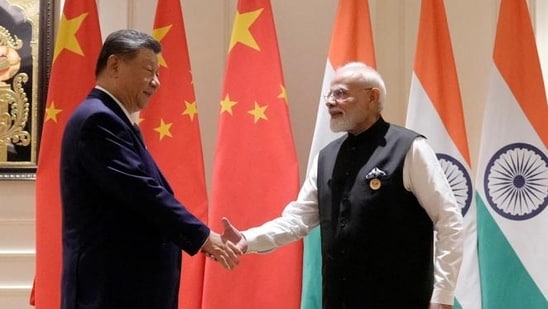
The bigger story is not the political differences between the two countries but that, together, they will economically eclipse the West. As emerging economic superpowers, India and China will have some competing interests. But they also have common interests and some of these were crystallised in the outcomes of the recent BRICS summit in Delhi.
The first of these is that, as the first and third economy by size (or second and fifth in nominal GDP terms), China and India have a common interest in reforming the international economic institutions, notably the International Monetary Fund and World Bank. Their shareholding is currently dominated by Western countries, reflecting the position in the past. If reform is resisted, the available option is to build alternative institutions, currently represented by the Asian Infrastructure Bank and the New Development Bank, both prompted by and located in China but with large Indian involvement.
Second is maintaining an open global trading system in the face of the protectionist trend led by the Trump administration. Neither China nor India can claim to be champions of free trade: China’s mercantilist, export-driven development is attracting considerable resentment in Europe and even in some emerging economies. India’s history of protectionism and disruptive trade diplomacy in the WTO makes it an even less plausible champion of open markets. But both countries have a strong long-term interest in preventing the world from turning inward and in maintaining the trade rules of which the WTO is the guardian.
A third and related common interest is maintaining an efficient global payments system — now based on the dollar as a global currency — while preventing the US from using its control of the global payments infrastructure to impose its foreign policy through financial sanctions.
Both China and India face the threat of sanctions because of their dealings with Russia and Iran. India has no interest in allowing the Chinese to replace the dollar with the yuan, which has none of the properties required of a global currency. But both countries have an interest in promoting more limited, practical schemes, like those being developed in the BRICS group for efficient settlement in national currencies.
There is also a lot of common ground in dealing, globally, with the climate crisis. Both countries are already experiencing the malign consequences of warming and recognise the necessity of a rapid transition to renewables.
Indeed, one positive consequence of better relations between the two countries would be greater use of Chinese renewable technology in India. But both have energy security concerns currently met by coal. With the US abandoning global leadership in this area, responsibility will fall increasingly on China and India.
The climate issue is an example of an international public good at risk from a collapsing international order.
As two of the dominant powers of the future, China and India have a common interest in creating a stable international order to replace the one being abandoned by the US. And that common interest should transcend bilateral disagreements.
Vince Cable is former secretary of State for business and trade, the UK. The views expressed are personal