Despite Modi’s guarantee and the Ram temple hype, the Bharatiya Janata Party is busy setting its caste calculus right in Uttar Pradesh where it is aiming for a 100% result for the National Democratic Alliance (NDA) in the forthcoming Lok Sabha elections.
A triangular contest, the 80 Lok Sabha seats in Uttar Pradesh are crucial for the party’s third successive term at the Centre, especially when the Southern states are playing truant. The BJP and its ally had won 64
Despite Modi’s guarantee and the Ram temple hype, the Bharatiya Janata Party is busy setting its caste calculus right in Uttar Pradesh where it is aiming for a 100% result for the National Democratic Alliance (NDA) in the forthcoming Lok Sabha elections.
A triangular contest, the 80 Lok Sabha seats in Uttar Pradesh are crucial for the party’s third successive term at the Centre, especially when the Southern states are playing truant. The BJP and its ally had won 64 seats in Uttar Pradesh in the 2019 Lok Sabha election despite a challenge thrown by the formidable Samajwadi Party-Bahujan Samaj Party alliance.
On paper, the SP-BSP caste combination of Dalits-Yadavs-Muslims totals 50% of the state’s population. Ironically, it was the BJP, along with its ally, which polled 51.19% votes in the 2019 polls. The SP-BSP together ended with 39. 23% votes as the alliance was marred by mistrust.
Caste is a critical ingredient in the winning recipes of all political parties despite the consolidation of Hindu votes under the BJP banner. And while the BJP can bask in the glory of Ram temple and Modi’s popularity, they are engaged in stitching caste alliances to achieve the party’s target of 80/80. The focus right now is on Yadavs and Dalits, the core voters of the Samajwadi Party and the Bahujan Samaj Party, respectively, besides some extremely backward castes.
“Some of these castes are numerically small, but have a huge impact in elections as they hold the veto power and vote together,” political expert Dr Badri Narain said.
According to him, as many as 40 SCs and most backward castes don’t have a leader in UP, which is known for identity politics. The BJP is trying to win them over by giving them representation in the party or their various forums.
The idea is to consolidate 80% of the vote bank leaving aside 19% Muslims, who they realise would not vote for the party despite efforts to woo Pasmanda Muslims after prayers were allowed in a cellar in the Gyanvapi mosque in Kashi. They had accepted the Ram temple, but now they fear a threat to every mosque.
This is how BJP is trying to woo the castes: On Sunday, Madhya Pradesh chief minister Mohan Yadav, who has been mandated to penetrate the Yadav vote bank of the Samajwadi Party, was addressing a Yadav Mahasabha in UP
Flaunting his Yadav caste, he tried to woo the Yadavs telling them how the BJP was committed to giving representation to every section of the society and he was an example. He also claimed the Yadavs, influenced by Prime Minister Narendra Modi’s development vision, were breaking away from the shackles of one family.
Yadavs are 7% of the state population and hold the veto power in 15 Lok Sabha constituencies.
Two days later on Tuesday, chief minister Yogi Adityanath expanded his council of ministers, even accommodating those who had called him names. After much dilly-dallying, he inducted Suheldev Bhartiya Samaj Party chief Om Prakash Rajbhar, who waited nine months even after Union home minister Amit Shah’s promise to him. Rajbhars have a sizable presence in East U.P.
The other three lawmakers inducted into the ministry were Anil Kumar from Rashtriya Lok Dal, Dara Singh Chauhan from Ghosi in East U.P. and Sunil Kumar Sharma. Anil Kumar is a Dalit from a Jat-supported party, Dara Singh belongs to the most backward caste in the state while Sharma is a Brahmin from West UP.
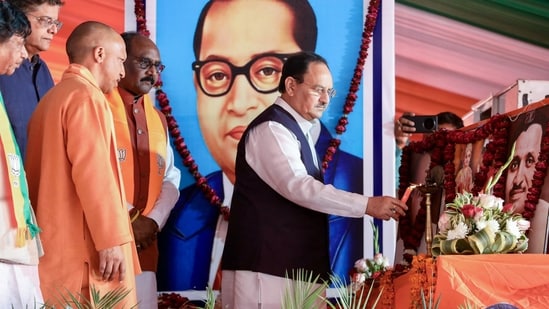
On March 7, BJP national president JP Nadda and chief minister Yogi Adityanath addressed a national-level Anusuchit Varg Mahasammelan in Agra, often called the Bhim Nagari because of its Dalit population. While Nadda attacked Congress for using the Dalits as a vote bank, Yogi played on the dignity factor, saying how the visitors to Ayodhya pass through the Rishi Valmiki International Airport before paying obeisance at the Ram temple. He also named Agra Metro Station after BR Ambedkar.
Thus, the BJP is making serious efforts to penetrate the Dalit and Yadav core vote banks of the BSP and the SP. The BJP had breached the Dalit group through its welfare schemes, now it has deployed its MP CM to make inroads in the Yadav vote bank also.
Since 2014, the BJP has been sewing up electoral alliances with smaller groups to muster the support of their followers.
“Caste alliances always play a crucial role in winning polls in a state where identity, though fractured at the caste level, is thriving in politics. Their mobilisation, despite their minimal population and restricted pockets of influence, makes a huge electoral difference to mainline parties,” Narain said.
Caste fixing is on with the opposition also working on their strategy.
Sunita Aron is a consulting editor with the HT based in Lucknow. You can find her on X as @overto. The weekly column, Keeping up with UP tackles everything from politics to social and cultural mores in the country's most populous state. The views expressed are personal.
One Subscription.
Get 360° coverage—from daily headlines
to 100 year archives.
Archives
HT App & Website