India’s Independence is the story of sacrifice and hard-won freedom from colonial rule—a story worth celebrating. But the birth of a nation 79 years ago also witnessed the monumental tragedy of Partition which saw one of the world’s largest displacements of 12 million people.
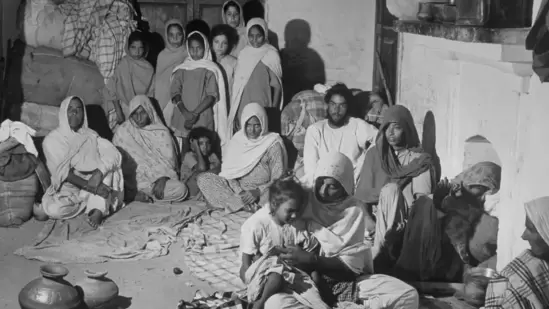
The gendered impact of this displacement is rarely discussed. One of India’s most eminent feminists, Urvashi Butalia author of The Other Side of Silence: Voices from the Partition of India talks about seeing the Partition story through the eyes of women and how some themes, particenceularly those relating to honour continue to play out nearly eight decades later.
What led to the writing of The Other Side of Silence?
Both my parents were Partition refugees. Despite the fact that they had lived through that time and always talked about it, as a young person I paid no attention to their stories because it just wasn't real to us. It was not reflected in anything we were learning in school, for example, about the political differences between Nehru, Congress and the Muslim League.
Then two things happened. The first was when a friend asked me to help identify people for a film on Partition. So, I started talking to people and that’s when I started to listen to the stories.
{{/usCountry}}Then two things happened. The first was when a friend asked me to help identify people for a film on Partition. So, I started talking to people and that’s when I started to listen to the stories.
{{/usCountry}}But even that didn't hit me so hard as 1984 when Indira Gandhi was assassinated and the whole shape of Delhi changed as it suddenly became a violent city. You could see buses burning, people shouting, and the administration, as you know, completely collapsed.
A citizen group Nagrik Ekta Manch was spontaneously set up and many of us volunteered. I had the responsibility of recording people’s stories so that we could file compensation claims or at least have documentation. So many people told me, “This is like Partition again.” I thought, if five days of violence can do this to people, then what must that time have been like? Why do we never think of it?
So I started with exploring my own family history and began to see this city as a city of Partition.
When we talk of Partition, the public recounting tends to look at the big picture: The displacement of 12 million people, one million dead from violence and disease, displacement camps and so on. But there is another accounting for, what you call the “gendered telling of Partition”.
Once you start looking at people’s experiences, you realise there are many ways that differentiate that experience. For example, class where people who were well-off were able to leave by car or even fly out. It’s not like they didn't suffer losses but relatively, they were not as vulnerable as people who had to take trains or walk in those big kafilas.
In all of these, the experience of women stood out because suddenly for them, the public sphere—the road, the train, the refugee camp—became their home. These were women who had never left their kitchens and homes and now the public space was where they had to make their kitchens and look after their children. This made them extremely vulnerable, especially when people were walking and they would stay behind to clean up after cooking and got ambushed or abducted.
I came across a story completely by accident, which at first, I found difficult to believe, of the ways in which families, especially Sikh and Hindu families, killed their own women because they were so scared that they would be abducted and raped and the entire community and religion would become polluted as a result. So, they chose to make them ‘shaheed’, ‘martyred’.
Nobody asked the women what they wanted or thought about two nations fighting about everything. Yet, one of the things they did agree on was to rescue the women who had been abducted. In a meeting as early as September 1947, they agreed that they would allow search parties to go into each other's countries to locate women who had been abducted and bring them back to their supposed homes, which meant bring Hindu women back to India and Muslim women to Pakistan.
The possibility of relationships of choice was completely wiped out by a law that said any woman seen to be living with a person of the other religion (after March 1947) would be assumed to have been abducted and restored back to her family.
Women social workers and police were sent to search for these women. It took them two, three, even four years to find them, by which time they might have been married, had children, formed a relationship with the man. But they were brought back and placed in camps in Karnal, Jalandhar, Delhi’s Lajpat Nagar market where they would spend their entire lives because their families wouldn't take them back since they had been ‘polluted’ by having sex with a man of the other religion. Many pregnant women, the story goes since there is no documentary evidence, were forced to have an abortion, or safaya (cleansing).
But, there were many remarkable stories as well. For example, the state set up rehabilitation for widows and gave them houses in Lajpat Nagar along with pensions and jobs. Single women were trained in tailoring. And I remember a shop in Shankar Market, now shut, which was run by refugee women.
So, women learned how to negotiate the public world.
When you write about gathering oral testimonies from women, you mention how different it was from that of men. For instance, you talk of interviewing women in the nooks and crannies of their households where, if a man was around, he would just take over the interview. You say something that I found incredibly moving on the importance of listening to “the half said thing, the silences which are sometimes more eloquent than speech.” And in so many ways this is not limited to Partition stories but the lives of women in general.
It is very, very difficult to get to talk to women alone because women have no leisure and they have no freedom to interact alone with somebody. The men will sit around or the kids will come in and ask for something.
Then, for example, how do you have a conversation with a woman about sexual violence, in a society where we don't even talk about sex? Where is the vocabulary, even if the woman trusts you completely? Where is the vocabulary for her to be able to describe what happened? Sometimes these things are unspeakable and you have to read into the body language, the hesitations, the euphemisms. I remember getting initially very frustrated about this and then I read an article which really changed the way I thought, which said when you talk to women you have to learn to listen in stereo, because you must listen to what they say, and you must listen to the silence and watch the body language.
Often with women's experiences, the entire community will know and talk about it like a public secret, but the woman herself will never articulate it. You have to negotiate your way through that. You have to arrive at the truth in a roundabout way.
You write about Thoa Khalsa in Rawalpindi where 90 Sikh women threw themselves into a well rather than face capture by the enemy and where they have been valorised as martyrs. Would you agree that this notion of honour vested in the bodies of women continues till today? How do we begin to change that narrative?
Absolutely. There are so many echoes today of that. Even the whole abduction business, finds echoes in “love jihad” stories today.
We have to stop locating it in honour. One of the things that Uma Chakravarti says which I found very apt is that we should no longer call these honour killings even if we put the word ‘honour’ in quotes. We should call these custodial deaths because these women are in the custody of their families. So at Thoa Khalsa, there was a discussion in the Gurudwara that the step was to be taken. And then the event is dramatized as our brave women.
Seventy-nine years later, Partition remains foundational to the story of India, but essentially a thing of the past. Why do we need to remember this story and what are the appropriate ways to memorialise it?
We need to remember the stories for many reasons. One of them is that we really need to learn that this kind of thing should never happen again. When you look at the stories with honesty and integrity you will see that it’s not like one side attacking the other. Both were complicit. That is an education on how capable of violence we are. And how we need to be alert to what we can do to avoid it again.
If we talk about it, we also discover that the history of Partition is not only a history of violence. It's also a history of deep connections, deep friendships, of the many ways in which people helped each other. It is also a history of resilience and survival. So in some ways it can be very inspirational to see how people survived that adversity and how they came out of it with compassion.