
 E-Paper



No victors, only victims in this ‘war of the worlds’
Russia's immersive full-spectrum war on Ukraine will have internal and external consequences, which will see all stakeholders suffer in different degrees

 Prefer HTon Google


We are in the midst of an “immersive full-spectrum” war where not just the combatants, but the entire world will suffer short- and long-term consequences. This is as close as it gets to the apocalyptic Cold War scenarios when the West and Eastern blocs flirted with mutually assured destruction, aptly summarised in its acronym — MAD. This is also a war between diametrically opposite ideologies, political systems, leaders, and the aspiration of nations to redraw the world order. The war is immersive because millions across the world directly or indirectly, have skin in the game and are participating vicariously. It is full-spectrum because every tool of war, from street fighting to long-range missiles, to cyber-attacks to economic strikes, nuclear, biological & chemical (NBC) threats to narrative shaping strategies are in play simultaneously.
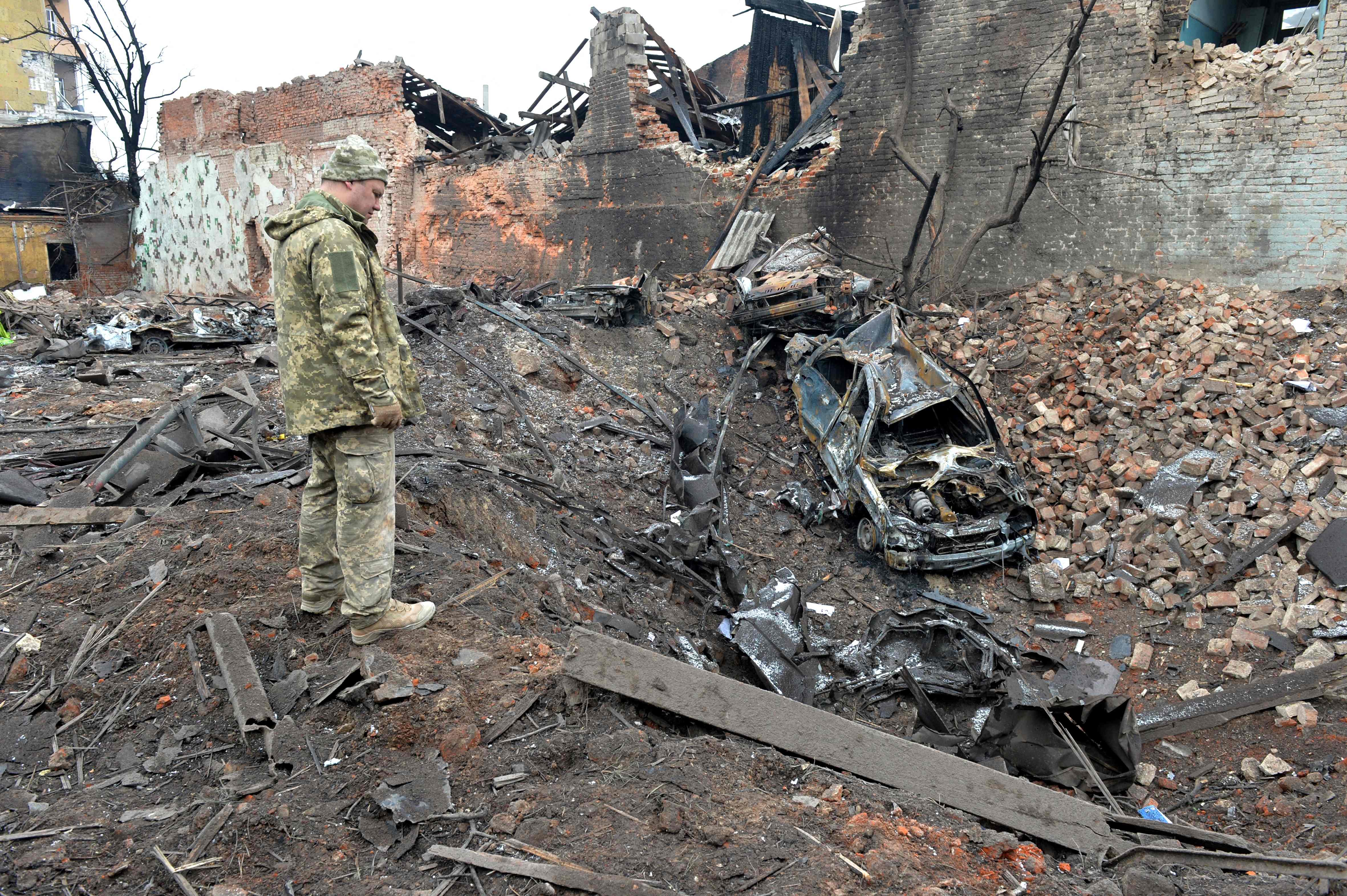
But like most wars, at its heart, this is also a battle between a regime trying to impose its will on people who simply refuse to accede to it.
This war has only three possible outcomes.
The first is that Russia’s military juggernaut pummels Ukraine into submission and draws the red line for North Atlantic Treaty Organization (NATO) in blood. The second is that Ukrainian resistance becomes the Western bloc’s bulwark against the hegemonistic ambitions of an autocratic leader and ousts Putin from Ukraine and consequently, possibly from Moscow as well. The third possibility is that Ukraine becomes the epicentre of destabilisation sucking in both Eastern and Western Europe, for the foreseeable future. In all three scenarios, there will be only victims, not victors, as all stakeholders will suffer, some more than others.
Beyond perfunctory statements, India has little heft in this conflict as we are sandwiched between the moral high ground needed to claim a place in the global high table and the realpolitik of abandoning a trusted ally whose war withal and veto support, is critically needed, especially against China. Despite pronouncements of self-reliance, India is decades away from any meaningful independence in matters of external or economic security.
This war has important lessons and consequences for us. The first is the sheer speed with which modern war can tailspin out of control. Barely days ago, military experts were writing off Russia’s mobilisation as Putin’s brinkmanship, perhaps forgetting that seemingly quixotic and incredulous behaviour is an essential ingredient of brinkmanship. We need to introspect whether our war machinery can meet such timelines given that even relatively minor conflicts in the past, had us scrambling for imported munition and ordnance at the eleventh hour, and most of it from Russia at that.
The second lesson is that despite the profusion of ideological, moral, and material support, the dirty business of fighting will have to be done by the nation itself. All world leaders, put internal appetite for body bags ahead of committing concrete external assistance, regardless of the righteousness of the cause.
The third lesson is that while being caught in a crossfire of two blocs can be dangerous, being left out in the cold by both, can be equally perilous. Regardless of the outcome of the war, a weakened Russia will lean towards China, economically and ideologically. The West has already started calling out India’s hedging and will compel us to make a George Bushian choice of either being with or against them. It will be hard to remain non-aligned when surrounded by inimical and hegemonistic countries, two of which have already taken our territories, when our ever-dependable ally is herself reeling.
The internal consequences of this war are equally alarming, and the timing could not have been worse. With the global supply chain in tatters, virtually every commodity’s price will skyrocket inflation at the same time when unemployment is at an all-time high, setting the stage for stagflation. Major investments will be cautious as the financial world waits for the debris of war to settle. With national elections barely two years away, political mindshare and financial policies will be oriented towards internal hustings rather than the changing world order, as indeed it has for the last few months.
And then there is China, which has a penchant for embarking on expansionist aspirations when the world is distracted. From the Chinese perspective, this is an opportune moment to lean into territories along India’s eastern flank. India is economically weak with shortages depleting our strategic reserves. The European war ensures that no country (or the UN) has any mindshare whatsoever to aid us materially or politically. We are simply too far down in the priority now, especially with the West rooting for China to rein in Putin. During a war between superpowers at NATO’s doorstep, Ladakh or Arunachal Pradesh will be a far-flung side act.
The only silver lining of a looming Armageddon is that it may compel our political leadership across ideologies to realise the existentialism of putting aside parochial, divisive, and short-sighted objectives to forge a sense of national unity. Especially if we have to take on a far mightier adversary. And that might be the best lesson we could learn from Ukraine.
Raghu Raman is the founding CEO, NATGRID
The views expressed are personal


