“I would not be here without his statesmanship. He is a great military leader, but I think he has shown himself to be a great diplomat,” said US vice-president JD Vance, praising Pakistan’s Field Marshal Asim Munir after the US and Iran agreed to a ceasefire after months of war. Pakistan played a key role in the negotiations that led to the agreement.
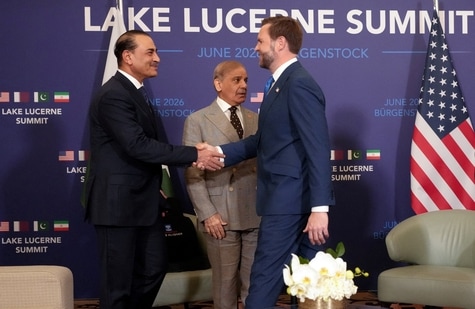
There has been an unmistakable turnaround in Pakistan’s geopolitical fortunes. In 2022, when Munir became the chief of army staff, the country was in a troubled state. Its economy was teetering on default, former Prime Minister Imran Khan was challenging the political power of the military with mass and intra-army support, insurgent violence was at its peak, relations with the Afghan Taliban had deteriorated, India was unwilling to transform the 2021 ceasefire into a comprehensive dialogue, China was supportive but unhappy with the targeting of its citizens, and the Joe Biden administration was deliberately ignoring Islamabad. Unsurprisingly, Munir was internally focussed, stiff-bodied, and inscrutable. In 2026, both the country and the man are more confident.
There is concern in India about the strategic implications of Pakistan’s comeback, and debate about how to respond to this moment of déjà vu. From renewed calls for dialogue to reports about Track-1.5 dialogues, there has been a sense of “movement” that obscures more than it illuminates. This moment demands an assessment of Pakistan on its own merit. It requires one to attempt and see Pakistan from Munir’s vantage.
On the home front, Munir has settled two immediate questions. His authority within the military is undisputed. Whatever institutional chasms his self-promotion may have created are unlikely to surface soon. His ruthless response in ordering the court martial of former director-general, Inter-Services Intelligence (ISI) lieutenant general Faiz Hameed, which led to the latter’s imprisonment, and targetting other pro-Imran-Khan officers has had the desired effect. Similarly, Pakistani social media is “controlled”, mainstream media is “managed”, and Khan remains in jail. Most traditional political parties have made their peace with this situation and cut a Faustian bargain with Munir. Combine this with his pushback during Operation Sindoor and the psychology of becoming a field marshal becomes apparent.
Also read: Pak’s misuse of Indus treaty
Then, there is the question of Pakistan’s long-term economic prospects. From Munir’s vantage, the worst has been consigned to the past. The economy is expected to grow at 3.7% in 2026 and inflation has fallen from 40% in 2023 to 11%, forex reserves are at $22 billion, and a trifecta of the International Monetary Fund bailout, Saudi Arabian finance, and remittance growth has ensured that the current account has gone from a deficit of $17.5 billion in 2021-22 to a surplus of $1-2 billion, despite the shock of the US-Israel-Iran war. This picture looks promising, but Pakistan risks another debt crisis unless it creates wealth at home. Structural issues such as excess borrowings, low investment, low taxation, a stressed energy sector, and weak exports performance continue to cast a long-term shadow.
On the question of insurgencies, there is a belief in Rawalpindi that the worst has passed. The ongoing bombing campaign in Afghanistan is limiting the Tehrik-e-Taliban Pakistan’s ties with Kabul, whereas the Baloch and Islamic State militants are struggling to create sustained strategic effects. To be sure, insurgent violence continues unabated, and there is no clear resolution in sight. But, in Munir’s eyes, the quality, scale, and tempo of attacks have gone from being unsustainable to manageable. This is where the risk lies: Without a political solution to these insurgencies, it is only a matter of time for the clock to turn back on these seeming successes.
This brings us to Munir’s newfound international profile as a conflict mediator. There is no doubt that Islamabad is in a geopolitical sweet spot and has refashioned its ties with the US, China, Iran, and its Gulf partners. In the US, Munir is not just investing in President Donald Trump, but also in Vance, who is widely considered to be Trump’s successor if the Make America Great Again (MAGA) Republicans win the November mid-terms and return to power in 2028. His dalliance with the US has not prevented China from deepening and widening support for Pakistan’s defence. The Saudi financial pipeline is secure, thanks to the bilateral defence pact.
But geopolitical sweet spots, as India learned the hard way, are limited, time-bound, and a diminishing phenomenon in international politics. Excessive reliance on external factors for national well-being is ultimately a limiting, not liberating, feature.
This is where the element of risk is highest for Munir. For now, Islamabad is unwilling to spend its strategic equities on Kashmir by entering active hostilities with India. This is why Munir is keeping the narrative tightly focussed on the Indus Water Treaty (IWT). He understands that this is an issue on which there is more sympathy for Pakistan than for India in world capitals. But whether he understands that this is probably the only issue on which there is support for Pakistan’s narrative is unclear. Few countries have the appetite to challenge India’s position on, concerns around, and stakes in Kashmir, despite the value they may see in Munir’s arbitration skills.
What should bother Munir then is that his international success has likely peaked. Whether it plateaus or troughs from here needs to be seen. But it will not translate into a fundamentally altered equation with New Delhi. Even with Kabul, there will be limits to how far a bombing campaign will take Pakistan. True, Iran is likely to be more accommodative of Islamabad, but Tehran is so battered that it will also revisit its posture on Kashmir as it rebuilds ties with India.
Munir has played his cards effectively since coming to power. The bigger test, however, is whether he has learned the lesson from history that Pakistani army chiefs often overplay their hand precisely when they feel they’re winning.
Avinash Paliwal teaches at SOAS University of London and is a nonresident scholar in the Carnegie South Asia Program, Washington D.C. The views expressed are personal