
 E-Paper



Terms of Trade | Ram Navami and déjà vu
A principal-agent analysis of communal violence in India

 Prefer HTon Google


“That evening at 8:40 pm, the procession arrived at the mosque area of Burra Bazar (in Burdwan town of West Bengal) playing pipes and drums. Muslims at prayer inside the mosque were enraged and the two sides came to blows. The news spread rapidly to the Berikhana mosque, where a crowd of Muslims armed with sticks collected and refused to allow the idol to pass”.
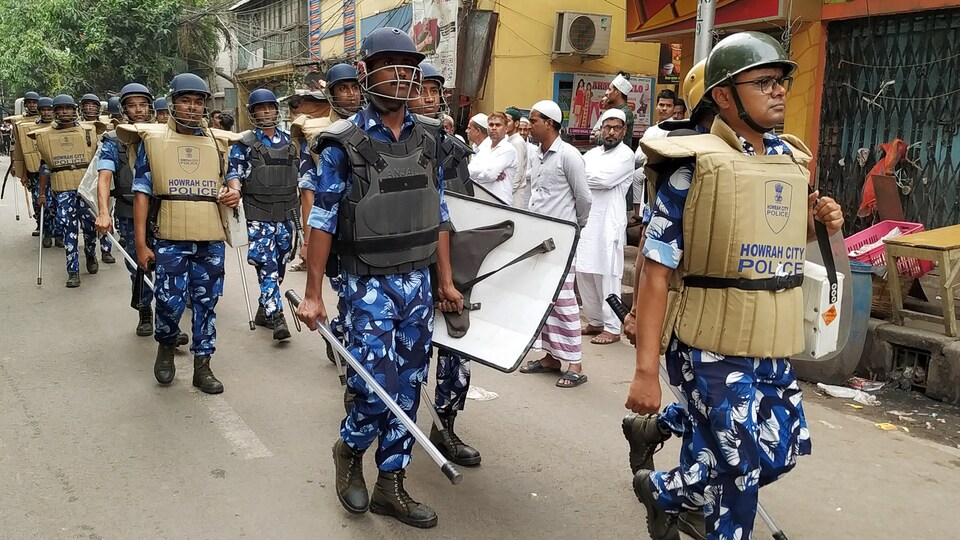
It is easy to assume that this passage is describing one of the events which have led to widespread communal tension in present day West Bengal around Ram Navami celebrations last week. Except they are not. This passage has been borrowed from Cambridge historian Joya Chatterji’s book Bengal divided: Hindu communalism and partition 1932-1947 and is describing events in Bengal of 1938.
This week’s news cycle has been dominated by reports of communal violence on Ram Navami from various parts of the country. The situation is particularly bad in the states of West Bengal and Bihar. What Joya Chatterji's book shows is that contrary to what a lot of people would like to believe, communal tension around festivals in India is not a recent phenomenon. In fact, historians have argued that it has been an integral part of India’s city life for a long period of time.
“Urban political or social associations (in Indian cities) were nothing like the ‘public’ bodies that began to appear in eighteenth-century Europe. These European ‘societies’ were in principle universally accessible to all individuals with common interests, but in Indian cities association was sanctioned by denser criteria of lineage, caste and religion, and it was operated by strict rules of exclusion. Religious conflict was restrained by distinctive methods: not, as later nationalist fondly liked to suppose, on the basis of a genuinely ‘composite’ culture founded on an active and mutual respect among practitioners of different religion, but on routine indifference, a back-to-back neglect, which on occasions like religious festivals could be bloodily dispensed with,” Sunil Khilnani writes in his book The Idea of India.
Democratic competition is a key driver of majoritarian communal violence in India
In fact, one can go a step further and cite research to argue that the incentives to precipitate communal violence have increased with the onset of democratic competition in India. A 2016 research paper (for a summary see economics and policy site, Ideas of India) published by political scientist Gareth Nillis and others — it is based on a comprehensive database of Hindu-Muslim riots in India from 1962-2000 prepared by two other scholars — made an important contribution to this argument.
Nillis et al examine the question whether having a Congress MLA affected the possibility of Hindu-Muslim riots and find that riots were less likely and less severe in places where the Congress won in closely fought electoral races (victory margin being less than one percent) than where it lost narrowly. The authors explain this result by arguing that the Congress’s historical support base has always had a diverse communal composition and failure to prevent riots lead to a disintegration of this base, which provides an incentive to keep communal conflict in check. To be sure, Nillis et al are the not first researchers who have studied communal violence in India and there are various other theories on what leads to communal violence. They include a backlash against rising prosperity of Muslims, representation of Muslims in the executive and degree of civic engagement among various communities in a locality. This 2014 column published in The Mint by Pramit Bhattacharya provides a useful summary of the literature on this issue.
There are reasons to believe that realpolitik of communal riots has undergone a change in the recent past. A 2020 analysis in the aftermath of 2020 communal riots in Delhi (it was preceded by a big loss for the Bharatiya Janata Party in the Delhi assembly elections) by political scientist Neelanjan Sircar, and published in news website, The Print, argued that the arrival of social media had changed the relation between geography and politics of communal violence. “If violence in one part of the country can yield electoral benefits (via social media driven narratives) in another part of the country, then there no longer needs to be a local electoral incentive for communal violence, and there no longer needs to be a local trigger for the violence either,” Sircar wrote.
But not all communal violence is majoritarian in India
It is useful to return to the example of West Bengal. On 21 November, 2007 the city of Kolkata saw widespread arson and rioting by a mob which had assembled under the banner of All India Muslim Forum. It was protesting against Bangladeshi author Taslima Nasreen and the protagonist of the protest Idris Ali would go on to become an MP of the Trinamool Congress (TMC) from Basirhat constituency. The Left Front government had to call in the army to restore order to the city.
Ten years after the Kolkata riots and three years after Ali had become an MP, large-scale communal violence broke out in Baduria, a small town in the Basirhat constituency. It was triggered by a Hindu boy sharing an objectionable social media post about Prophet Mohammad. While the boy was arrested, a Muslim mob started a protest in front of the local police station that he be handed over to the crowd and ended up setting fire to the Baduria police station and several houses and business establishments belonging to Hindus. Ali was denied a ticket by the TMC in the 2019 elections.
While Muslims have clearly suffered more in communal violence in post-independence India (largely a reflection of their minority status), any claim which argues that minority communalism and its violent manifestations do not exist is simply not true. What one can argue with greater confidence is the fact that principal actors who plan for such conflicts, irrespective of their religious background, hope to reap political benefits from the communal polarisation which follows.
The question that is often left unanswered: who are the agents of communal violence?
Days after violence broke out at various places during Ram Navami in West Bengal, the state police arrested a man who was seen brandishing a gun in one of the processions. The TMC leadership, as is to be expected, is claiming that the arrest will expose a larger conspiracy behind the violence. However, the video clearly shows that the man who has been arrested comes from a poor background and it is unlikely that he would have been the mastermind of orchestrating communal violence at a state-wide level. In fact, one can go ahead and argue that most people, whether Hindus or Muslims, who partake in large-scale religious mobilizations, which sometimes turn violent, are disproportionately from the ranks of the poor.
A 2017 HT report by Snigdha Poonam on Kanwariyas – not to suggest that there is a link between them and communal violence but the annual ritual does test the limits of legality and civility in north-India – captured this well.
"All of these men were born in the same village, belong to the same caste – Mali (OBC) – and most continue to live and work there. “Some of us work as cooks, some of us as vegetable vendors, some of us as construction labourers,” Naresh says, now holding on to the bamboo pole tied across the middle of the deck. He is a small man with dark skin, high cheekbones and sunken eyes. He and his friends make up the first generation of men in their families to work outside the fields; only one of them has gone to high school. Naresh himself dropped out in fifth grade to support his family. A vegetable vendor, Naresh makes ₹15,000 a month and saves at least ₹7,000 through the year to put in the Kanwar kitty. It’s what everyone must contribute towards a basic fund of ₹1,25,000", Poonam’s report says.
It is extremely likely that this is also the overwhelming class background of crowds which constitute Ram Navami processions prone to rioting or indulge in arson in name of protests against Taslima Nasrin or set fire to police stations to seek instant retribution for hurting communal feelings. In the case of a place like West Bengal, it can be argued that such people also unleash a lot of political violence at the behest of local leaders, which might not be communal in nature.
Why do the poor, who are struggling to make ends meet indulge in such risky endeavours? It is here that our collective confirmation biases, which often ascribe a benign haplessness to the poor, prevent an objective analysis of the problem. Ironic as many will find it, returning to what Karl Marx wrote in the 19th century is a useful way to solve this problem.
Marx’s dangerous class of Lumpenproletariat…
“The “dangerous class”, [lumpenproletariat] the social scum, that passively rotting mass thrown off by the lowest layers of the old society, may, here and there, be swept into the movement by a proletarian revolution; its conditions of life, however, prepare it far more for the part of a bribed tool of reactionary intrigue,” Karl Marx and Friedrich Engels, wrote in The Communist Manifesto in 1848.
For Marx and Engels, who are known for having given a doctrine which seeks to unite the poor against capitalist exploitation, to castigate a section of the poor like this might surprise a lot of people. But the Marxian disdain towards the lumpenproletariat was driven more by concrete experiences of this particular class acting as mercenaries for the rich in positions of power to crush revolutionary uprising in contemporary Europe beginning with the coup d'état against the French revolution of 1789 than any subjective elitism.
While the term has all but disappeared from the current political lexicon; Marxism itself is hardly a framework in fashion, it is pretty useful in explaining the problem at hand. A brief digression from India’s communal violence problem is useful here.
In his book The Dangerous Class: The Concept of the Lumpenproletariat political scientist Clyde W. Barrow has almost resurrected the discussion on this category to analyse, among other things, the surprise victory of Donald Trump in the 2016 presidential elections in the US.
Barrow argues that the downward economic mobility which the working class experienced as a result of outsourcing in the US and the indifference of the established political elite to it played a key role in building a constituency for somebody like Trump. “An entire generation of proletarians slowly watched themselves and their children sink into lumpenproletarian status, with no bottom in sight. Thus, as a long-time television actor, Donald Trump — a lifetime lumpen capitalist and con artist — found it easy to don “the garb of authenticity in claiming to stand for the people” by courting the support of newly déclassé white Americans, sometimes dog-whistling, sometimes openly espousing racist, nativist, and chauvinist views. And so Trump became the new clown prince of the lumpenproletariat,” Barrow writes in his book.
To be sure, Barrow is also critical of Marx and Engels for ignoring the lumpenproletariat question in their theoretical writings. “On the one hand, Marx and Engels assigned to the lumpenproletariat a significant and even decisive role in their political analyses of historical class struggles in nineteenth century capitalist societies, but on the other hand they assume in their more theoretical writings that in the long run, “all other classes [except the bourgeoisie and proletariat] decay and finally disappear in the face of Modern Industry”. Thus, despite the lumpenproletariat’s significant, and reactionary, historical role in nineteenth-century class struggles, Marx and Engels seem to suggest that the lumpenproletariat will eventually be relegated to the dustbin of history”, Barrow writes.
The book notes that latter Marxist theorists also struggled with a concrete set of praxis to deal with this class’s reactionary potential. “Karl Kautsky offered the harshest assessment, concluding that the lumpenproletariat would simply have to be dealt with by force of state. Rosa Luxemburg saw this option as counterproductive and instead proposed to make the lumpenproletariat into bribed tools of socialist intrigue with a rapid and massive expansion of social welfare that would quiet them. Lenin and Mao both entertained the idea that lumpenproletariats might be recruited into revolutionary armies and controlled with military discipline, but based on their experience both of them cautioned that the lumpenproletariat was always a source of disruption and it could never be trusted within the socialist movement because of its anarchistic and criminal inclinations,” Barrow writes. Most people would agree that democracies across the world continue to toy and struggle with these ideas at the same time.
…is useful to understand the growing communal mobs in India
India has made significant economic progress in the three decades of economic reforms and is on the verge of becoming the third largest economy in the world. However, almost everybody agrees that the reforms have been far less successful in generating quality and stable employment for millions of Indian workers, especially the younger ones. It is this group of young angry men living on the margins of daily survival who, it can be argued, have swelled the ranks of lumpenproletariat in India.
It is in this political economy that we must seek answers to questions of why has there been such a proliferation of angry and riotous displays of religiosity across religions which often mutates into episodes of communal violence. Religion continues to be an important factor polarising politics in India and there are enough rich politicians to bribe India's lumpenproletariat into creating such flare-ups.
Any political strategy which seeks to deal with the growing risk of communal precipitation on festivals must deal with the question of how to prevent the lumpenproletariat from being a bribed agent of communal provocateurs in India. A lot of commentators like to argue that growing communal flare-ups can damage India’s long-term growth prospects. What they do not realise while making such claims is that India’s unequal and jobless growth has played an important role in providing more and more foot soldiers for such communal clashes.
Every Friday, HT’s data and political economy editor, Roshan Kishore, combines his commitment to data and passion for qualitative analysis in a column for HT Premium, Terms of Trade. With a focus on one big number and one big issue, he will go behind the headlines to ask a question and address political economy issues and social puzzles facing contemporary India
The views expressed are personal


