
 E-Paper



Terms of Trade | The class-differentiation in India’s economic dynamism
New research by a SOAS economist on occupational mobility in 2005 and 2011-12 shows the simultaneous creation and destruction of millions of jobs in the economy

 Prefer HTon Google


Congress leader Rahul Gandhi has taken to YouTube to publicise his interactions with poor people off late. While Gandhi and his party might have very different motivations for releasing videos of him talking to the poor, the interactions do give us an interesting insight into their lives.
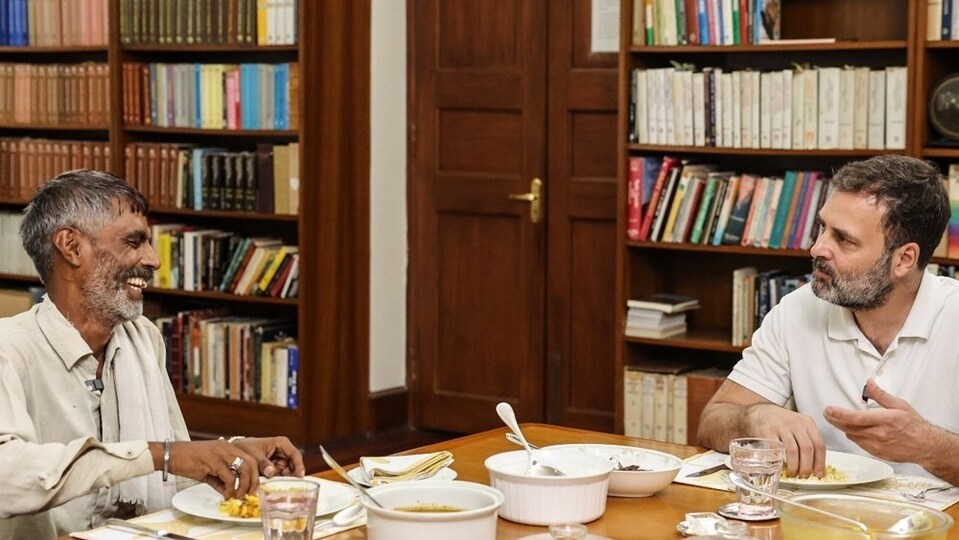
This edition of the column is inspired by one of Gandhi’s many videos where he was talking to a vegetable seller from Azadpur market in Delhi.
Rameshwar, the person in the video, went viral on the internet after breaking down on camera while narrating his inability to buy tomatoes due to a lack of working capital. While speaking to Gandhi in the video, Rameshwar told him that he had tried his hand at all kinds of manual work from loading bricks and being a construction worker to selling vegetables in the last 10 years. The end result of all of these jobs, Rameshwar says, was nothing but penury.
It is possible to argue that if Gandhi were to talk to one of the successful entrepreneurs in India’s start-up eco-system, he would narrate an equally dynamic professional trajectory, except with spectacular economic gains. It would look like this -- joining the founding team of a start-up, getting and eventually selling some stock options to get a few crore rupees, using that to start another company by raising seed capital and multiple venture capitalist rounds, the second company being acquired at a very large value, part of which would have been used to found another company.
Every stage in this process is likely to have made a significant addition to the entrepreneur’s personal fortune.
While these two examples might appear to be an extreme characterisation of India’s current economic situation to the readers, they are actually not very far from the truth.
The short point is while the Indian economy is anything but a stagnant space, the dynamism’s economic fruits vary drastically for different sets of people.
Rameshwar is not the only poor in India who has tried his hand at multiple jobs without being able to make economic gains. Recently published research by SOAS economist Surbhi Kesar provides path-breaking evidence to support this question. In her paper Economic transition, dualism and informality in India: Nature and patterns of household-level transitions which has been published in the Review of Development Economics this month, Kesar has used the India Human Development Survey (IHDS) data from 2005 and 2011-12 to track occupational mobility within households across sectors.
Kesar’s research is the first-panel data analysis – tracking the same sample over time – which has looked at this question. Kesar’s research looks at the period which is the best India has ever had in terms of GDP growth. The received wisdom on India’s economic performance during this period has been that of jobless growth as overall employment did not increase much. This suggests that the employment part of the economy has been largely stable.
Kesar’s research shows that what actually happened in the Indian economy during this time was a simultaneous creation and destruction of millions of jobs leading to a huge sectoral churn in employment in the economy.
“Around 46%–75% of households from each sector in 2005 transitioned towards some other sectors over the period, and 40%–77% of households in each sector in 2011–2012 had transitioned towards them from other sectors”, the paper said.
“Moreover, these transitions are not unidirectional; rather they are counterbalanced by simultaneous transitions in opposite directions”, the paper added.
Have these transitions been beneficial for the workers? While Kesar clearly said that average consumption levels did not fall across sectors during this period, she raised a counterfactual to evaluate whether the transitions had been necessarily favourable by asking whether the transitioning households have made higher/lower incomes compared to a simulated scenario where they did not transition.
Her analysis suggests that despite rising average consumption levels, a significant volume of such transitions, especially the ones towards informal wage work and informal self-employment, are counterfactually unfavourable. Moreover, whether the households undertake favourable versus unfavourable transitions is highly correlated with usual suspects such as access to education and credit, being located in urban areas and being located higher in the caste order. In Rameshwar’s case, it is not very difficult to imagine that each of these factors has played an adverse role.
Kesar’s excellent research, while it clearly breaks new ground, is not the only piece of evidence to support these claims.
A recently released report by NCAER (National Council for Applied Economic Research) on food delivery workers – HT covered its main findings here – showed that while the gig economy offers a short escape from unemployment to younger workers, it does not necessarily offer upward mobility or improved social security to most of them.
Research by two more scholars, Srishti Yadav and Satendra Kumar – their findings have been discussed in these pages – showed a similar dilemma among the relatively well-off section of farmer households. While Yadav’s research said that non-farm upward mobility created a disincentive to invest in agriculture, Kumar’s work showed that economic anxiety in cities played a big role in attracting (dominant caste) younger workers to the cause of the farmers’ protests against the (now withdrawn) farm laws.
While an overwhelming part of India’s 400 million-plus workers are jumping from the proverbial fire to the frying pan in terms of moving from one precarious employment to another, a small section at the top perhaps never had it better.
This is the salaried elite who are making a fortune working in the new economy, which ironically is thriving on the sweat and blood of a large part of the poorly paid and overworked workforce described above.
The abundance of cheap labour which will even bring its working capital to the job (read millions of delivery persons with their two-wheelers) is the bulwark of a very large part of India’s unicorn club.
A recent analysis of Income Tax Returns (ITRs) in these pages showed that unless one is born a billionaire, it perhaps makes more sense to aspire to be a part of the elite corporate bureaucracy than contemplate being a businessman or entrepreneur. The concerns on inequality and mass employment of better quality notwithstanding, very few people will disagree that India’s club of reasonably rich people will keep expanding in the foreseeable future to an extent where in absolute terms it will overtake the size of this group in many advanced countries. It is this part of the economy which is driving the bullish view on the Indian economy in capital markets inside and outside the country.
While there are no de jure barriers for movement from the ranks of the wretched majority to the privileged and upwardly mobile minority, de facto it is getting increasingly difficult in a world where run-of-the-mill higher education (of the sort given in India’s subsidized public educational institutions) is becoming more and more divorced from the employability requirements of the new economy.
It is this glass ceiling which is India’s biggest fault line today. Breaking this is an extremely difficult task and not breaking it will condemn India to a state where an overwhelming share of its workers will never be able to break out of their hand-to-mouth existence. Once the demographic dividend has ended, it will become an economic nightmare.
While there is nothing new about this prognosis, new research, especially Kesar’s work cited here showed that the dynamism within the ranks of the poor has made it extremely difficult to mobilise them politically. The problem at hand, in a way, has made a caricature of Karl Marx’s critique of the distribution of labour under non-communist systems.
“For as soon as the distribution of labour comes into being, each man has a particular, exclusive sphere of activity, which is forced upon him and from which he cannot escape. He is a hunter, a fisherman, a herdsman, or a critical critic, and must remain so if he does not want to lose his means of livelihood; while in a communist society, where nobody has one exclusive sphere of activity but each can become accomplished in any branch he wishes, society regulates the general production and thus makes it possible for me to do one thing today and another tomorrow, to hunt in the morning, fish in the afternoon, rear cattle in the evening, criticise after dinner, just as I have a mind, without ever becoming hunter, fisherman, herdsman or critic”, Marx wrote in The German Ideology which was published in 1845.
The problem facing today’s communists is that it is capitalism, not communism which has begun forcing workers from one profession to another without ceding control of economic decisions to the society at large. Even the most committed and brightest communist organisers will find it very difficult to work for a revolution if the workers in their trade union keep shifting every couple of years.
Every Friday, HT’s data and political economy editor, Roshan Kishore, combines his commitment to data and passion for qualitative analysis in a column for HT Premium, Terms of Trade. With a focus on one big number and one big issue, he will go behind the headlines to ask a question and address political economy issues and social puzzles facing contemporary India.
The views expressed are personal


