
 E-Paper



Terms of Trade | The story of two betrayed revolutions in Bihar
The political trajectory and subsequent tragedy of Swami Sahajanand Saraswati and Karpoori Thakur in Bihar underlines the complex interplay of caste and class

 Prefer HTon Google


Last month, the state of Bihar remembered two of its stalwart leaders.
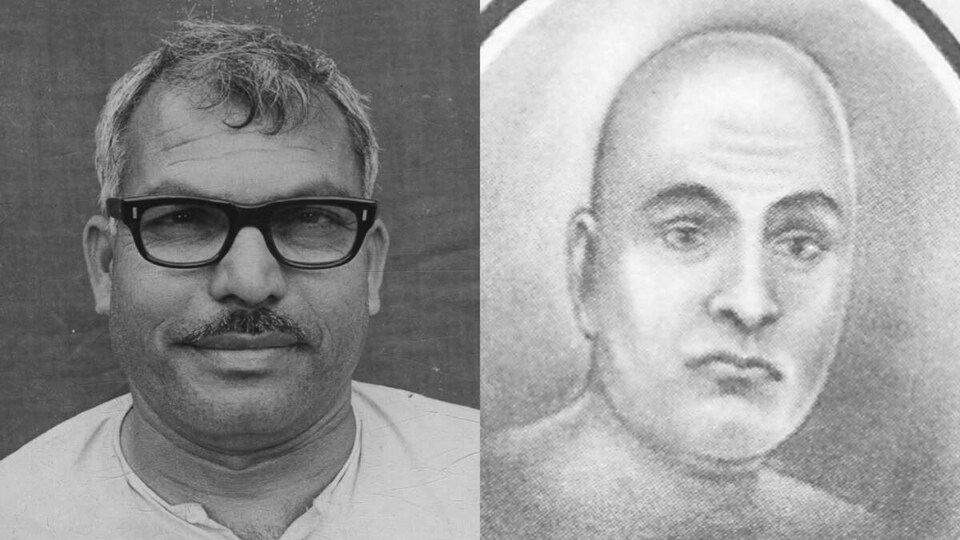
February 17 was the death anniversary of a freedom fighter, a radical leader of the socially backward classes and former chief minister Karpoori Thakur, who is always remembered with a reverential prefix of Jan Nayak (hero of the people). February 22 was the birth anniversary of Swami Sahajanand Saraswati, who started as an ascetic, became a social reformer and went on to become one of the most militant farmer leaders during the freedom struggle.
Both Thakur and Swamiji (as the latter is fondly remembered in Bihar) are celebrated across the political spectrum in the state today. As is to be expected, their death and birth anniversaries saw a lot of political events. The Bhartiya Janata Party (BJP), in fact, flew in the union home minister and senior party leader Amit Shah to address its programme celebrating Saraswati’s birth anniversary celebrations.
While both Saraswati and Thakur were genuine revolutionaries, the larger political project of both these leaders was actively sabotaged by their own fellow travellers within their lifetime. That betrayal is not just a historical tragedy but a reflection of persisting complexities in the state’s, and to a large extent, India’s political economy due to the complicated intersection of caste and class. A brief biographical history of both Saraswati and Thakur is necessary to make this case clearly.
Swamiji: from a hero of the land-owning castes to a pariah
Born as Naurang Rai in 1889 in Ghazipur district of what is now Uttar Pradesh, Saraswati had pretty much decided to be an ascetic when he decided to fight a battle for social equality in what can be crudely referred to as upper echelons of the caste order.
Saraswati’s social revolt came against what he believed was unjust discrimination by Brahmins against Bhumihars (a dominant landowning caste in Bihar and eastern Uttar Pradesh). He argued that the latter were in no way socially or ritualistically inferior compared to the former and produced a whole lot of research and documentary evidence to support his claims. His arguments prevailed over his detractors and this won Saraswati a lot of popularity within the ranks of the Bhumihars; it eventually landed him a leadership position in the Bhumihar-Brahmin Mahasabha, a caste organisation of two big landowning castes in the region.
The landowners who elevated Saraswati were soon to realise that they had made a mistake as he was more interested in fighting exploitation of all sorts than tactical political manoeuvring to promote the interests of the propertied upper castes which is what such groups wanted to do in reality.
“Ideologically, the Mahasabha was committed to cultural and educational works among the Bhumihar community, but it had the hidden political agenda of displaying loyalty to the British rulers and thus acquiring political dividends for the dominant leaders, who mostly comprised zamindars”, Ramchandra Pradhan writes in the introduction to his translation of Sarawati’s autobiography, The Struggle of my Life.
Saraswati took up the agenda of the underclass in the caste group and subverted it from within, generating a sharp backlash from the rich landlords. Exposing the hypocrisy of so-called caste organisations when it came to fighting against economic injustice even for people from the same caste was a theme Saraswati would keep reiterating in his political life.
In his subsequent political activities, his struggle against inequality, particularly the plight of poor farmers, would trigger similar contradictions within the Congress party in Bihar, eventually leading to a parting of ways. While Saraswati was among the founders of the All-India Kisan Sabha (for the uninitiated, this was the organization which led the huge farmers’ mobilisation in 2018) he continued to face growing marginalization in mainstream politics.
Karpoori Thakur: The subaltern who broke the glass ceiling
The importance of Karpoori Thakur in Bihar’s politics is best described by quoting from a 1977 article published in the Economic and Political Weekly (EPW) which was reporting the legislative party meeting of the Janata Party in June 1977.
“Located on the western fringes of Patna, in the Braj Kishore memorial, 235 legislators of Janata Party had met to elect their leader…Even before the voting was completed, it was clear that Karpoori Thakur was winning. With the solid support of about 50 BLD legislators and about 68 belonging to Jan Sangh, he had a head start over the other candidates…Despite this foregone conclusion the air was thick with speculation while the voting was in process. Karpoori Thakur was a barber by caste, wasn’t he?”, the author writes.
That a man, who pursued his own political agenda despite belonging to a weak and numerically insignificant caste could become the chief minister of a caste-ridden feudal state like Bihar was, simply speaking, unimaginable.
Thakur moved very fast and very militantly to advance his agenda of social equality once he captured power in Bihar. He brought in a law to give reservations to the backward castes (Mandal Commission recommendations on reservation for Other Backward Classes would only be implemented in 1990) with a separate provision for the more deprived within the backward castes. Thakur also removed English as a compulsory subject in schools as he believed that most students from socially deprived backgrounds could not pass the subject and it excluded them from seeking higher education and better jobs. Thakur’s radical agenda in power was preceded by him being a rabble-rouser par excellence against social inequality and discrimination in the state.
His contribution to social equality notwithstanding, Thakur could not last as the chief minister for his full term and was brought down by people within his own party which included leaders from dominant backward castes.
In his book Nitish Kumar: The rise of Bihar Arun Sinha gives details about the hostility Thakur faced from the biggest dominant OBC group in Bihar.
“Yadavs as a group had begun to assert themselves within the Lok Dal in the mid-1980s. They wanted to be the decision-makers in the party as they represented a caste with the single largest population (11 percent) in the state. They turned hostile to Karpoori who stood for a fair representation of all castes, particularly the lower backwards, to which category he belonged. The hostility grew to such an extent that they conspired to defeat him in Samastipur in the Lok Sabha elections in 1984-85…During the selection of Lok Dal candidates in 1985, Yadav leaders opposed the nominations of lower backwards, commending names from their own castes. ‘You are not interested in giving representation to the poor’, Karpoori lamented”, Sinha writes.
Contradictions between lower OBCs and Dalits and dominant OBCs were not limited to machinations within political parties in Bihar in that period. As Dalits and lower OBCs started asserting their rights with the ascendancy of leaders such as Thakur, both upper castes and dominant OBCs (they also owned large tracts of land in many parts) reacted violently unleashing a long chain of caste-based massacres in Bihar.
“The diverse class/caste interests and its political repercussion had its obvious reverberation during Karpoori’s ruling regime. It is significant that the All-India Backward Classes’ Federation marched through the streets of Patna on 14 March demanding, along with reservation of jobs, the release of all the accused in the Belchhi massacre case (of 1977), particularly of Inderdeo Chaudhary, MLA, the main accused in the case and a hero of the Kurmi caste. This was a clear indication of the caste conflict that would soon create a rupture in backward caste and Dalit relationship. The major outrages against harijan sharecroppers and agricultural labourers since March 1977 occurred in Kargahar, Belchhi, Pathadda, Chhaundadano, Gopalpur and Dharampura and in almost all cases the accused belonged to these aggressive backward castes”, Manish Kumar Jha writes in his essay called Caste and Popular Politics in Bihar: The Enigmatic figure of Karpoori Thakur.
Thakur, pretty much like Saraswati, died a politically marginalised and betrayed man.
“Delivering the inaugural lecture of the Eklavya Jayanti Samaroh on 14 February 1988, three days before his death, at the Vidhayak Club, Sabha Kaksha, Patna, Karpoori Thakur lamented that the different castes – backwards (pichhde; perhaps he referred to MBCs because by this time he was marginalised by the upper OBCs such as the Yadavs), “Harijans”, tribals (Adivasis) who have been victims of the caste system collectively are divided among themselves. Discrete caste-based organisations were just for show off, he suggested. He emphasised that there was a need for collective organisation and once this collective became politically viable and visible, only then would justice be done for the excluded groups”, Jagpal Singh writes in an EPW article published in 2015.
The appropriation of Saraswati and Thakur by their saboteurs
Anybody who is aware of political rhetoric in present-day Bihar would know that Swami Sahajanand Saraswati’s name is evoked as a politically correct euphemism for the political mobilisation of the Bhumihar caste in Bihar. It is not just a coincidence that the BJP leader who was leading the campaign for Amit Shah’s programme on his birth centenary comes from the same caste.
While it is increasingly likely that an overwhelming majority of the Bhumihars are exploited (by crisis-ridden agriculture and capitalism at large) rather than an exploitative (of the backward caste peasantry) lot today, it will not be far from the truth to argue that the political leadership within the community seeks a restoration of status quo ante and the feudal dominance it brought rather than a progressive struggle of the kind Saraswati wanted his followers to carry on.
Thakur’s fate is largely the same. The Rashtriya Janata Dal (RJD), which has been the primary engine of mutation of a genuinely radical subaltern revolution into a sectarian attempt to usurp all of its gains for a small group, claims itself to be the true inheritor of his legacy. Nothing could be further from the truth.
In lieu of a conclusion
To be sure, the dialectics of politics and markets have made sure that Bihar's society gravitates towards a more just order which is closer to the struggles waged by Thakur and Saraswati in their lifetimes, even if in a perverse way. The development of capitalism and marginalisation of agriculture has eroded the power of feudal lords and the caste and class oppression they could unleash using these powers.
Similarly, the arrival of Nitish Kumar-led Janata Dal (United) has made Bihar’s politics more competitive and egalitarian as far as OBC dominance is concerned.
The intent of this column is not to vilify present-day politicians who have been shown as having betrayed the ideals of Saraswati and Thakur. Present-day politicians must establish and preserve their hegemony by engaging in democratic competition and it will be a bit rich for a newspaper column to question the legitimacy (or lack of it) bestowed on them through such processes.
What the column intends to underline is the fact that the road from caste to class in India is not as straightforward as a lot of people want us to believe. Both Saraswati and Thakur, notwithstanding their revolutionary zeal, met with historical accidents while trying to negotiate this road.
Every Friday, HT’s data and political economy editor, Roshan Kishore, combines his commitment to data and passion for qualitative analysis in a column for HT Premium, Terms of Trade. With a focus on one big number and one big issue, he will go behind the headlines to ask a question and address political economy issues and social puzzles facing contemporary India.
The views expressed are personal


