What makes June 21, 2015, different from June 21, 2023? When Prime Minister (PM) Narendra Modi performed yoga with thousands as part of Yoga Day eight years ago, others dismissed it as a “show” by a political “showman”. The significance of such showmanship in politics, diplomacy, and public life was evident in New York this time around.
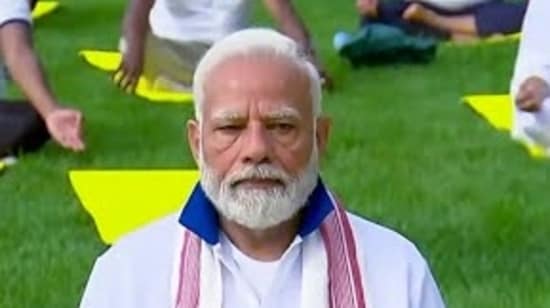
Modi practised yoga with delegates from 183 countries on the North Lawn of the United Nations (UN) Headquarters on that day. Until recently,
What makes June 21, 2015, different from June 21, 2023? When Prime Minister (PM) Narendra Modi performed yoga with thousands as part of Yoga Day eight years ago, others dismissed it as a “show” by a political “showman”. The significance of such showmanship in politics, diplomacy, and public life was evident in New York this time around.
Modi practised yoga with delegates from 183 countries on the North Lawn of the United Nations (UN) Headquarters on that day. Until recently, his predecessors used to utilise their overseas trips to promote domestic politics. Through Indian immigrants and Indian traditions, Modi has now begun to influence the internal politics of other democracies throughout the world. As yet, prior to him, no Indian PM has recognised this power.
Its first impressions began to emerge shortly after ‘Howdy Modi’ was held on September 22, 2019, in Texas. Addressing an Indian crowd in the presence of then United States (US) President Donald Trump, the PM demonstrated to the entire world for the first time that these are the days of Indian pride. Modi was aware that the number of non-resident Indians in the US is close to 4.5 million. They play a vital role in the local political, social, and economic landscape. This is why, like Trump, president Joe Biden has indicated his resolve to deepen ties with these voters via Modi. In a democracy, nothing is more vital than the voter and his/her vote.
Consequently, India and the Indian diaspora are becoming increasingly significant to western countries, including the US. Indian immigrants in Africa were already powerful enough.
The US is the most powerful country in the world, and we are the largest democracy. It is easy to argue that, in the shifting global geopolitical landscape, the US needs India and India needs the US. Can you envisage such relations between the US and Afghanistan, or between the US and Russia? Successful partnerships cannot be formed solely based on necessities.
Take Pakistan for example. We fought four wars against that country. It continues to wage a shadow war against us, costing billions of dollars and human lives each year. Despite this, why have our social ties with Pakistan remained? Language, culture, cuisine, and people-to-people relationships never change.
Similarly, the way the Indian diaspora has reinforced its standing in nations such as the US, Australia, and the United Kingdom has made dialogue between the government in New Delhi and their leaders easier.
I was in Singapore and Malaysia last week. On this five-day trip, I had to deal with four interpreters. Those with me in Singapore were of Chinese ancestry. They kept emphasising that we have more than 9% Tamils here, who make significant contributions to the country. They brought up PM Modi’s name often during the conversations. This has never happened before. The same was true about Malaysia. In reality, the Indian diaspora has a strong sense of optimism about India today. If you don’t believe me, look at the news from last Thursday. There were two more news pieces, both of which were prominently published along with Modi’s yoga event. The Indian stock market had reached a new high, and gold prices had dropped by ₹360. The data from the last three years show that, despite Covid and the Russia-Ukraine war, the Indian economy outperformed expectations. Despite rising prices and unemployment, the Indian market and buyers remain optimistic. Covid-19 and the Russia-Ukraine war have pushed Europe into a recession, but the Indian markets have returned to glory.
It’s no surprise that many economists believe India will dominate for the next 15 years.
Indeed, India and people of Indian origin have come a long way. I recall the time when Mahendra Pal Chaudhary, a person of Indian origin, was elected PM of Fiji in 1999. His government survived just a year in power with great difficulty. On May 27, 2000, the majority of his cabinet and he himself were captured by Opposition leader George Speight and rebel forces.
At present, Rishi Sunak is the PM of Britain, making Indians all around the world feel proud. The country that left us poor 75 years ago is now in the hands of an Indian. Today, CEOs of Indian origin lead 25 of the world’s top 500 corporations. People of Indian origin have a voice in parliaments, ministries, and in big institutions on every continent. There is no better time than now to breathe new life into the “India story” that former PM Manmohan Singh once crafted.
PM Narendra Modi is doing an exemplary job in this regard.
Shashi Shekhar is editor-in-chief, Hindustan. The views expressed are personal
One Subscription.
Get 360° coverage—from daily headlines
to 100 year archives.
Archives
HT App & Website