India is one of the most vulnerable countries in terms of climate change, water, air and environmental pollution. The Tata Centre for Development (TCD) is harnessing the rigour of the University of Chicago’s Economics department to address some of India’s most pressing policy and development issues, combining multi-disciplinary research with strategic outreach and partnership to translate evidence into impact.
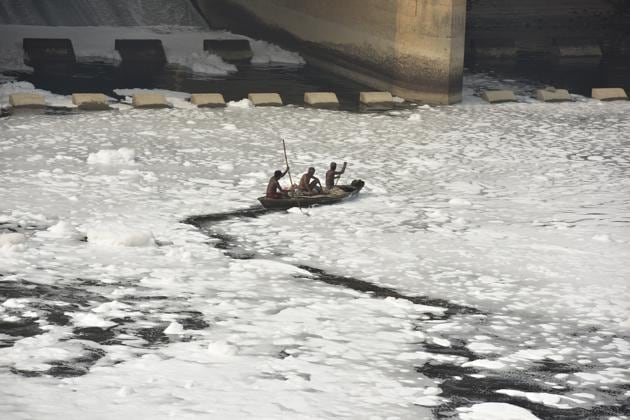
In an interview to Hindustan Times, Supratik Guha, Professor at Pritzker School of Molecular Engineering at University of Chicago, speaks to Hindustan Times on river pollution, their ongoing Water-to-Cloud (W2C) project, and what needs to be done to clean up our rivers.
KD: What is the state of the Ganga and Yamuna?
SG: Rivers are complex, dynamic systems. Hence, they need regular monitoring at various sites to get a sense of the health of the river system. The Water-to-Cloud team (W2C) has studied the Ganga in Varanasi and Kolkata, and the Yamuna in New Delhi for the last two years. Our research findings tell us the following:
First, with over 20 drains discharging untreated wastewater in Yamuna in New Delhi and a number of barrages, including the ones at Wazirabad, ITO and Okhla, restricting water flow, pollution levels in the Yamuna are high throughout the year. The Najafgarh drain is a major contributor of untreated wastewater in New Delhi. Dissolved oxygen levels are below 5 mg/l at most times of the year, creating an unhealthy environment for fish and other species to thrive. Data from April 2019 shows a slight improvement compared to data from April 2018, possibly due to increased flow of water from the Wazirabad barrage noticed this year.
Assi nala (a river turned into a drain now) in Varanasi carries a major share of the city’s wastewater from domestic and industrial sources. A pollution hotspot is observed around this area. Due to the high flow in the Ganga, the dilution ensures that most parameters comply with Central Pollution Control Board limits for bathing water standards round the year. Rivers are self-purifying entities provided that their flow is not disturbed too much. Data shows that the Ganga in Varanasi mostly has excellent DO levels (usually above 5mg/l) despite the higher anthropogenic activities around ghats in Varanasi. This can be attributed to a better river flow in that stretch of the Ganga. This is also true for improved water quality in the monsoons over summers even though domestic or industrial pollution load may remain uniform through the year.
{{/usCountry}}Assi nala (a river turned into a drain now) in Varanasi carries a major share of the city’s wastewater from domestic and industrial sources. A pollution hotspot is observed around this area. Due to the high flow in the Ganga, the dilution ensures that most parameters comply with Central Pollution Control Board limits for bathing water standards round the year. Rivers are self-purifying entities provided that their flow is not disturbed too much. Data shows that the Ganga in Varanasi mostly has excellent DO levels (usually above 5mg/l) despite the higher anthropogenic activities around ghats in Varanasi. This can be attributed to a better river flow in that stretch of the Ganga. This is also true for improved water quality in the monsoons over summers even though domestic or industrial pollution load may remain uniform through the year.
{{/usCountry}}KD: What needs to be done to clean the rivers?
SG: Pollution levels in rivers can be lowered by reducing the amount of untreated wastewater that enters them and by ensuring a continuous flow to dilute the polluted waters. While the zero-discharge norms exist in India, empowering regulatory bodies to implement them and penalising the violators is the need of the hour. The minimum e-flow notification for the Ganga has ensured a continuous flow in the river to dilute the polluted water, which may be a good short-term strategy, but in the long-run dilution should not be considered a solution to pollution. Hence, restricting waste at source and moving towards a circular economy (this entails gradually decoupling economic activity from the consumption of finite resources, and designing waste out of the system) will help clean rivers.
A systems approach needs to be adopted to intervene at each stage of the water cycle. Improving infrastructural capacity, changing people’s attitudes towards a common pool resource such as water by creating awareness, understanding the real cost of pollution and its long-lasting effect will together help clean rivers. At the foundation of all this is making reliable data accessible to all to ensure transparency and trust. A multi-stakeholder approach is the way forward.
KD: What does the Water-to-Cloud technique do? And why is better than the earlier system?
SG: Effective river basin management and water policy formulation requires access to reliable and up-to-date data in easy-to-understand formats for timely decision-making. Traditional water quality monitoring approach involves grab sampling, followed by transportation of samples to a laboratory where they are analysed using scientific instruments and the results are produced in a couple of weeks. Traditional laboratory-based testing is tedious, slow, expensive and prone to inaccuracies due to mishandling.
We at the University of Chicago envisioned the Water-to-Cloud system for such high-resolution spatial and temporal monitoring to gain insights that may be missed with the traditional approach. Geo-tagged, time-stamped mobile cyber physical sensing systems are used to collect such data over a given area at high spatial resolutions. These can identify pollution hotspots as well as provide data on violators and efficacy of government sanitation interventions. W2C gathers insights from such data and attempts to create machine learning-based models for water quality predictions.