This is the interim period between wars that were fought with humans and those that will be fought with machines. As we straddle the yesterday and tomorrow, the world is in the middle of a bloodless war between the old-world hegemon that is the US, and the contender for the crown that is China. As the US plays Russian roulette with China in an all-in trade war, the rest of the world waits for the winner to be announced so that it can realign its national interest, according to the new world order.
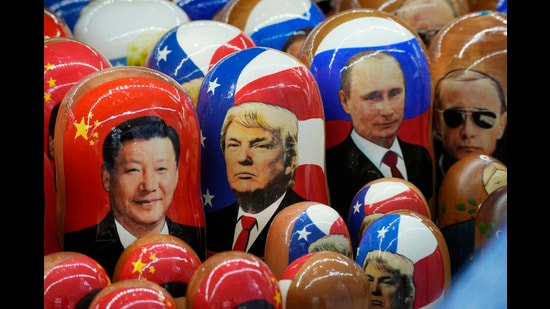
The incumbent power is bloated with debt and battered by a sharply torn population, a chunk of which does not have faith in the current leadership. America has advantages of its economic might, its military, its control of the global trade pipelines. But it also has one arm tied behind its back due to the friction of checks and balances that democracy imposes on a country. This is not an opinion on democracy but an observation on the costs of democracy when in need of nimble-footed manoeuvres. China, as an authoritarian regime with thin institutional resistance to government actions and harsh controls on free speech and anti-government protests, is free to act and pivot very fast in response to events.
In fact, US President Donald Trump learnt from his first attempt in his first term that China could be nimble and pivot its strategy even as the US government negotiated political wrangling and courts over policy decisions, and is now attempting to run roughshod over institutions and processes that attempt to hold him back. It is yet unclear if he will succeed.
{{/usCountry}}In fact, US President Donald Trump learnt from his first attempt in his first term that China could be nimble and pivot its strategy even as the US government negotiated political wrangling and courts over policy decisions, and is now attempting to run roughshod over institutions and processes that attempt to hold him back. It is yet unclear if he will succeed.
{{/usCountry}}China, as the aspiring power, has the energy and drive to go all-in and is not held back by either public opinion or voters. The US government has a tight time window before the pain inflicted due to an ugly stock market crash and the threat of a recession begins to shave off Trump’s approval ratings. How this global reset works out will be decided over the next few weeks. At the moment, it is guns to the temple as each waits for the other to blink first.
The rest of the world also waits as the titans battle. Nobody can predict how the chips will finally fall, but one thing is sure — the post-War rules-based international order is over. It has been decaying over the past few decades and now we stand at the brink of a new order. Or maybe disorder. A transition from an erstwhile great power to one or more aspirants is usually a messy process.
As global giants wrestle for supremacy, where does that leave us as average workers, entrepreneurs, consumers and investors? As citizens of the world’s largest democracy, we should take heart as we have a few things that set us apart from many other countries and blocs of the world. As a nuclear power, our physical borders will remain strong. With 60% of our GDP coming from domestic consumption, our reliance on the rest of the world is lower than countries where exports are the engine of growth. The macro picture looks strong with fiscal deficit under control and growth still above 6% a year. While we may see some shaving off of the growth number this financial year, India is not going to slip into a recession even if the US does. A recession is defined as two consecutive quarters of negative growth. A slowdown is growth slipping from say 7.5% to 6.5%.
The impact of the trade war has most dramatically been seen on the stock market meltdown globally. New investors into the stock market who have not seen such a market event are obviously worried. What we face today is a text-book definition of systematic risk, also known as market risk or undiversifiable risk. You must have heard the caveat in mutual fund ads: “mutualfundsaresubjectomarketrisk…” Well, here we are in the middle of that market risk. This is risk that the entire market faces and cannot be eliminated through diversification. It is caused by macroeconomic factors such as inflation, interest rates, or geopolitical events, all of which have an impact on all asset classes and the entire economy as a whole.
Investors who are losing sleep over the stock market volatility and the consequent losses are clearly in the wrong asset class. You need the seatbelt of asset allocation between safe fixed deposits and bond funds, and equity through a diversified portfolio, to have the resilience to remain invested in equity. Markets go up and down and sometimes the downs are hard and can last for years. If you don’t have staying power to ride out the down time, this ride is not for you. This ride does not have an airbag for the crash, so unless you are belted down, you are in trouble. This too shall pass, but now is the time to get out of the room and not take any action (either buy or sell) as the tariff guns go click, click, click.
Monika Halan is the best-selling author of the Let’s Talk series of books on money. The views expressed are personal