
 E-Paper



What Punjab and Haryana owe Uttar Pradesh and Bihar: Agriculture and labour cost
The advantage cultivators from Punjab and Haryana enjoy from migrant labour is that for the net income per acre earned, the labour costs borne is especially low

 Prefer HTon Google


Earlier this year, three men on a motorcycle opened fire on a group of agricultural migrants in the Moga district of Punjab, injuring two. Nirvair Singh, a purported member of the Devinder Bambiha gang, took responsibility for the attack in a social media post, marking it as a protest against migrants from Uttar Pradesh and Bihar who “spoil the atmosphere” of Punjab.
This incident was the culmination of a wave of resentment against migrants and their growing assertion in Punjab, predating the rape and murder of a five-year-old boy in Hoshiarpur, allegedly by a migrant worker in September 2025, which resulted in a coordinated expulsion campaign with the slogan “bhaiye bhajao, Punjab bachao” (drive out migrants, save Punjab).
Many in positions of power, including the chief minister, tried to diffuse tensions and reiterate the role of migrants in the economy of Punjab. It may be useful to take stock of the relative position of the agricultural economies of Punjab and Haryana, and tease out the reason why migrants are so crucial to these economies.
Why migrants are crucial
Punjab and Haryana are the top agricultural producers in the country. According to the Household Consumption Expenditure Survey 2022-23, among households self-employed in agriculture, those in Kerala have the highest monthly per capita consumption expenditure (MPCE) in the country, followed by Punjab and Haryana. These are also the only three states in the country where MPCE for rural households self-employed in agriculture is greater than that of rural regular salaried households. According to the Situation Assessment of Agricultural Households (SAS) 2019, the last available NSS survey on farm incomes, farmers in Punjab and Haryana earn the highest net income from each acre cultivated for paddy and wheat, respectively.
In both Punjab and Haryana, the rural economy is typically segmented between a dominant landowning caste group, such as Jats, Jat Sikhs, and Ahirs, and landless caste groups, predominantly Dalit, that would have historically undertaken agricultural labour on the formers’ fields. As the gains of the Green Revolution have plateaued, increased agricultural incomes for both landowners and labourers have brought with them aspirations and the desire to move towards something better. For landowners, this means white-collar, preferably government jobs. Recruitment in the armed and paramilitary forces has played a key role in these states. Some landowning caste groups are able to translate these aspirations into channels of employment better than others — Ahirs in southern Haryana have been relatively more successful than Jats in northern Haryana. In the absence of such channels, international emigration, legal or illegal, becomes a valve for pressure release.
Landless households have not been left behind in this process. Not only is the incidence of regular salaried employment the highest in Punjab and Haryana, according to the Periodic Labour Force Survey 2022-23, but the share of regular salaried employment in total employment for the Scheduled Caste is 33%, well above the national average of 20%. Landless households may not be as successful in accessing white-collar employment, but do not eschew blue-collar regular salaried employment, such as in factories, which, for landowning castes, is often beneath their status. As a result, there has been a great deal of migration out of villages in Punjab and Haryana of young Dalit men, leaving a gap in the agricultural labour market.
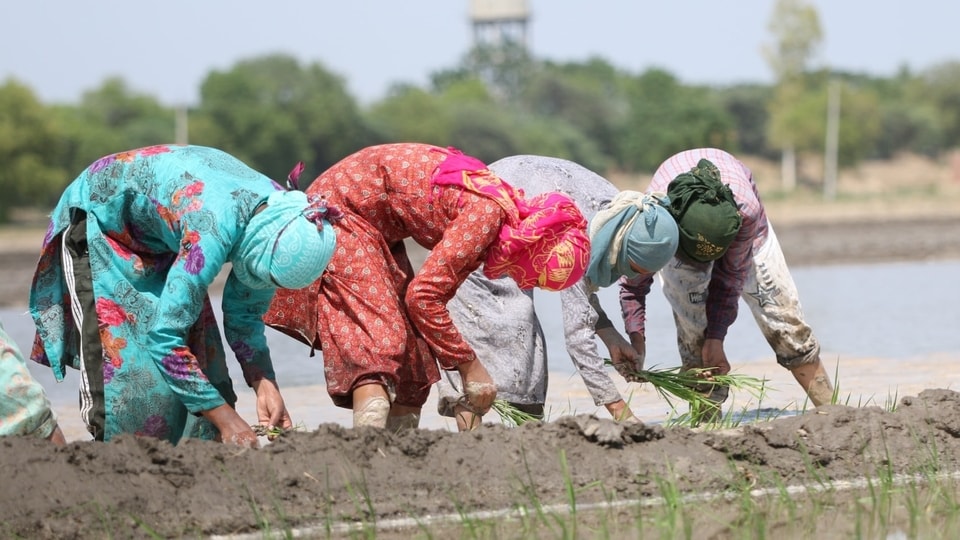
This tightening of the labour market, however, has not manifested in a labour-cost squeeze on farmer incomes, thanks to migrant labour. For decades now, migrant labour from Uttar Pradesh and Bihar come to Haryana and Punjab, typically for a few weeks, and execute harvest operations. In southern Haryana, where I conducted fieldwork, migrants work exclusively on piece-rated contracts to harvest bajra in the kharif season and wheat and mustard in the rabi season. Piece-rated contracts shift the incentive to work harder and longer onto the workers themselves, reducing supervision costs for employers and speeding up the harvest process. On being asked why cultivators preferred to hire migrant workers over local labourers, MD, an Ahir cultivator in Bas Dudha, said that daily wage workers come in at 9:30 AM in the morning, take an hour-long lunch break and a tea break, and leave promptly at 5:30 PM. Migrant workers work till late in the night. It is this discipline that landowners prize over all else; contrast this with what several landowning respondents bemoaned as the locals’ lack of willingness to work, presumably a consequence of increasing bargaining power and living standards among landless Dalits in Punjab and Haryana, not to mention access to subsidised grains under the PDS, another thorn in the landowners’ side.
Despite the tightening of local labour markets, the steady inflow of migrant labour has kept labour costs low for cultivators. In Visit 1 of the SAS, paddy-cultivating households (that cultivate paddy on over 90% of their operated area) in Punjab earned the highest net income per acre in the country, at over ₹30,000. However their labour cost per acre is close to that of paddy-cultivating households in Odisha and Maharashtra, states where net incomes are less than a third of those in Punjab. Labour costs per acre for paddy cultivating households are markedly higher in the southern states than in Punjab and Haryana. And in Visit 2, wheat-cultivating households (that cultivate wheat on over 90% of their operated area) in Haryana and Punjab paid less in labour costs per acre than their counterparts in Uttar Pradesh and Bihar. For the levels of net income per acre that cultivators enjoy in Punjab and Haryana, the labour costs they have to bear is especially low. This is the advantage that cultivators have from migrant labour and we would do well not to forget it.
Srishti Yadav is assistant professor of economics, School of Humanities and Social Sciences. Azim Premji University. The views expressed are personal


