
 E-Paper



What UNGA can do in a turbulent world order
The side events, of civil society and businesses engaging with leaders, take centre stage in a largely symbolic UNGA. However, its key role in consolidating attitudes on several global issues cannot be discarded

 Prefer HTon Google


Over 130 heads of State and government travelled to New York for the General Debate of the 77th United Nations General Assembly (UNGA) last week. Why so many leaders participate in an event without the prospect of tangible outcomes remains a paradox to those watching from afar. With geopolitical tensions in play, the Russia-Ukraine conflict took centre stage. Diplomatically, Ukraine and its supporters scored well. The wins began with a solid majority (including India) providing President Volydymyr Zelensky a derogation to make a video address, overriding the norm that leaders speak in person.
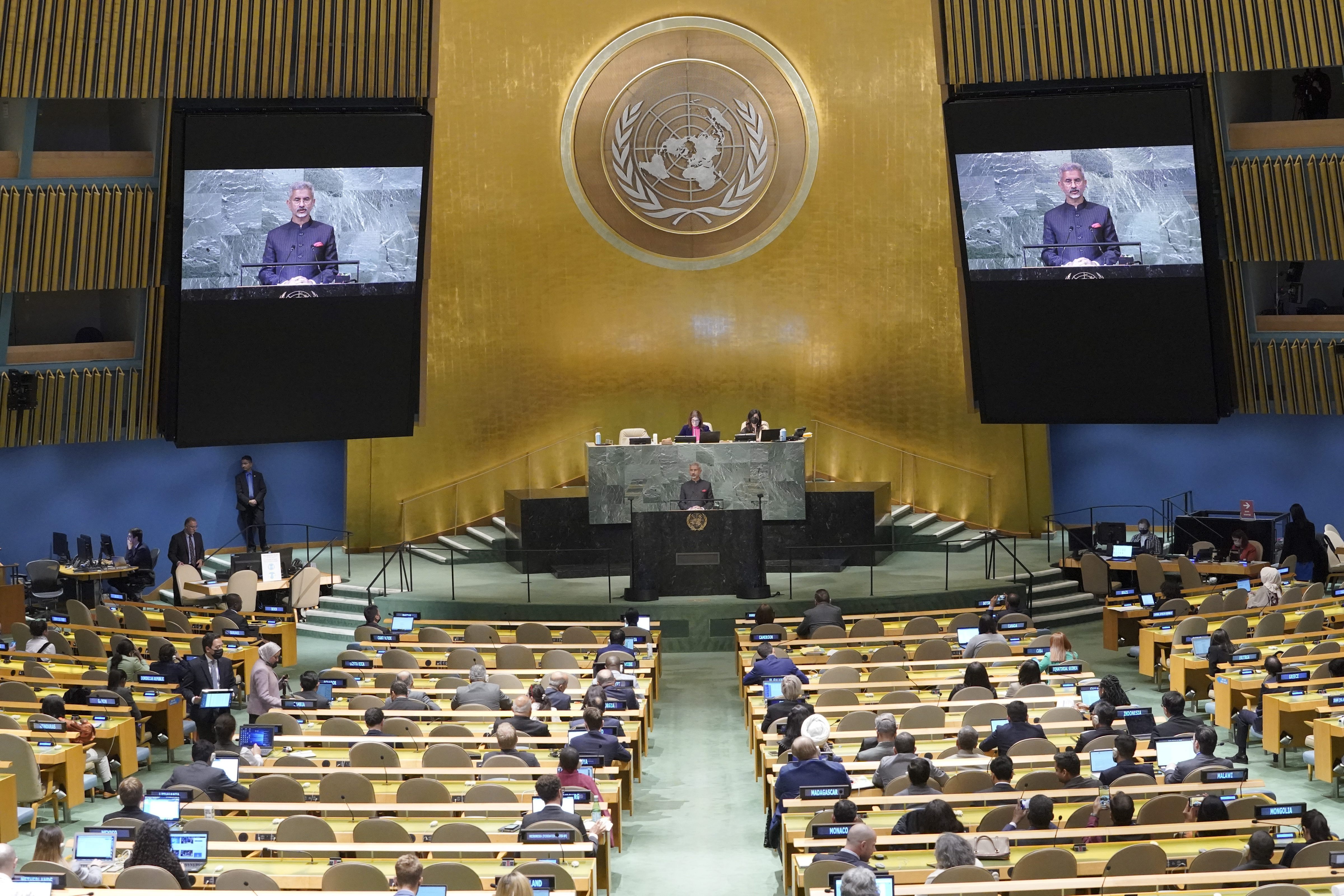
Western leaders led by United States (US) President Joe Biden were present in full force to make their case that Russia had “shamelessly” violated the core tenets of the UN Charter, disregarded international law, and undermined world order. A Security Council meeting added to the global floodlighting of Ukraine’s travails.
Russian President Vladimir Putin is not a regular at UNGA (he last attended in 2015). Hence, the Russian delegation led by foreign minister Sergei Lavrov — a UN veteran — was outranked in protocol terms. Lavrov’s riposte from the UNGA pulpit came after most leaders left. Pronouncements at the UN will not decide the outcome of the conflict. However, we cannot discard the impact of consolidating global attitudes through a narrative against Russia.
The concerns at UNGA were more than about Ukraine alone. Climate, food, fuel, and debt crises, the fate of the Sustainable Development Goals, health and inflation loomed large, bringing to the fore the bleak global scenario on several fronts. With priorities shifting, issues such as countering terrorism, suffering in Afghanistan, and the famine in the Horn of Africa, slid down the global index of interest.
UN secretary-general Antonio Guterres used the catastrophic floods in Pakistan as a cause celebre to highlight the consequences of the climate crisis. Biden singled out Pakistan’s disaster as an example of the “human cost of climate change”. Leveraging this, Prime Minister (PM) Shahbaz Sharif went beyond Pakistan’s usual preoccupation with Jammu and Kashmir, pitched Pakistan as a victim of climate injustice and sought disaster recovery and rebuilding funding. Henceforth, Pakistan, whose burgeoning financial worries predate the unprecedented flooding, will try reframing its economic problems as a climate crisis-fuelled crisis.
The US joining those — such as India — calling for reform of the Security Council stirred hope of breaking the gridlock bedevilling such efforts. As in the case of the World Trade Organisation (WTO), where the US made a deft procedural shift on the patent waiver for vaccines, the reform advocates will need to do more to surmount the naysayers’ objections.
With about 500 side-events on offer, the bandwidth of most delegations results in sparse numbers listening to the main statements. Barring a few plenary speeches, UNGA has become more about the side events that attract civil society, business, celebrities, global foundations, and others to engage with leaders on some of the most intractable global challenges. As multi-stakeholder partnerships are now in vogue, Microsoft recently set up a UN liaison office. Expect more big businesses to follow suit. According to an astute observer, “UNGA is now a late-summer version of Davos.” Seeing and being seen at UNGA seems as important as engaging with counterparts who leaders may find difficult to meet otherwise. In short, side businesses are the main business at UNGA.
External affairs minister S Jaishankar, who steered India’s participation at the event, maintained a punishing pace, engaging numerous counterparts in multiple formats. He demonstrated that UNGA is not merely a defensive game of deflecting Pakistan’s pinpricks. India, however, did not field its best diplomatic asset — PM Narendra Modi. Even in his absence, his evocative call that “today’s era is not one of war” — made to Putin on the sidelines of the Shanghai Cooperation Organisation — found resonance. Also, Mexico formally presented President Andres Obrador’s proposal to have PM Modi, Pope Francis, and Guterres form a dialogue and peace committee to address the Russia-Ukraine conflict. It indicates that the imagery of leaders makes for perceptions about States on global issues.
Russia and China, who are comfortably ensconced in permanently privileged perches at the UN, may well afford to have their top leaders not participate when the world converges. An aspirational India, desirous of a better place in an evolving global order and eager to contribute constructively, needs to consider if it should follow their example or prepare a creative programme that showcases the strength of our leadership while navigating the pitfalls of UNGA as the way forward.
Despite its well-known drawbacks, UNGA remains resilient as a multilateral convening forum without parallel. The mushrooming “minilateral” and “plurilateral” groupings are creative coalitions that have their utility. Still, as limited membership clubs, they lack the legitimacy that the inclusive UN forum confers in tackling global challenges. The UN is the only platform to test the global temperature on issues that impact all. It is of little relevance whether this happens in the plenary hall, the many side events of UNGA, or at events held in New York coinciding with it.
Euphemistically, the UN may well be “the god of small things.” Its successes are indeed small in comparison to the mammoth challenges of global governance that we confront. In an imperfect world, however, that is all we can manage. Until diplomacy can design better, sagacity demands that we make the best of what we have. That’s why “Come September, its UNGA time” remains a diplomatic truism.
Syed Akbaruddin served as India’s Permanent Representative to the United Nations in New York, and is currently dean, Kautilya School of Public Policy
The views expressed are personal


