
 E-Paper



Photos: Japanese wheelchair dancer who dreams of performing at Olympics ceremony
Born with spina bifida, a disorder that paralysed Japanese wheelchair dancer Kenta Kambara's lower body, aims to perform at the Tokyo 2020 Paralympics opening or closing ceremonies, seeking to send a message to disabled and able-bodied people alike: it's okay to be different. Kambara was in third grade at elementary school in Kobe, western Japan, when his mother told him he would never walk. Although there are speculations that Games might be cancelled due to the global spread of the novel coronavirus, but Kambara is not discouraged as he prepares for more events.
Updated on: Mar 12, 2020 5:36 PM IST


Share via


Copy link

1/9
 View Photos in a new improved layout
Updated on Mar 12, 2020 5:36 PM
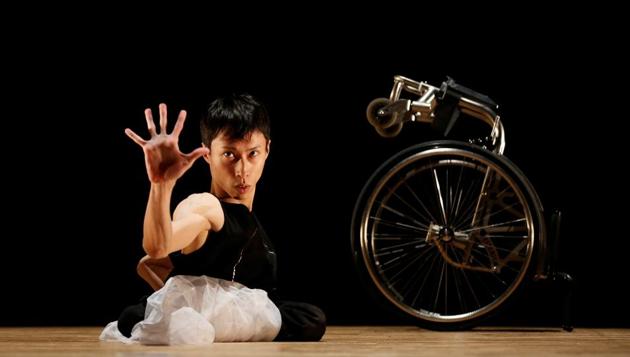
Kenta Kambara, 34, performs onstage during a dance event in Tokyo. Whirling, spinning, reaching, grasping - Japanese wheelchair dancer Kenta Kambara’s emotive performances are wordless testimony to artistic passion and possibility. Born with spina bifida, a disorder that paralysed his lower body, Kambara aims to perform at the Tokyo 2020 Paralympics opening or closing ceremonies, seeking to send a message to disabled and able-bodied people alike: it’s okay to be different. (Kim Kyung-Hoon / REUTERS)
2/9
 View Photos in a new improved layout
Updated on Mar 12, 2020 5:36 PM
Kambara rehearses for an upcoming performance at a studio in Tokyo. “If you can’t walk with your legs, it’s okay to walk with your hands. If there is anything you want to do but cannot, it’s okay to find another way,” Kambara, a computer systems engineer and father of a two-year-old daughter, told Reuters. (Kim Kyung-Hoon / REUTERS)
3/9
 View Photos in a new improved layout
Updated on Mar 12, 2020 5:36 PM
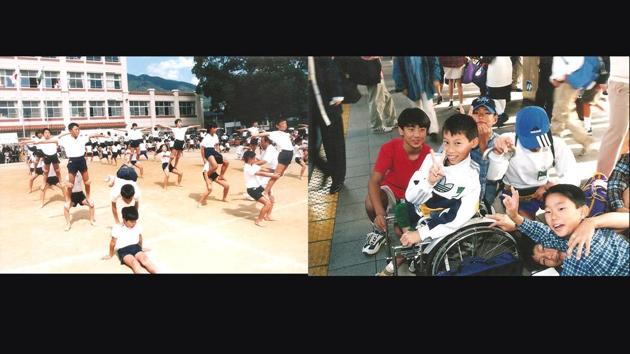
Kambara participates in an event for sports day at his elementary school in Kobe, Japan, 1997 (L). Kambara poses with his friends during an elementary school trip at a station in Mie, Japan, 1996 (R). Kambara was in third grade at elementary school, when his mother told him he would never walk. “It was a huge shock and I remember crying,” he said. “But that was the trigger to think about how to confront my disability and find different ways to achieve my goals.” (Kenta Kambara / Handout via REUTERS )
4/9
 View Photos in a new improved layout
Updated on Mar 12, 2020 5:36 PM
School children touch Kenta Kambara's arm after listening to a lecture he had given at an elementary school. “These days, people use the keyword ‘diversity’ but not many people have experienced it themselves,” he said. “I want people to understand by seeing me dance that it’s precisely because my body is different that it is interesting. Then that will become a trigger to accept other people’s differences.” “I also want them to think, ‘Wow, that’s cool!” (Kim Kyung-Hoon / REUTERS)
5/9
 View Photos in a new improved layout
Updated on Mar 12, 2020 5:36 PM
Chie Kambara hands their sleeping daughter Shiori to her husband Kenta at their home. Kambara, whose upper body is well developed from propelling himself with his arms since childhood, began dancing five years ago and less than a year later, performed at the Rio Paralympics closing ceremony. (Kim Kyung-Hoon / REUTERS)
6/9
 View Photos in a new improved layout
Updated on Mar 12, 2020 5:36 PM
Kambara performs a dance as part of a lecture for an elementary school. The self-taught Kambara’s repertoire includes handstands on his wheelchair, serpentine moves of his lean, muscular arms and slender fingers, and dizzying spins on a collapsed wheelchair, itself an integral part of his performances. (Kim Kyung-Hoon / REUTERS)
7/9
 View Photos in a new improved layout
Updated on Mar 12, 2020 5:36 PM
Kambara flexes his upper body muscles as he gets ready to perform at a dance event. “I’d already come to terms with my disability before I began dancing so it’s not as if dancing ‘saved’ me. But before I started dancing, I often felt my wheelchair was cumbersome in my daily life ...But when it comes to dancing, I feel my use of a wheelchair makes it unique,” he said. (Kim Kyung-Hoon / REUTERS)
8/9
 View Photos in a new improved layout
Updated on Mar 12, 2020 5:36 PM
Besides aiming for the Paralympics ceremonies, Kambara harbours a bigger dream - to dance at the Olympics closing ceremony as a way to boost interest in the Paralympic Games. “There shouldn’t be a division such that if you are disabled, you can only perform at the Paralympics,” he said, but noted that in contrast to the Paralympics, there are no open auditions for the Olympics ceremonies. Results of the Paralympics auditions are expected by the end of March. (Kim Kyung-Hoon / REUTERS)
9/9
 View Photos in a new improved layout
Updated on Mar 12, 2020 5:36 PM


