
 E-Paper



Photos: Galapagos tortoises return home after decades in captivity
Diego, the giant Galapagos tortoise whose is credited with almost single-handedly saving his once-threatened species, was put out to pasture on June 15 along with two dozen of his fellows. The group returned to their native island after decades of breeding in captivity under a conservation program. Galapagos National Park rangers gave the tortoises a ride home from the coast of Espanola island, releasing them in lush cactus rich pastures where they will spend the rest of their days.
Updated on: Jun 19, 2020 7:20 PM IST


Share via


Copy link

1/8

 View Photos in a new improved layout
Updated on Jun 19, 2020 7:20 PM
A park ranger moves with a chelonidis hoodensis tortoise on his back before it is released in Las Tunas, on the Espanola Island in Ecquador’s Galapagos archipelago on June 15. A group of giant tortoises who have lived in captivity for decades and helped rescue their species from the brink of extinction have returned to the wild in the Galapagos Islands. (Parque Nacional Galapagos / AFP)
2/8
 View Photos in a new improved layout
Updated on Jun 19, 2020 7:20 PM
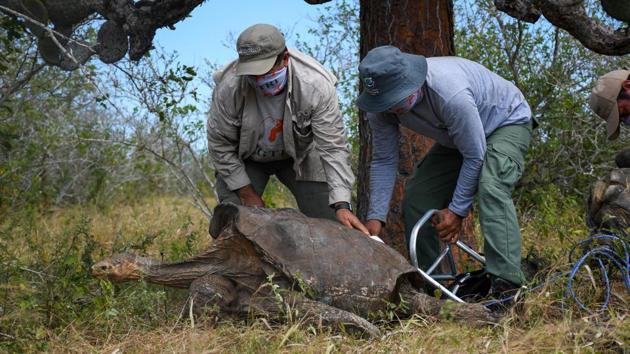
Star among the 25 tortoises that were returning home was 100-year-old Diego, the giant Galapagos tortoise pictured here as he is released, whose tireless efforts are credited with almost single-handedly saving his once threatened species. (Parque Nacional Galapagos / AFP)
3/8
 View Photos in a new improved layout
Updated on Jun 19, 2020 7:20 PM
Around 50 years ago, there were only two males and 12 females of Diego’s species alive on Espanola. Today there are 2,000. Renowned for his fertility, Diego alone has fathered some 800 offspring in a breeding program which was set up in the mid-1960s to repopulate the islands, AFP reported. (Parque Nacional Galapagos / AFP)
4/8
 View Photos in a new improved layout
Updated on Jun 19, 2020 7:20 PM
A Galapagos National Park ranger nestles a tortoise into a harness before heading to the release site. Ecuador’s Galapagos Islands, located in the Pacific Ocean, were made famous by 19th Century English naturalist Charles Darwin’s studies of their breathtaking biodiversity. (AFP)
5/8
 View Photos in a new improved layout
Updated on Jun 19, 2020 7:20 PM
The giant tortoises are known for their long, leathery necks and lifespans of over 100 years. Virtually synonymous with the Galapagos Islands, they were one of the species that helped Charles Darwin form his theory of evolution in the 19th century. (Parque Nacional Galapagos / AFP)
6/8
 View Photos in a new improved layout
Updated on Jun 19, 2020 7:20 PM
Before being taken back by boat to Espanola, the 100-year-old Diego and the other tortoises had to undergo a quarantine period to avoid them carrying seeds from plants that are not native to the island. (Parque Nacional Galapagos / AFP)
7/8
 View Photos in a new improved layout
Updated on Jun 19, 2020 7:20 PM
The tortoises were brought by boat from the tortoise recovery program on Santa Cruz island in the Galapagos. From there, rangers used backpacks to take the tortoises - who can weigh up to 180 kg - to an area where cactus grows in abundance that will help them readapt. (Parque Nacional Galapagos / AFP)
8/8
 View Photos in a new improved layout
Updated on Jun 19, 2020 7:20 PM


