
 E-Paper



C-section operations high at Pune district government facilities in five years: NFH Survey
Overall increase in number of births delivered by caesarean section has also gone up in the district from 31.9% in 2015-16 to 34.6% in 2019-20


According to the National Family Health Survey 5 (NFHS) carried out by the ministry of health and family welfare, the data for Pune district shows that the overall number of Caesarean section or C-Section operations in the district has gone up in the last five years.

While the number of such operations in public health facilities has gone up, those in private health facilities have dipped in the last five years. In addition, the overall out-of-pocket cost for C-Section operations have increased by about Rs 1,550 from 2015-16 to 2019-20.
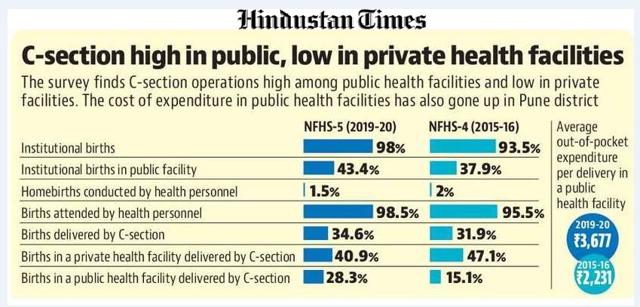
The institutional births in the district have also gone up from 93% in 2015-16 to 98% in 2019-20 and the number of institutional births in public facility also went up by 5% in these four years with improved health facilities and the number of births attended by skilled health personnel also increased by 3% in the same time period. The survey showed that more mothers now have access to skilled health professionals during childbirth and also more have opted for institutional births.
The overall increase in the number of births delivered by caesarean section has also gone up in the district from 31.9% in 2015-16 to 34.6% in 2019-20. Increased caesarean section operations are discouraged by medical experts across the globe.
According to the World Health Organization (WHO), since 1985, the international healthcare community has considered the ideal rate for caesarean sections to be between 10-15%.
However, caesarean sections have become increasingly common in both developed and developing countries. The average out-of-pocket cost for institutional birth in public facilities has also gone up, found the survey. The cost went from Rs 2,231 in 2015-16 to Rs 3,677 in 2019-20 in the district.
In Pune, the number of such operations has gone up especially in public health facilities where such operations are discouraged. The survey said although the number of such operations went down in private health facilities in 2019-20 as compared to 2015-2016 by about 6%. However, the number of C-section operations in public health facilities has gone up a whopping 13.2%.
Dr Madhuri Rokade, a resident medical officer at PMC’s maternity hospital, Sonawane hospital said, “Usually we get mothers who have had their first delivery through C-section operation in a private hospital and then for the second delivery we have to opt for a C-section again. The reason to avoid C-section operations is as it is a surgery and so the surgical risks and risks due to anaesthesia are involved which are not involved in a natural birth process. In addition, the scar which is caused due to Caesarean operation is a permanent scar.”


