
 E-Paper



Externment an effective measure to prevent crime? Pune statistics tell a different story
Externment is one of various preventive actions taken by police against people with mounting criminal records. In 2016, the city police externed a total of 135 criminals. However, the number of violations - externed person violates the order and entering the area without permission from which he was directed to stay out - have been far more.


For Pune police, while externment has emerged as a common practice to keep criminals away from the city, in reality though, it does not seem to be very effective, according to police statistics exclusively accessed by Hindustan Times.

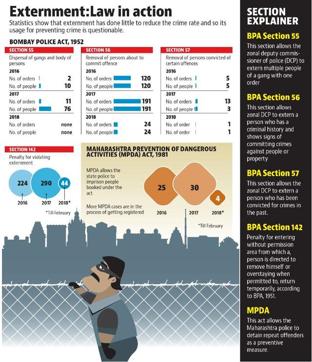
Externment is one of various preventive actions taken by police against people with mounting criminal records. In 2016, the city police externed a total of 135 criminals. However, the number of violations - externed person violates the order and entering the area without permission from which he was directed to stay out - have been far more. According to city police, there have been a total of 224 violations in 2016.
In 2017, the number of total externments went up to 280, while the number of violations touched 290, according to the statistics maintained by the preventive crime branch (PCB) of Pune police.
In the first two months of 2018, the city witnessed 25 externments and 44 violations. Known colloquially as "tadipaari" or "haddpaari", externment of a person or a gang happens based on the zonal deputy commissioner of police's decision.
In the Pune Police Commissionerate, an entire branch is dedicated to the prevention of crime. The branch is dedicated to tracing patterns and preventing crimes from happening. Among other laws, the Bombay Police Act (BPA), 1951, provides various provisions to the police to take preventive actions against criminals. The increased number of preventive actions and the parallel increase in the cases of violation of externment raises questions about the ground-level effectiveness of the very action.
In a series of incidents, criminals externed by the Pune police were found not just entering the area from where they were asked to stay away from, but also committing crime.
A case of sexual assault was registered against a man identified as Ganesh Mahamune, 31, who was booked for a repeated sexual assault at Dattawadi police station on March 23.
On March 2, Vishrambaug police arrested Vinod Gaikwad, 37, for tricking a 60-year-old man into handing over his gold chain and cash worth Rs 77,000.
Another few weeks earlier, on February 14, Akash Raju Kale, 26, was booked for sexual harassment of a 17-year-old girl in Chinchwad.
What is common between the three of them is that they were under externment for their involvement in serious crimes before.
"The recommendation for externment is made at the police station level, following which the assistant commissioner of police (ACP) enquires into the recommendation. The deputy commissioner of police (DCP) will then issue a notice," explains Ravindra Kadam, joint commissioner of police, Pune.
"ACP-level officer is appointed to look into the recommendations. Based on his report, We call the person and give him enough opportunity to represent himself before passing an order. We also ask his place of preference outside Pune city," said Basavraj Teli, DCP Zone-1. “However, since offence under Section 142 (of BPA) is considered to be a petty offence, people are bailed out easily. Cases under 142 should be monitored and investigated thoroughly. The concerned police station (where he is externed) has to keep a close watch on him."
Pune has four zones and corresponding DCPs and the state law allows externment under three sections of Bombay Police Act (BPA), 1951.
In 2015, the Maharashtra Legislative Assembly passed Maharashtra Prevention of Dangerous Activities (MPDA) act, which gives the police more rights in the field of preventive actions. For the past two years, under DCP Praveen Mundhe, Zone-2 has had the maximum number of preventive action under MPDA - 9 in 2016 and 10 in 2017 - in the city. However, it has not prevented the number of externment violations from increasing by over 50 counts therefore questioning the effectiveness of externment as a preventive action.


