
 E-Paper



Arun Khore: Pune postman who became a leading Dalit chronicler
Arun Khore details his journey of four decades on becoming an expert on Dalit issues

 Prefer HTon Google


On a routine day in December 1976, a young postman from the Deccan Gymkhana post office was on his morning delivery rounds when he was shocked by what he saw at one of the bungalows on Prabhat road.
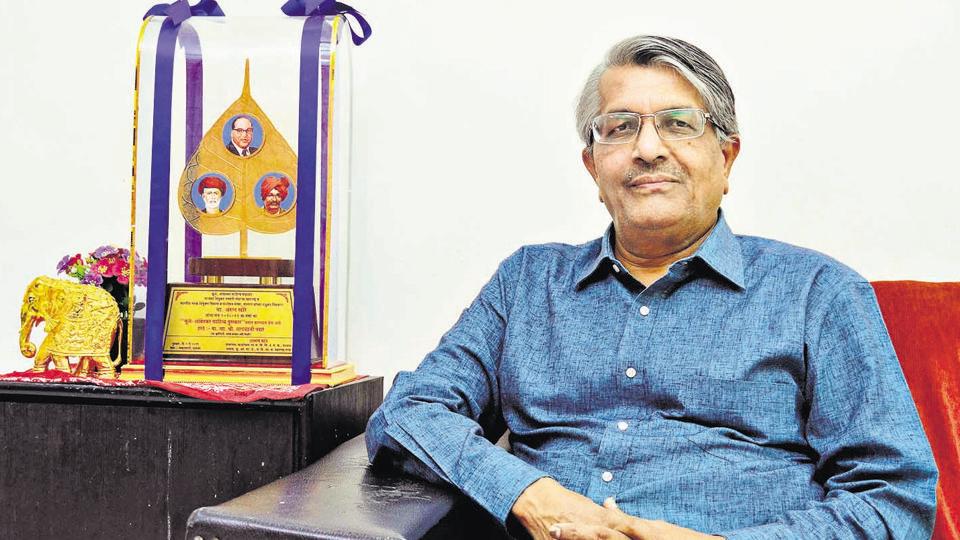
Heavy police presence and burly police dogs, were hovering around picking up scents at a crime scene. Terrified of dogs, the postman was hesitating to enter the bungalow to drop letters in the mail box. He however, completed his task after being assured by a police officer that the dogs won’t harm him.
“That was the site of five murders in the Abhyangar bungalow off Prabat road,” the former postman recalled. These were part of the 10 Joshi-Abhyankar murders that shook Pune and went on to make an indelible mark on Pune’s crime history. Four months later when the murder accused were arrested much to the relief of Punekars, the postman wrote his account of his close encounters with the Abhyankars and sent it to the local newspaper, hoping that it would be published.
A few days later, Pune’s leading daily, Sakal, published the gripping account that at once captivated readers. That postman was none other than Arun Khore (64), well-known in Maharashtra as a veteran journalist and Dalit chronicler.
“Such was the impact of that single article,” recalled Khore, “that my identity transformed from a postman to a writer.” Almost everyone who knew him had read the piece and wanted to discuss it with him over tea. “People told me that I was a talented writer and I should write more…”
The son of a city bus driver, Khore had lost his mother when he was studying in Class 1. Owing to his shift timings, his father felt it best to send him to a remand home for destitute children in Shivajinagar.
This is where Khore spent his early years, while continuing his education at a Pune Municipal Corporation (PMC) school. He was later shifted to another remand home in Mumbai, then Bombay, and returned to Pune to graduate with a Bachelor’s Arts from Abasaheb Garware college.
Khore loved to express his thoughts in words and with two of his friends brought out a handwritten newsletter that was put up on the college noticeboard on patriotic occasions like Independence Day, Republic Day and birth and death anniversaries of freedom fighters.
He has one particular memory of those days. “The year was 1972 and I was in my last year of ‘pre-degree Arts’ (BA) at the Abasaheb Garware College. This was the silver jubilee year of Indian Independence and young Dalits of the Dalit Panther were in the news. One of their founders, Raja Dhale, had written a piece in Sadhana, a Marathi magazine of socialist and progressive thoughts. Dhale had written, said Khore, “The punishment for insulting the national flag is more than the punishment for committing atrocities against a Dalit woman. So should we simply fold the flag and keep it aside?”
This article incensed a section of society and Khore’s fellow students from the Patit Pawan Sanghatana (one of them being Pradeep Rawat who went on to become the BJP’s member of Parliament from Pune) organised a strong protest. They wanted the college to be closed, “They asked me whether I would now write a piece a condemning Dhale,” said Khore.
“ ‘Certainly not,’ I said, because I didn’t find anything wrong in what Dhale had written. I also refused to participate in the proposed college bandh, and fortunately, the college authorities decided that there would be no bandh,” said Khore.
First Outcry of Dalit Youth
He recalled that this was, in a sense, “The first outcry of the Dalit youth.” It had been just 16 years since the iconic Babasaheb Ambedkar had passed away. As a small boy he had a number of Dalit and Muslim friends and would often go to their homes. Like him, they were all underprivileged and Khore had no caste or communal biases against them.
Because of the behaviour of the other students, in college, it did not take long for Khore to become conscious of his non-Brahmin roots in the Brahim-dominated society of Pune.
A voracious reader, Khore read extensively and was deeply impressed and influenced by the writings of the titans of Marathi literature such as Vi. Sa. Khandekar; Ga. Di. Madgulkar, Shankarrao Kharat; and those of freedom fighters such as Swatantryaveer Savarkar, Ambedkar and the great reformer Mahatma Phule.
Visiting Phule Wada
As a young boy, Khore had visited the house where Phule lived in Pune’s Ganj peth, years before it became a national monument. “There would be children, sitting in a row, defecating. There was a lot of garbage all around,” he recalled.
It was perhaps because of his extra-curricular activities that Khore was invited by All India Radio (AIR), Pune to conduct an half-an-hour discussion for the youth on a social issue. He chose two other youngsters for the discussion- a student from the Film and Television Institute of India (FTII) and a woman from Beed, and conducted a discussion on Mahatma Phule’s work and contribution. Khore asserts that this was the first-ever discussion aired on AIR in Maharashtra on a non-Brahim reformer like Phule.
“I do not know about the rest of the country, but certainly, this was the first discussion on Phule on All India Radio in Maharashtra,” said Khore.
Postman Years
Given his hands-to-mouth existence, Khore had to look out for a job immediately after graduation in 1976. He cleared the requisite tests and became a postman. Later, he went on to complete his Master’s in Arts in Noteworthy Marathi Literature in 1981.
Khore worked as a postman in the Deccan Gymkhana Post Office from January, 1976 to June, 1977 and during this period, had two of his articles published in Sakal.
Urged by his friends and well-wishers to continue writing after his immensely popular piece on the Joshi-Abhyankar murders, Khore thought seriously on those lines. On the mere assurance of an alternative job, he resigned from his service in the Postal department and joined the full-time journalism course at Ranade Institute under the University of Pune (now, Savitribai Phule Pune University).
Forays into Journalism
His freelance writing continued and one day he received a letter from the legendary editor of Sakal, SG Mungekar, asking, “Khore, what are you doing nowadays?” Khore replied that he was jobless and was worried about his livelihood. That was when he was offered a job as a sub-editor- the entry-level post for copy editors. Later in life, he became editor at four prominent Marathi dailies and would write a number of books.
“It was because of Mungekar that we non-Brahmins could join Sakal,” said Khore. Given his love for writing, he would go beyond his sub-editorial duties and cover events. He took special interest in covering the nascent Dalit movement of those days. “It was easy because most journalists didn’t want to waste time on these upstarts,” said Khore.
Early years of Dalit Movement
This was the time when Dalit literature was surfacing on the horizon in Maharashtra with writers like Daya Pawar, Baburao Bagul, Laxman Mane, Laxman Gaikwad, Bapusaheb Kamble, and others. Khore witnessed the birth of the association of Left and Dalit writers- the Dalit writers’ Group in 1979. He made it a habit to take a photographer along with him and captured historic moments like these of the Dalit movement.
“I could understand Babasaheb better through them,” he said.
In the course of his journalism, Khore met Babasaheb’s widow, Maisaheb and emerging Dalit leaders and writers such as Ra. Su Gawai, Namdeo Dhasal, Rajabhau Khobragade and Jogendra Kawade.
The younger Dalit leaders such as Babasaheb’s grandson Prakash Ambedkar, Ramdas Athawale, Jaideo Gaikwad and Neelam Gorhe came in later and Khore actually witnessed their entry in politics.
Now a frequent journalistic face at Dalit events, even the leaders began courting him and a high point came in 1985 when the tallest socialist leaders of the day such as SM Joshi and Mohan Dharia invited Khore to speak from the dais along with them. “They felt, here’s a journalist who regularly covers our issues. Let us invite him to speak,” recalled Khore.
Dalit Chronicler
Over the years, Khore reported extensively on the Dalit movement, including major agitations such as the one to rename Marathwada University after Babasaheb Ambedkar.
He wrote a touching piece on how the Dalit writer Laxman Gaikwad had become homeless due to fight within his family. It was this piece that eventually triggered the Maharashtra government’s decision to allot a flat in Mumbai to Gaikwad under the 10% quota.
When a number of new Dalit writers came to the surface with one book after another, creating the genre of Dalit literature, it was Khore who would regularly review the books and interview the authors.
He said, as a result of his regular and extensive reportage on Dalit issues, Kesari, the rival Marathi daily in the city was forced to appoint a reporter exclusively to cover Dalit issues, thus expanding the space for the coverage of such issues.
Disunity Among Dalit Leaders
When asked about the sharp disunity among Dalit leaders, Khore said the main reason is personal ambitions of the leaders and lack of firm political ideology.
“In 1990, Dalit activists had blocked three major roads in Mumbai demanding that the various factions of the Republican Party of India (RPI) come together.
The Republican Presidium was then formed,” he said. However, later, in 1997, there were sharp differences between the leaders when Prakash Ambedkar opposed the decision of the other leaders to align with the Congress, he recalled.
Khore has closely followed Prakash Ambedkar’s efforts since 1983, to broadbase the Dalit movement, right from trying to bring Dalits, Muslims and other backward classes on a common platform to forming the Bharipa Bahujan Mahasangh and the Vanchit Bahujan Aghadi.
Notably, VBA’s alliance with the All India Majlis-E-Ittehadul Muslimeen (AIMIM) resulted in a spectacular electoral victory of AIMIM’s Imtiaz Jaleel from Aurangabad in the recent Lok Sabha elections.
This effort was very similar to the Bahujan Samaj Party (BSP) founder Kanshi Ram’s forays in Maharashtra during 1988-89, said Khore.
The Dalit Muslim Minority Suraksha Mahasangh formed by smuggler-turned-politician Haji Mastan and Dalit leader Jogendra Kawade was heavily criticised by Khore.
He noted that a high point for Dalit leaders was when four of them- Prakash Ambedkar, Athawale, Gawai and Kawade were elected to the Lok Sabha in the 1998 polls as a result of RPI’s alliance with the Congress.
Khore is of the view that unless Dalit leaders come up with a clear political vision coupled with an economic and social agenda, the Dalit movement in Maharashtra will continue to suffer from disunity and “political gimmickery.”


