
 E-Paper



World Haiku Utsav 2019: Pune celebrates 400-year-old Japanese poetry
World Haiku Utsav 2019 inaugurated on Friday saw a mixed bag of enthusiasts and aspirants at the International Centre, SPPU


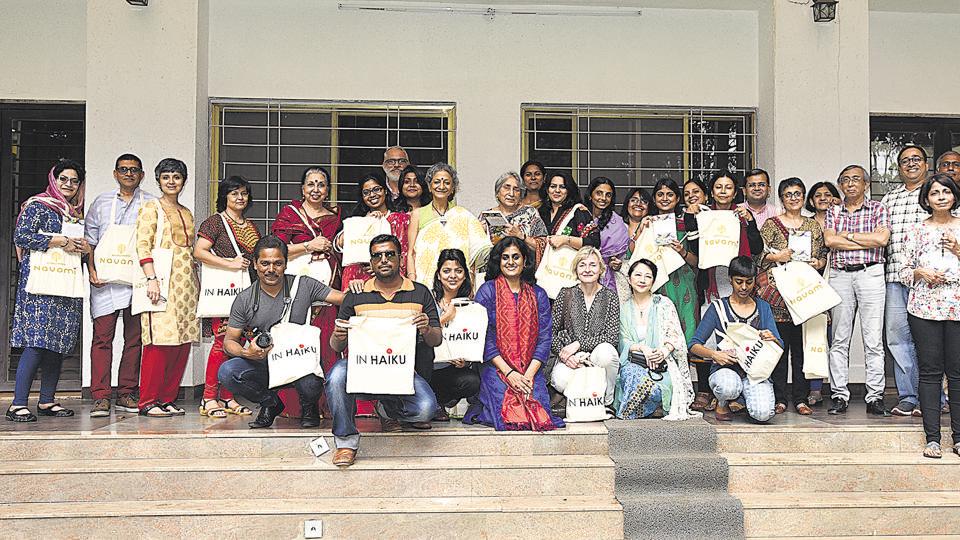
The International Centre at Savitribai Phule Pune University (SPPU) wore a solemn, stoic and poetic look on Friday, as members of IN Haiku (Japanese art form), Haiku enthusiasts and guests trickled in for the sixth edition of Triveni, World Haiku Utsav 2019 from February 1-3, 2019.
A wide-eyed Shreya Narang is in a deep conversation with Kashmir-based teacher Gurpreet Dutt. The two young women have been mesmerised by the art of Haiku and have flown down to Pune especially to be a part of the three-day Haiku Utsav.
In its sixth edition, the festival is the brainchild of Kala Ramesh a musician who is passionate about Haiku. She is one of the founding members of World Haiku Club India.
“This year is very special as we complete 10 years of the World Haiku review and launched our anthology titled Fuga No Makoto. I started out by organising a meet for barely 11 people in 2006 and today I have 50 people attending. It says a lot of how we have evolved over the years,” says Kala, as she juggled between welcoming the guests and ensuring that everything was in place for the event.
Susumu Takiguchi, a haiku poet, critic, artist and essayist was seen interacting with the members and guests at the event.
Takiguchi who is based in London, came down to be a part of the event as he was eager to see Haiku grow on a large scale.
“I was a part of a Haiku conference held in Bengaluru in 2008, organised by Kala and now this is my second one in India. I am happy to see the results on how Indians have been developing with Haiku. So far, the outcome is great. I want to experience what the people have here to share about the art. I haven’t seen the contents of all of their works. But I can see that it is almost like a small explosion,” said Takiguchi
He adds that he can feel the vigour and enthusiasm with which people are not only trying to write but he can also see a rising trend in the literature.
“Ultimately, the purpose is to see Haiku grown in the country. I want people to not merely adapt the art but to also bring in Indian sensibilities and what their cultures have to say in it,” added Takiguchi.
Susumu was one of the first Haiku poets who initiated the World Haiku Club in India.
Gurpreet, an intermediate school teacher had been introduced to Haiku two years ago during a workshop. Since then, she has used all her time after work to create poems and Haiku.
“I come from a disturbed area and depression is very prevalent because of issues in our surroundings. Haiku helped me overcome this depressed feeling and atmosphere. When you live in a troubled area, you need something to hold on to and feel alive. Haiku has helped me feel that passion and search myself. It helps me bring a sane balance in my life,” said Gurpreet.
Shreya, a Class 12 student from Punjab, has come down with her father to experience the Utsav. She had been introduced to Haiku six years ago. However, she took keen interest only a year ago.
“I took time to learn it step by step. The best part is that I have access to online social media groups where I can seek advice and guidance. It has helped me hone my poetry skills,” says Shreya.
Members of the club, K Ramesh, who is a headmaster in a Chennai-based school was first introduced to the concept of Haiku in the year 2000.
“The brevity of the art and the fact that you can say a lot in few lines appealed to me. I have seen, over the years, how a young crowd has grown interested in the art. They are exploring the medium and trying it out too. The Internet has been very useful and helpful to us. It has opened a huge opportunity for us.”
The Utsav is a close-knit affair strictly only for enthusiasts. It is still a niche market, looking for funding and strong support.
“It is lovely to see like-minded and interested people. It is wonderful and rewarding to listen to other people’s poetry and meeting people face to face also enhances the experience. It is still a very niche space but we have seen an increase in people and that’s good,” says Johannes Manjrekar, who works with Haiku and (Haibun- a prosimetric literary form originating in Japan).
On what advice, would they like to give aspiring poets? Takiguchi adds, “Probably, the most important advice is to not set any dos and don’ts. I would suggest, read your poem aloud, once it is ready. This will help you understand it better and tweak it the way you want. Also, always, follow your instinct. Never, change what you have written because someone asks you to. Like in a carriage, the horse has to be in front, followed by the carriage, similarly, in your work, your sensibility should be the priority and then the grammar and rules.”
‘Nobody wants to fund a Haiku event’
A Hindustani classical music exponent, Kala Ramesh is glad to have been able to bring together the sixth edition of Triveni, World Haiku Utsav at International centre, Savitribai Phule Pune University from February 1-3, 2019.
Kala was introduced to Haiku in 2005 when she was working towards being a professional musician.
“When I got to know of Haiku, I developed interest but it was a lonely struggle. Back then, in India, there were no references and no one to consult. My first works were published in Simply Haiku, a Haiku magazine, and then I received a mail from Susumu Takiguchi, a haiku poet, critic, artist and essayist ,” said Kala.
Susumu wanted Kala to explain why she liked Haiku, and how would she help spread awareness about it in India. “He was on the lookout for someone from the past 15 years. He wanted a helping hand in India to help spread this form of poetry. I was recently bitten by the bug and decided to be of help,” added Kala
Together they formed the World Haiku Club India. “I was unknown to the world of Haiku, Susumu, roped in 20 like-minded poets and that’s how we got together. We had our first meet in 2006, followed by a one-of-its-kind Haiku conference in Bengaluru 2008, owing to help from Sri Sri Ravi Shankar and Tata Trust.
The meets continued in 2010, 2013, 2014 and 2016. “We are not a funded group and use self-funds for all our events. It is sad that nobody wants to fund a poetry event especially a Haiku one. They are unaware of the art form and it is still unknown to many,” said Kala.
She added that she is grateful to NS Umrani - pro vice-chancellor, Savitribai Phule Pune University and Ashok Chaskar, professor and author, for providing the space. “I am so happy that we have a space midst nature to experience poetry and more.”


