
 E-Paper



Pune district experienced 16% surplus rainfall this season
The standardised precipitation index (SPI) map released by IMD, shows that Satara and Solapur fall under severally dry conditions while Sangli, Aurangabad, Beed and Nandurbar are under the moderately dry conditions.


This year, Pune district received good rainfall in the first week of June and witnessed a week-long dry spell in the third week. However, post mid-July, the district received considerably good amount of rainfall.
Although Pune district shows better figures in terms of receiving rainfall (+16 per cent) than average, Pune city received 10 cm less rainfall this season, according to Jeevanprakash Kulkarni, retired scientist with the India Meteorological Department (IMD). The average rainfall the city receives is 56.6 cm, however, this year the city received only 44.4 cm of rainfall, said Kulkarni, who is presently associated with Satarkindia forum that issues warnings on various climatic conditions. However, Panshet, Varasgaon and Khadakwasala dams, which are the main sources of water for the city, have reached full capacity.
Now, with the less than average south-west monsoon departing, drought-like conditions loom over Marathwada and couple of districts in central Maharashtra namely Sangli, Satara and Solapur, stated IMD officials.
The standardised precipitation index (SPI) map released by IMD, shows that Satara and Solapur fall under severally dry conditions while Sangli, Aurangabad, Beed and Nandurbar are under the moderately dry conditions.
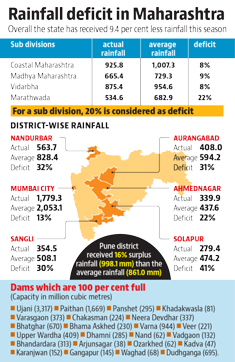
“Overall, Maharashtra received 9.4 per cent less rainfall this season. Generally, deficit is termed when the percentage goes over 10. So, it is safe to say the season wasn’t good, but it was not bad either,” said Kulkarni.
As per the IMD website, 25 districts of Maharashtra received less than average rainfall, with Solapur topping the list with 42 per cent deficit. Sangli, Nandurbar and Aurangabad were at the top with a deficit of about 31 to 32 per cent.
Marathwada region, known for it’s mild and moderate dry condition, is at a deficit of 22 per cent. Except Nanded, all other districts from the region have received far less than average rainfall.
“Most districts of Marathwada have been affected by less rainfall. Drought-like condition seems likely, but situation is far better than the one they faced in 2015. The excessive rainfall in July has filled up most dams, hence, solving the drinking water problem. However, crop conditions will be critical,” added Kulkarni.


