
 E-Paper



At Chandigarh’s PGI, it’s a long wait for patients to get medical tests done
In the absence of an appointment system, all patients are called in the morning, mostly empty stomach, and they end up waiting till late evening.


Sitting on a wooden chair in the waiting hall of the Nehru building at Post Graduate Institute of Medical Education and Research (PGIMER), 14-year-old Singh (name withheld) could not control his tears.
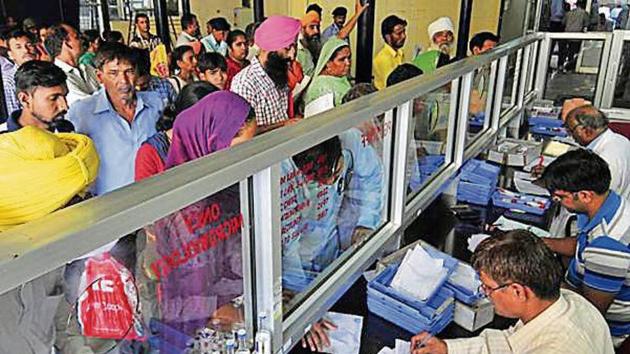
He left his house in Dera Bassi at 5:15am to get an MRI (magnetic resonance imaging) scan done at 10am – according to the date given to him three months ago. But it was 1pm and he was still waiting, struggling to control hunger and tears.
At the PGIMER, there is a long – one to six months — waiting period for various tests. In the absence of an appointment system, all patients are called in the morning, mostly empty stomach, and they end up waiting till late evening.
“We visited the PGIMER in June and were asked to get an MRI scan done. We got a test date for September and were called at 10am,” said Rajwant Kaur, mother of the child.
They reached the hospital at 6:30am and deposited Rs 2,500 fee for the test and Rs 1,300 for medicine. “It’s 1pm and we are still waiting,” she said.
A couple sitting next to Kaur is from Kurukshetra. They had left at 5 in the morning and changed two buses to reach the institute on time – 9am. They too were waiting for their turn at 1pm.
Naresh Kumar, patient’s husband, said: “In April, she was asked to get an MRI scan done. We were given this date and have been sitting here since morning.”
4-6 months even in urgent cases
Similar is the scenario in other diagnostic centres. The waiting time for PET (positron emission tomography) scan, even for “urgent’ cases”, is four to six months.
“In August, I brought my mother to the PGIMER as she complained of severe pain in breasts and loss of appetite. The doctors told us it looks like a case of breast cancer, which might have spread to other organs,” said a woman, who did not wish to be named. “They marked the case as ‘urgent’ and asked us to get the PET scan done. But the date we got was February 26, 2019.”
“After several requests, we got today’s date, that too if any other patient doesn’t turn up,” she said. “My mother, 62, is waiting empty stomach, but our main concern is getting the tests done, so that treatment can be started.”
Dr BR Mittal, head, nuclear medicine, PGIMER, said: “Currently, there is a waiting period of four months for PET scan, but urgent cases are seen on priority. Our doctors sit till 3 at night and conduct tests.”
Dr Mittal said second PET scan machine is to be installed within a fortnight. “Funds for the third machine have also been sanctioned. With this, the waiting time will come down,” he said.
‘Appointment system in a week’
“The PGIMER is overburdened,” said PGIMER director Dr Jagat Ram, while admitting there is a need to have a system in place to ensure time slots are given to patients and at least children are examined on priority.
Dr N Khandelwal, head of the radio diagnosis and imaging department, said there are four MRI machines while daily requisition forms received from the out-patient department (OPD) average around 250.
“The capacity is to conduct just 150 scans per day. We conduct MRI scan for emergency cases and indoor patients too,” he said.
Dr Khandelwal said slot-appointment system for MRI patients referred from the OPD and other centres is planned to start within a week.
“We have already started it for patients from the Nehru building. Now a patient will get message on phone, getting information about the time slot for the MRI scan,” he said.


