
 E-Paper



By the way: Of books, jobs, and two men protesting on a tower
Rakesh Prashar and Deepak Kumar must be wondering: At what point did a protest atop a 100-foot tower, near the chief minister’s residence in the capital, become too small for the government to react to? How high is high enough?


Rakesh Prashar and Deepak Kumar must be wondering: At what point did a protest atop a 100-foot tower, near the chief minister’s residence in the capital, become too small for the government to react to? How high is high enough? Is it even worth the trouble? What other work do we have, anyway? Should we have invoked religion and the nation’s pride, somehow?
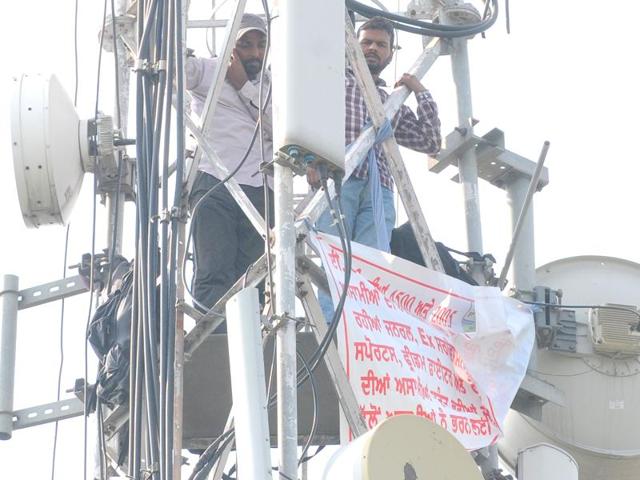
And you must be wondering who these people are.
They are unemployed men who have done an Elementary Teacher Training (ETT) course and also passed a Teacher Eligibility Test (TET), seeking jobs in the Punjab government. They are sitting on a mobile-signal tower, close to chief minister Parkash Singh Badal’s official residence; threatening to self-immolate or jump if not given job letters. It’s been three days already, and this article will be published on their fourth day up there.
“We are not going to come down,” Rakesh, 29, tells me over the phone.
The government is clear on its stand that such ‘blackmail’ will not be tolerated, and has not even bothered to send any official to the protest site in Sector 3. “The TET is not a guarantee for jobs. It is only an eligibility test,” says education minister Daljit Singh Cheema.
Rakesh argues, “In all, for 6,500 jobs, there are only around 5,300 people eligible. Counselling was done, but letters are not being given.” The government says it has no vacancies, and that the men on the tower are among those who haven’t made it on merit.
Their plan is to stay there for five days, at least. “It’s really cold up here,” Rakesh says. But that’s the least of their problems. “We cannot even stretch our legs, lest we fall all that long way down.” Then, why protest? “Why are people with merit lower than ours getting jobs?” he retorts, and goes on to cite examples from among the reserved categories. Are you against reservation? “I don’t know that. I just know that people with lower score have got jobs, and we are hanging up here, with our six bottles of water of which barely any remain, and our eight packets of biscuits that are almost over.”
What else do you have? “A blanket, a sheet, and some books,” says Rakesh, who belongs to Gurdaspur, graduated in humanities and got his ETT certificate in the 2006-08 batch. Deepak, 35, is not interested in speaking over the phone.
But how did you manage to get in? After all, the tower is in a high-security area. “We manoeuvred through a barbed-wire fence, then scaled a wall; and then climbed the tower. It was pretty straightforward.”
Silly question: How did you know there would be a platform up there for you to sit on? “We have enough experience of doing this!” Rakesh has spent five, six and fifteen days at different times over the past year atop towers in Punjab. “There is always a place for repairmen on these towers, for emergencies.”
Have you called home yet? “No. Neither has Deepak,” he claims. Rakesh has a one-year-old son. His wife recently got hired as an ETT teacher, he says, while he awaits a government signal on the tower.
Can’t you simply get a private job? “You, tell me! Where will I, with my qualifications, get a decent-paying, secure job in the private sector? There is no industry in Gurdaspur. My parents do not have the money to help me start a business.” He says he has been a factory worker in Jammu. “I have even stood at the Labour Chowk, but returned without work sometimes. There are more people than there is work, everywhere.”
But the government says it has brought in industry. “I don’t see it, honestly. After studying so much, passing that test, and protesting for years, do you expect us to work in some factory and be satisfied with it? We need a job that has dignity.”
By the way, did you say you have books with you? Novels, to pass time? “No, books from our courses and TET preparatory syllabus.”
What are you going to do with the books? “We’ve read them enough. Now is the time to burn them.”
Wait a minute. Did they consider going to Bigg Boss? That’s where the real attention is! I’ll ask them when they come down, if they do.
aarish.chhabra@hindustantimes.com


