
 E-Paper



By the way:Thanks for the hate on Valentine’s, my love
Hate is not the right kind of word to start a Valentine’s Day article with. But I sincerely hate how easy it is to be in love these days. In fact, I hate the whole modern concept of love. No, not for that super-villain called Western Influence, or because I am single, which I am not, by the way. Nor am I hyperventilating over some leftover bitterness of a recent break-up that I may or may not have liked. Like I said, I have a problem with the ease of it.


Hate is not the right kind of word to start a Valentine’s Day article with. But I sincerely hate how easy it is to be in love these days. In fact, I hate the whole modern concept of love. No, not for that super-villain called Western Influence, or because I am single, which I am not, by the way. Nor am I hyperventilating over some leftover bitterness of a recent break-up that I may or may not have liked. Like I said, I have a problem with the ease of it.
It is now common — particularly in the socially better-off pockets that People Like Us (PLUs) inhabit, places where ‘honour killings’ are looked upon with dishonour — to find parents who have no problems with their kids having boyfriends or girlfriends. Fathers are either supportive or quiet. Mothers are either quiet or hyper-excited to know what’s going on. These people belong to a species called ‘cool parents’.
Then there are the siblings, especially younger brothers and older sisters, who find no thrill in saying, “I will tell papa-mummy, OK!?” They, in fact, are keen to be friends, at least on Facebook, with the one you are dating.
There are also grandparents who are either disinterested in the whole thing, or overly interested to the extent that they are keener than you are in taking your relationship to the next level, to what they call a logical conclusion, to marriage.
In fact, worse, there are now general people who have no problems with lovers holding hands in public. And this tribe is growing.
Horrible, I say.
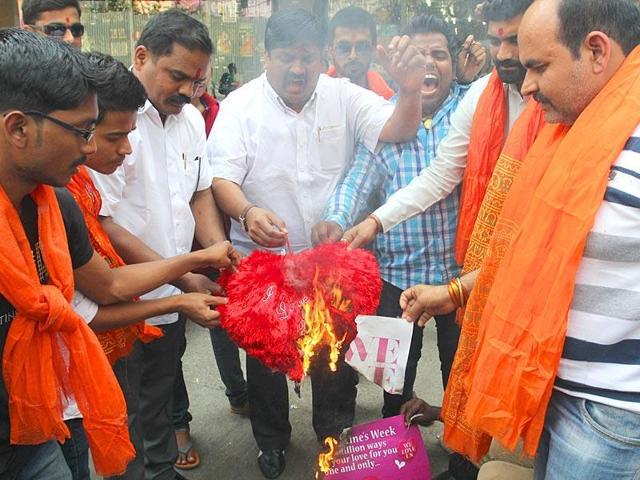
Thank God, that there are still the Good Samaritans of the Right wing who bring back the charm. Every Valentine’s Day, they diligently wake up to the concept of love, then dress up in all their camera-friendly finery, mark their foreheads with some red stuff in a straight line headed to the sky, and then go to parks and other places where love is practised.
Before they reach their much-loved love spots, they also call journalists and cops, who are happy to oblige for what is now a time-tested tradition.
Tradition, after all, is what they are out to protect.
Once there, they are quick to spot lovers, and quicker still to bring out their weapons of choice.
It may be anything, from a freshly cold-creamed hand, to blue/black ink, to garlands of hawai chappals or other kinds of torn shoes. Some groups also carry rakhis — wristbands that symbolise brother-sister love — which they get the girlfriends to tie on the wrists of their boyfriends. Clearly, incest seems to hold a special place in the hearts of these porn-hating activists.
My heart, however, stopped when I read a piece of news, that this year some Righties are not doing their Valentine’s hate-the-love thing. They say they want to avoid negative publicity, and do not want to give any opportunity to the opposition to attack “our PM” Narendra Modi on this issue. (That’s unfair to Modi, who is actually an expert on this kind of love — as a poet once said, ‘Hatred is his beloved.’)
Someone needs to tell these guys that if they stop hating love, we’d be left with quite nothing.
It is their beloved hatred that gives love its spirit of rebellion, the lifeblood of what is otherwise quite a cheesy, drab phenomenon.
Keep the hate coming, my love.


