E-Paper



Independence Day 2025: Bengaluru struggles to achieve freedom from flooding, traffic and unplanned urban growth
Bengaluru’s shift from Maharaja-era planning to post-independence sprawl has fueled floods, traffic, and infrastructure strain through haphazard growth

 Prefer HTon Google


Bengaluru has transitioned from the Maharaja-era’s carefully planned abundance to post-independence unplanned sprawl, aggravating floods, traffic congestion, and infrastructure stress. Early planners envisioned ‘ring towns’ and self-contained industrial hubs to manage growth and relieve pressure on the city. Instead, Bengaluru expanded haphazardly, overburdening its ecology and urban systems.
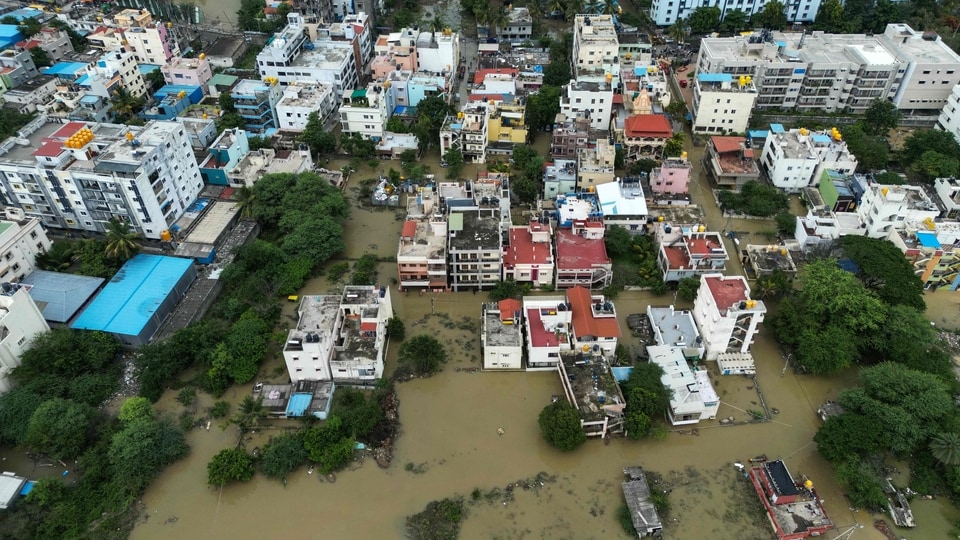
Urban experts note that post-independence planning largely focused on middle-class aspirations for individual plots and low-rise housing. Today, congested roads, recurring floods, and uncontrolled real estate growth highlight how inadequate planning has strained the city’s infrastructure.
They add that from the 1960s to the 1980s, Bengaluru’s limited expansion allowed it to manage growth, but the software boom of the 1990s changed the landscape. Rapid, unregulated development outpaced infrastructure, leaving the city struggling to keep up.
With Independence Day approaching, experts reflect that decades after gaining political freedom, Bengaluru has yet to achieve freedom from the consequences of unplanned urban growth. They question whether the city has built on the foresight of its early planners or replaced that vision with systems that limit, rather than support, its growth.
Sarang Kulkarni, Managing Director of Descon Ventures, said that after Independence, large public sector companies such as ISRO, BEL, and HMT set up their establishments in Bengaluru. These had large campuses where people could both work and live. When the IT sector arrived, companies also created campuses, but this time, housing demand grew outside the workplace, and the need for transport increased. Previously, work and housing were part of the same campus.
Also Read: “Does the area flood?” Bengaluru homebuyers and investors now have fresh real estate worry
“With this shift, there was a requirement to create transport corridors, but the government neither had sufficient land parcels nor, more importantly, a master plan. As a result, roads began to appear haphazardly in response to demand. The only planned road network from that period that we see today is the Outer Ring Road; beyond that, most expansion was unplanned,” he said.
“In those days, people with army backgrounds and workers from the early companies settled in Bengaluru. Over time, layouts began forming in parts of the city because, while the industries were doing well, they could not accommodate everyone near their workplaces. Many people wanted plotted developments; this gradually translated into a real estate demand in the 1970s and 1980s, when the IT industry started looking at Bengaluru. After the 1990s, we saw major migration into the city, and this growth became exponential and largely unregulated,” Kulkarni said.
Sandeep Anirudhan, Convenor of the Coalition for Water Security, points out that, “From the 1960s till the 1980s, the city didn’t expand much, so we survived. But the software boom changed everything, unregulated growth took over, and we never built the infrastructure to support it,” he said.
Anirudhan notes that “Pre-independence, we had stronger institutions that planned for the city to grow and thrive. Post-independence, especially in recent decades, we have allowed those systems to collapse. We’ve gone from building for abundance to manufacturing scarcity.”
Early real estate growth story of Bengaluru
In her book The Promise of the Metropolis, historian Janaki Nair observes that post-independence planning increasingly catered to middle-class aspirations for individual plots and low-rise houses.
Citing a study, Nair wrote, “88 per cent of dwelling units were on the ground floor… Bangalore is still an individual space-oriented and low-rise city” (p. 131). The “ideal of a site” and a lingering “nostalgia for the bungalow and the compound” shaped the planning imagination, a far cry from the integrated, capacity-focused layouts of the Maharaja’s time.
Even the city’s expansion, Nair notes, defied its own Master Plan. “The one common denominator in the spread of the city was the haphazard growth of the land used in spite of the City Master Plan… attributed to the multiplicity of jurisdictions involved in city development, and the uncoordinated and individual decisions of private developers” (p. 131).
Nair’s book showed that public housing provision was limited; “the City Improvement Trust Board distributed about 64,656 sites between 1945 and 1976, and the BDA distributed about 63,062 sites between 1976 and 1988, and a total of 71,483 by 1991. The Karnataka Housing Board built 5506 houses in today’s north Bengaluru’s Yelahanka, and 15,000 on the outskirts. The Karnataka Slum Clearance Board had built 2125 houses up to 1989.”(p. 131)
Bengaluru’s history of water management dates back centuries
Harini Nagendra, professor of sustainability at Azim Premji University, noted that Bengaluru’s history of water management dates back centuries. “Even during the Chola period, people had begun creating tanks and waterbodies in small pockets for irrigation and other needs,” she said.
Over time, successive rulers, from Kempe Gowda to Hyder Ali, Tipu Sultan, the Wodeyars, and later the British, expanded this network, constructing additional tanks as the population grew. This practice continued into the late 19th century, culminating in the creation of Sankey Tank in the 1890s.
Anirudhan points out that “Our ancestors built around 2,000 lakes, holding and recharging nearly 25 TMC of water into the aquifers, ensuring wells had ample water, when the city’s population was just a few lakhs. If we hadn't destroyed those lakes and wetlands, it would have been sufficient for even today’s 1.5 crore residents. They built for abundance. Now, we don’t even plan, let alone build; and the decisions we take are reductionist and destructive,” he said.