
 E-Paper



RBI’s 50 bps repo rate cut bonanza: Here’s how it will impact homebuyers’ EMIs
RBI’s rate cut lets homebuyers borrow more without raising EMIs. With a neutral stance, further cuts are unlikely, making it a good time to buy for those ready

 Prefer HTon Google


Although the festive season is still months away, RBI’s 50 bps rate cut is welcome news for prospective homebuyers, as it will help lower overall borrowing costs. For existing homebuyers, the RBI’s rate cut means they can now opt for a higher loan amount without increasing their EMI. The central bank has also adopted a neutral stance, signaling that it is unlikely to either cut or hike rates aggressively in the near term. This suggests that further rate cuts are not expected anytime soon, making it an opportune moment to buy a home—especially for those who are ready and need one.

However, experts caution that undecided buyers should not base their homebuying decisions solely on lower interest rates. Other financial and personal factors must also be considered.
Also, the actual benefit, however, hinges on how quickly banks pass on the cut by reducing their Marginal Cost of Funds-based Lending Rates (MCLR).
“With the RBI announcing a third rate cut this calendar year, bringing the total repo rate reduction to 100 basis points (bps), we’re seeing a gradual but positive shift for borrowers. Although each cut, including the recent 50 bps reduction, may seem modest in isolation, cumulatively they help ease the overall cost of borrowing,” says Deepak Kumar Jain, founder and CEO of CredManager.in, a loan distribution company.
For instance, on a ₹50 lakh home loan over 20 years, the EMI drops by around ₹3,164. For loans of ₹1 crore and ₹1.5 crore, the monthly savings are approximately ₹6,329 and ₹9,493, respectively. While these savings aren’t massive, they do improve affordability, especially in a high-cost housing market.
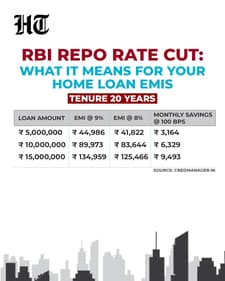
Will the rate cut make homes more affordable for buyers?
The rate cuts since the beginning of the year also mean that borrowers can now opt for a higher loan amount while keeping their EMI unchanged. With the RBI having reduced the repo rate by 100 bps so far this year, home loan rates are expected to fall further as banks begin to transmit the benefits of the monetary policy.
“This means if someone is paying a 9% interest rate for a ₹1 crore home loan and the interest rate comes down to 8%, then by keeping the EMI constant, they can opt for a higher loan amount by almost ₹7.5 lakhs,” says Abhishek Kumar, founder and chief investment advisor of SahajMoney, a financial planning firm.
The actual transmission to the end borrowers would depend on how quickly the banks pass on the benefits through lower Marginal Cost of Funds-based Lending Rate (MCLR) rates.
Thanks to the 100 bps rate cut this year, including a fresh 50 bps slash, Priya, a young IT professional in Pune, sees her ₹50 lakh home loan EMI reduced by over ₹3,000. That saving bridges the gap between rent and ownership, letting her seriously plan her move from tenant to homeowner.
The RBI has also cut the Cash Reserve Ratio (CRR) by 100 bps. This does not have a direct impact on home loan interest rates but there is an indirect impact.
“The reduction in the Cash Reserve Ratio (CRR) will help boost liquidity in the banking system, which means that banks have more funds to lend. Developers will be able to access more capital for their projects, and this can positively impact project completion timelines. It also gives banks the option to reduce home loan interest rates, which will have again positively impact sentiment in the affordable and mid-income segments,” says Anuj Puri, chairman, Anarock Group.
How does RBI’s 50bps repo rate cut impact existing homebuyers?
“With this RBI rate cut, the EMIs will come down by almost 10-12%. For example, if a person wants to continue with the same tenure the EMIs will be lesser, however if someone opts for a shorter tenure, the EMIs can remain the same and the loan can be paid within a shorter tenure,” said Sanjay Daga, CEO and managing director of Anex Advisory.
Assume you have a ₹50 lakh home loan with an interest rate of 8% per annum and a tenure of 20 years.
Before RBI rate cut:
- Loan Amount: ₹50,00,000
- Interest Rate: 8% per annum
- Tenure: 20 years
- EMI: approximately ₹41,833
After RBI rate cut (assuming 0.5% rate cut):
- Loan Amount: ₹50,00,000
- Interest Rate: 7.5% per annum
- Tenure: 20 years
- EMI: approximately ₹38,781
In this scenario, the EMI would decrease by approximately ₹3,052 ( ₹41,833 - ₹38,781), which is around a 7.3% reduction.
If you choose to keep the EMI the same ( ₹41,833) and opt for a shorter tenure, you could potentially save around 2-3 years on your loan repayment, depending on the lender's calculations.
What should those planning to buy a house do?
The RBI has also shifted to a neutral stance. Which means that they are neither inclined to cut nor hike interest rates aggressively in the immediate future. This means that further rate cuts in the immediate future are not likely. Hence it makes this the perfect time to buy a house if you really need one.
However, homebuyers who are undecided should not base their decision solely on the reduction in home loan interest rates. “Since floating rate loans fluctuate over the loan tenure, interest rates may rise or fall in the future. Instead, buyers should also consider their other financial goals and ensure they can afford the EMI payments throughout different economic cycles,” explains Kumar.
Anagh Pal is a personal finance expert who writes on real estate, tax, insurance, mutual funds and other topics


