
 E-Paper



A Nobel for the physics that ushered in quantum computing
The phenomenon on which they were working is known as quantum tunnelling


 Prefer HTon Google


RICHARD FEYNMAN, one of the 20th century’s greatest physicists, once quipped, “I think I can safely say that nobody understands quantum mechanics.” Appropriately, then, a certain sense of bemusement haunted the Session Hall at Sweden’s Royal Academy of Science on October 7th, when this year’s Nobel physics prize was announced, “for the discovery of macroscopic quantum-mechanical tunnelling and energy quantisation in an electric circuit”.
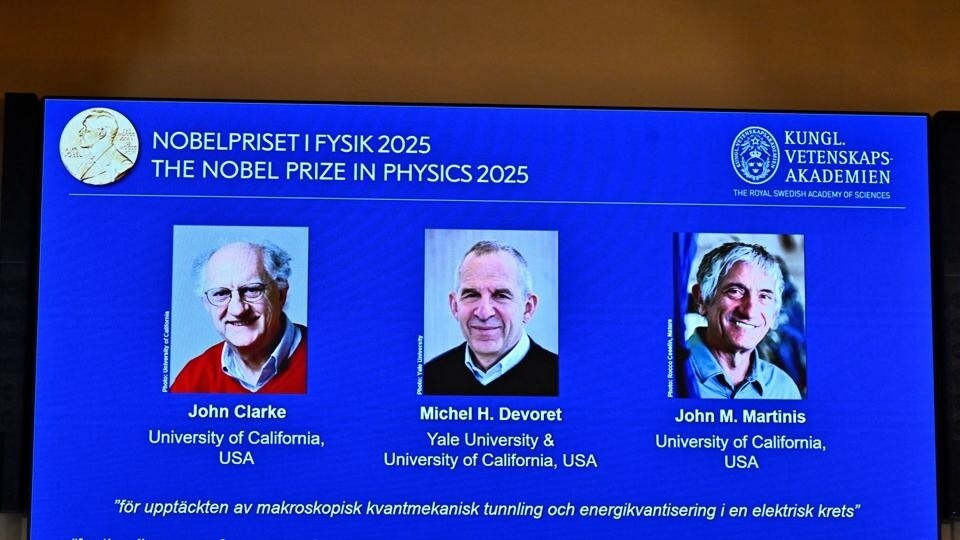
Goran Johansson, the member of the prize committee lumbered with the task of explaining the underlying science to the laity, seemed bemused by how to convey what the winners had achieved. John Clarke, one of those winners, seemed bemused as to why he and a team of two others had just been honoured for work done 40 years ago. And the audience, composed mostly of journalists, seemed, from the paucity of questions, bemused by what they had just heard. But perhaps this was because the academy’s announcement had committed the journalist’s faux pas of burying the lead: the science led to the invention of a crucial part of the technology for making quantum computers.
Computers, quantum or otherwise, are macroscopic devices. Conventional computers process “bits”—electrical signals that represent the binary digits one and zero. Quantum computers process “qubits”, the value of which is quantumly uncertain until a calculation is complete. But quantum mechanics is usually thought of as relevant only to the microscopic world of atoms and subatomic particles. The prize won by Dr Clarke and his two colleagues, John Martinis, a PhD student at the time of their discovery, and Michel Devoret, then a post-doc, was for bridging the gap to the macroscopic world.
The phenomenon on which they were working is known as quantum tunnelling. This, a manifestation of the uncertainty principle which lies at the heart of quantum mechanics, is the ability of quantum objects to appear on the far side of a barrier (generally some sort of energy barrier) without actually leaping over that barrier or passing through it. In the microscopic world this happens all the time. Radioactive decay, for example, depends on an alpha or beta particle (a helium nucleus and an electron respectively) tunnelling through the energy barrier that would otherwise keep it inside an atomic nucleus.
Cool things down close to absolute zero, however, and quantum effects can happen at a larger scale. In particular, at such temperatures superconductivity takes over. Electrical currents in superconductors are composed of multiple electrons twinned into what are known as Cooper pairs and sometimes further agglomerated into so-called Bose-Einstein condensates. In these states they move without resistance and can also cross physical gaps in the circuit wires carrying them by tunnelling across—such gaps forming what have come to be known as Josephson junctions after Brian Josephson, the British physicist who conceived of them and was himself awarded a Nobel physics prize in 1973.
Drs Clarke, Martinis and Devoret took things further. In a series of experiments involving what came to be known as artificial atoms—but were actually copper tubes filled with powdered copper attached to a superconducting silicon chip that included a Josephson junction—they showed that the current crossing the gap is quantised. In other words, it ratcheted up and down in steps, rather than changing smoothly. Since their device was clearly macroscopic, macroscopic quantum tunnelling was thus demonstrated.
And there things rested for some years until, in 1999, some researchers in Japan realised that if you could control the up and down ratcheting, you might use it to build a device that could process bits or, rather, since this would be a quantum device, qubits. That led to the invention of what are called phase qubits, which are oscillations between quantised energy levels in a Josephson junction. Those have led, in turn, to a more robust qubit design called a transmon, which Dr Devoret helped to develop.
Whether quantum computers will live up to the hype which now surrounds them remains to be seen. As does how much they will bemuse the world if they do.


