
 E-Paper



China’s satellite to explore Moon’s dark side successfully brakes for entry into orbit
Queqiao, the 400-kg satellite which has a designed life of three years, was launched on Monday to enable a rover to communicate with the Earth from the Moon’s mysterious far side, as part of the Communist giant’s ambitious goal of being the first country to send such a probe.

 Prefer HTon Google


China’s relay satellite, on an ambitious lunar exploration mission, has successfully braked near the Moon, completing a vital step before entering a desired orbit, space officials said today.
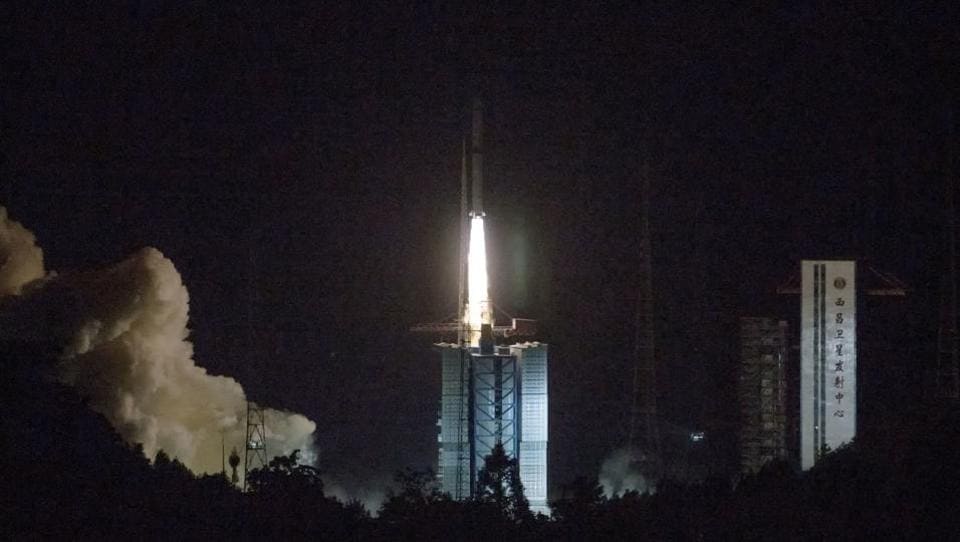
Queqiao, the 400-kg satellite which has a designed life of three years, was launched on Monday to enable a rover to communicate with the Earth from the Moon’s mysterious far side, as part of the Communist giant’s ambitious goal of being the first country to send such a probe.
It braked 100 km above the surface of the Moon in line with instructions from a ground control centre in Beijing, and then entered a transfer orbit from the moon to the second Lagrangian (L2) point of the Earth-Moon system, the China National Space Administration said.
“There was only a short window for the braking. And Queqiao had only one chance due to limited fuel,” Zhang Lihua, project manager of the mission was quoted by state-run Xinhua news agency as saying.
The relay satellite was launched on Monday to set up a communication link between the Earth and the planned Chang’e-4 lunar probe that will explore the Moon’s mysterious far side.
The satellite is expected to adjust orbit several times before it reaches a halo orbit around the L2 point, about 455,000 km from the Earth.
It will be the world’s first communication satellite operating in that orbit, the report said.


