E-Paper



Did UV Rays Doom Neanderthals?
Some researchers say sunscreen and tailored clothing might have helped humans survive when Neanderthals went extinct.


 Prefer HTon Google


What happened to the Neanderthals?
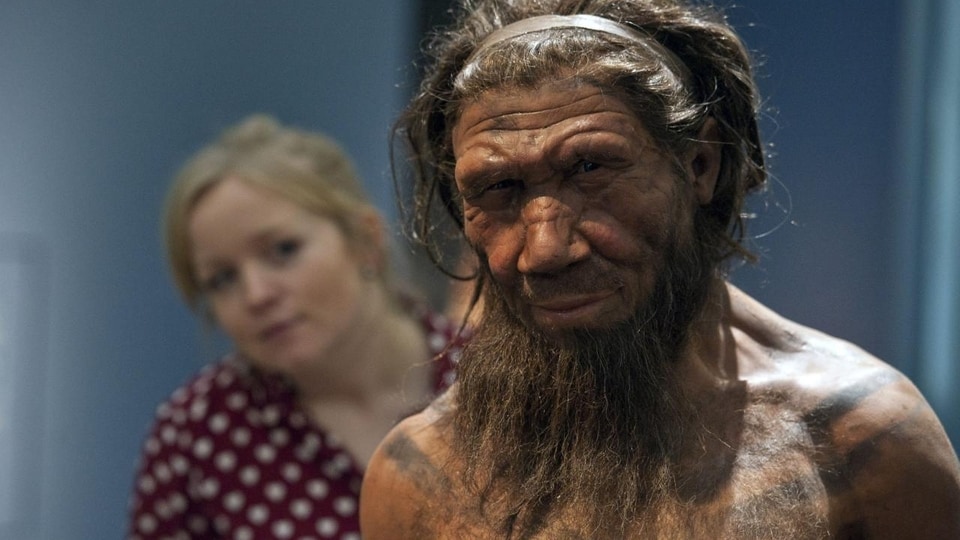
Our ancestral cousins went mysteriously extinct around 40,000 years ago, while humans did not.
The demise of one and survival of the other continues to flummox paleoanthropologists—but some researchers now think sunscreen and tailored clothing might have played a role.
Around the time Neanderthals bit the dust, a weakening of the Earth’s magnetic field resulted in exposure to higher doses of harmful ultraviolet radiation.
Clothing would have offered some protection. Both groups wore animal skins, but evidence suggests Neanderthals tended to wear loosefitting cloaks, while Homo sapiens sewed form-fitting garments. Humans also coated themselves with mineral pigments, which would have functioned as an ancient SPF.
It is unlikely that these differences in behavior alone would have resulted in the Neanderthals’ demise, but researchers think that their exposure to increased radiation would have had detrimental effects.
The increased exposure occurred when Earth’s north and south magnetic poles began to wander from their traditional positions.
The rotation of the planet and its molten core help generate a protective magnetic field that keeps our planet’s ozone layer robust and protects us from high-energy particles that constantly flow from the sun. The field is anchored at the poles, where magnetic forces are most concentrated. But small changes in the core can cause the poles to wander.
During the twilight of the Neanderthals, such a wandering caused the magnetic field to drop to about 10% of its average strength. Scientists call this the Laschamps event.
To test the effects of the Laschamps, Agnit Mukhopadhyay, a University of Michigan space scientist, and his group created 3-D models of what Earth’s magnetic field would have looked like during the event.
The results, published in the journal Science Advances, showed where the magnetic field was compromised, allowing radiation and particles to slip through.
Researchers know the magnetic field went haywire way back then by examining minerals smaller than the width of a human hair found within ancient deep-sea sediments and volcanic rocks. These tiny grains, which contain iron, become magnetized, and their alignment offers clues about the state of Earth’s magnetic field at the time.
The researchers’ analysis suggests Earth’s northern and southern latitudes up to 40 degrees would have been disproportionately affected by the weakening. This area in the Northern Hemisphere—including what is today Spain—is where many Neanderthal and Homo sapiens populations lived.
“As an anthropologist, I was intrigued, because I think a lot about how climate and weather might have affected Homo sapiens and other species, but I never thought about space,” said Raven Garvey, a professor of anthropology at the University of Michigan and Mukhopadhyay’s co-author.
For about a millennium or two, during the Laschamps event, Earth would have experienced higher levels of invisible, cosmic radiation.
But the impact of a thinner ozone layer wasn’t just about increased radiation exposure. It also would have affected cloud cover, wind belts, rainfall and general weather patterns.
“It’s not that the UV kills everybody,” said Alan Cooper, an evolutionary biologist at Charles Sturt University in Australia who wasn’t involved in the recent work but has published research with similar conclusions. “It’s climate change. Everything goes completely wild at that point.”
Not only did Neanderthals disappear from the fossil record around this time, Cooper added, but so did other species across the disproportionately affected areas.
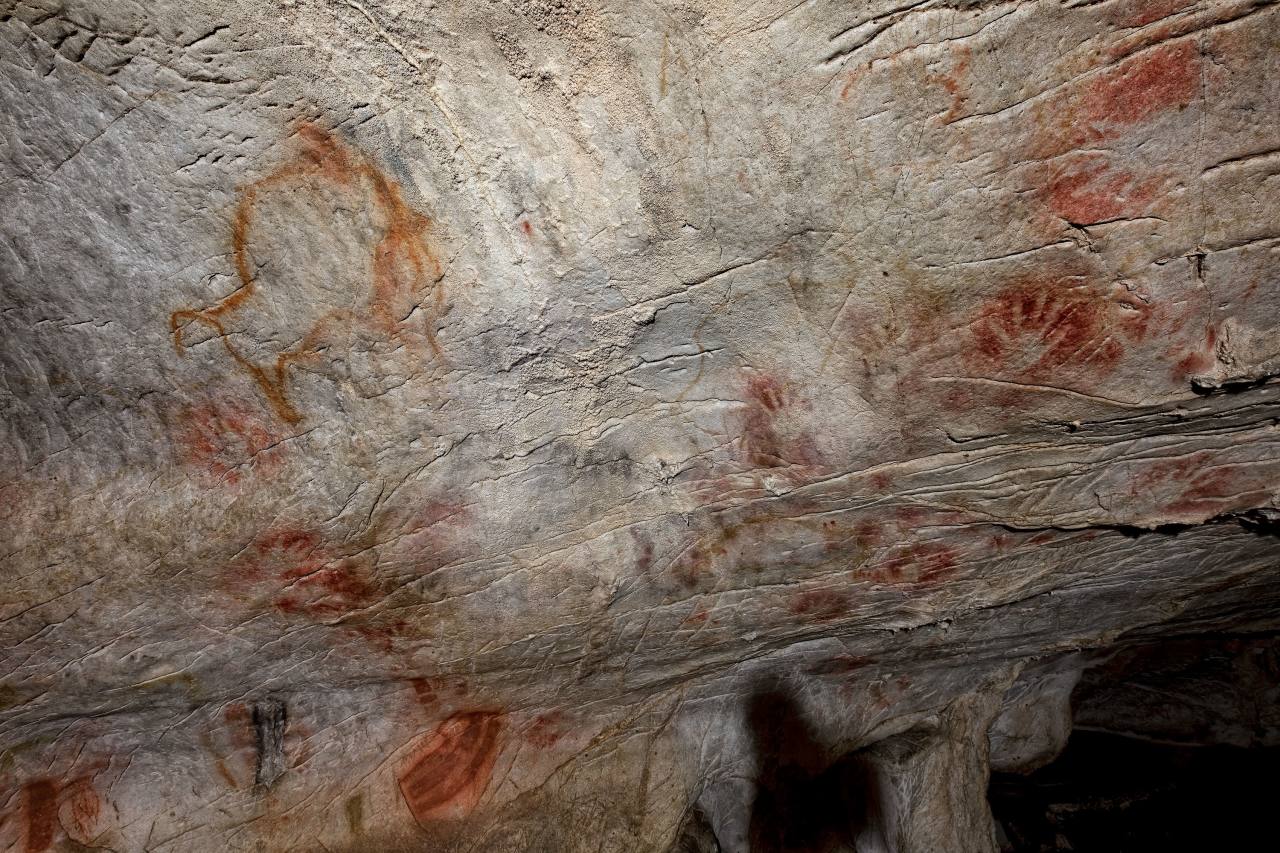
Mukhopadhyay’s group suggested two theories of what helped Homo sapiens, who interbred with Neanderthals, to survive: the use of a primitive kind of sunscreen known as ocher—a naturally occurring pigment composed of iron oxide often used for cave art—to protect their bodies from the sun, and clothing that hugged the body and covered more skin.
Right around the time of the Laschamps event, there was an uptick in cave art at sites archaeologists have linked to Homo sapiens, according to Cooper.
Anthropologists hypothesize that Homo sapiens also used ocher on their skin based on the fact that populations living in Africa and Australia today apply the pigment as a skin protectant, said Andrew Zipkin, an archaeological scientist affiliated with Arizona State University who wasn’t involved in the recent study.
Ocher is a naturally occurring pigment often used in cave art.Cave paintings in what is now Spain.
Archaeological sites linked to Neanderthals and modern humans have both yielded stone tools called scrapers used for processing animal hides to make them supple and wearable, Garvey said. But researchers have found evidence of a broader clothing-making tool kit at Homo sapiens-related sites.
“We’re also seeing things like needles and awls and the kinds of implements that would be very useful to poke holes in these hides and then stitch them together with sinew in the mass production of tailored clothing,” she added.
Anthropologists are careful to note that the coincident timing of the Neanderthal extinction and the Laschamps event could have been mere chance.
Differences in population sizes and other things could also have made the species’s survival less likely, according to Tony Capra, a University of California, San Francisco evolutionary geneticist who wasn’t involved in the work.
The goal of the recent work, according to the study authors, was to focus on one aspect of a multifaceted mystery.
“Whoever had the tailored clothing probably did have this advantage,” Garvey said. “But was it exclusive to one group and was it enough to lead to the extinction of one and the proliferation of the other? These are million-dollar questions.”
Write to Aylin Woodward at aylin.woodward@wsj.com