
 E-Paper



Ladakh sky shines: Solar storms bring aurora even at mid-latitudes in India
Rare auroras seen in Ladakh due to severe geomagnetic storm. Hanle observatory offers unobstructed views of the night sky.

 Prefer HTon Google


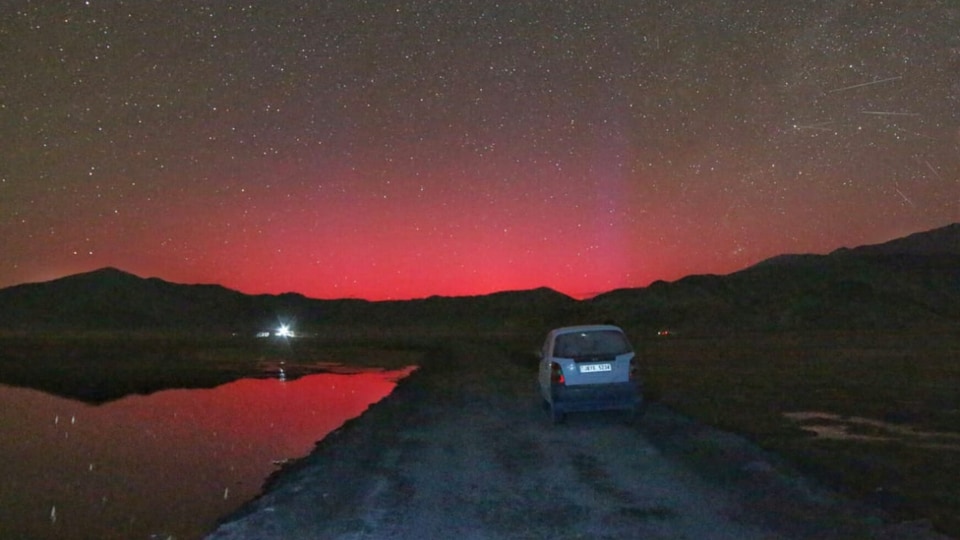
A powerful solar storm hit Earth on Friday, causing dazzling light shows in the sky. The storm, the strongest in over twenty years, has even created auroras in Ladakh despite it being located at mid-latitudes.
ALSO READ- Solar storms: Elon Musk says his Starlink satellites ‘under a lot of pressure’
The US National Oceanic and Atmospheric Administration (NOAA) Space Weather Prediction Center has reported the occurrence of a severe (G4) Geomagnetic storm, classified as G4 on NOAA's scale.
They are expected to persist through the weekend as additional coronal mass ejections enter Earth's outer atmosphere.
What are auroras? How are they created?
Auroras are stunning bands of light dancing in the skies, usually over Earth's poles. Thus, they are known as Northern or Southern lights, depending on their visible location.
They're created by magnetic storms triggered by solar activity and in this case, induced by coronal mass ejections. These storms send charged particles hurtling towards Earth via the solar wind. When these particles breach Earth's magnetic shield, they spark substorms. Fast-moving particles collide with oxygen and nitrogen in our upper atmosphere, causing them to glow in various colours as they release the energy from the impact.
ALSO READ- Nature's light show: The magic of Northern Lights explained
Hanle Observatory- the perfect place for a sky spectacle
The severe geomagnetic storm has even allowed rare aurora to show in Ladakh, as observed from the Hanle observatory. While rare, this is not the first sighting of Northern lights in Ladakh.
ALSO READ- ISRO tests ‘Made-in-India’ 3D-printed rocket engine. What is it?
Hanle boasts some of India's darkest skies. It is home to the Indian Institute of Astrophysics’ Indian Astronomical Observatory and has been designated India's first Dark Sky Reserve. Here, visitors can behold the unblemished beauty of the sky, unobstructed by light pollution, allowing the capture of faint celestial objects that are difficult to observe from elsewhere.
Check aurora videos from around the world
Social media lit up with people posting pictures of auroras. Check some posts:


