E-Paper



NASA explains why the Moon turns red during a lunar eclipse| Watch
A lunar eclipse occurs when the Sun, Earth and Moon are aligned so the Earth falls between the two and the moon passes into the Earth’s shadow (Umbra, Penumbra) briefly.

 Prefer HTon Google


The last total lunar eclipse of 2022 is expected to be seen on Tuesday. There would not be another full eclipse, says NASA, till 2025 while there would still be partial and penumbral lunar eclipses during this period. This eclipse is also a chance to witness ice giant planet Uranus in the sky as the dim moon will pave the way for other celestial bodies to shine brighter.
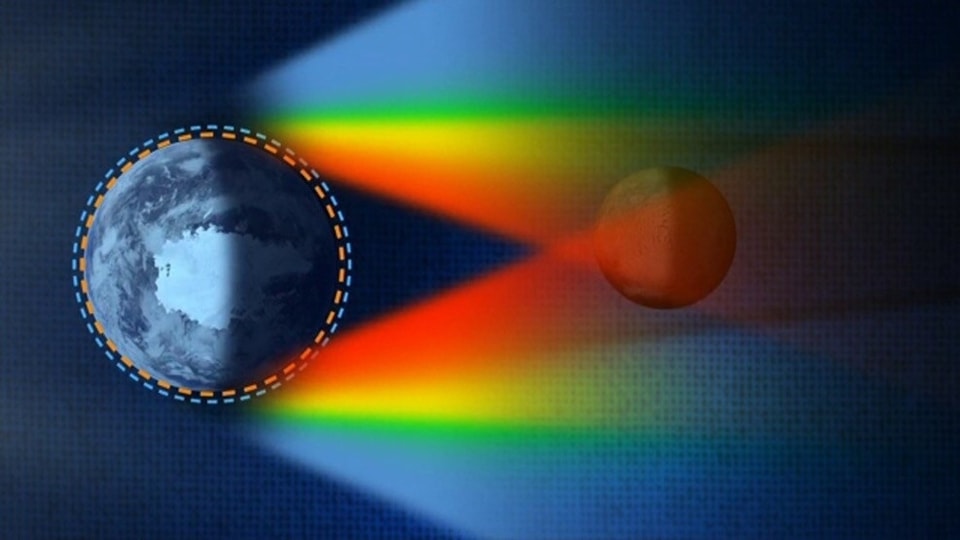
But why is the moon dim red during an eclipse?
A lunar eclipse occurs when the Sun, Earth and Moon are aligned so the Earth falls between the two and the moon passes into the Earth’s shadow (Umbra, Penumbra) briefly. It is normally understood that the energy of the Sun which reaches the Earth in the form of radiation is seen by human eyes as visible light, which has wavelengths.
Some colours have shorter wavelengths like blue and violet while others like red have longer wavelengths. When the Sun is overhead, we see the sky as blue but when it is setting, we see colours like yellow, orange and red dominate the sky accordingly. This phenomenon is called Rayleigh scattering.
Also Read | Lunar eclipse, meteor shower: November skies filled with celestial delights. Check details
"The same phenomenon that makes our sky blue and our sunsets red causes the Moon to turn red during a lunar eclipse. It’s called Rayleigh scattering. Light travels in waves, and different colours of light have different physical properties. Blue light has a shorter wavelength and is scattered more easily by particles in Earth’s atmosphere than red light, which has a longer wavelength," NASA explains in a post on its website.
Also Read | Dating the Mahabharata war – A tale of eclipses, archaeology, and genealogies
The blue colour, travelling in shorter, smaller waves makes it easy to get scattered by particles and dust but during the sunset, sunlight reaches us from low in the sky, travelling farther before reaching our eyes. Consequently, it passes through more air and particles scattering and rescattering blue light many times, in many directions. Thus it is removed from the atmosphere, allowing red, orange and yellow colours with larger wavelengths to go through.
In case of a lunar eclipse, when the Moon enters Umbra (the dark centre portion of a shadow), a path where all direct sunlight is blocked by the earth – the light from the Sun passes through the side of Earth, scattering through its atmosphere. Thus, till the time it reaches the moon, only longer wavelengths are left, turning the Moon red.
Once the moon exits the Umbra, it gradually resumes its original cycle, brightening like its usual self. Lunar eclipses occur roughly twice a year and while one doesn’t need any special equipment to watch it, a dark environment away from bright lights makes the best viewing experience.