
 E-Paper



Stunning reason that stripped away water from Venus, Earth's ‘evil twin’ revealed?
Venus lost its water due to stunning interactions of the solar wind with its atmosphere. Now, the planet is simply the “evil” twin of Earth.

 Prefer HTon Google


Once there was water on Venus, which is now referred to as Earth’s evil twin, but it has been stripped away. The latest data suggests that happened due to the interaction of solar wind with the atmosphere of the planet.
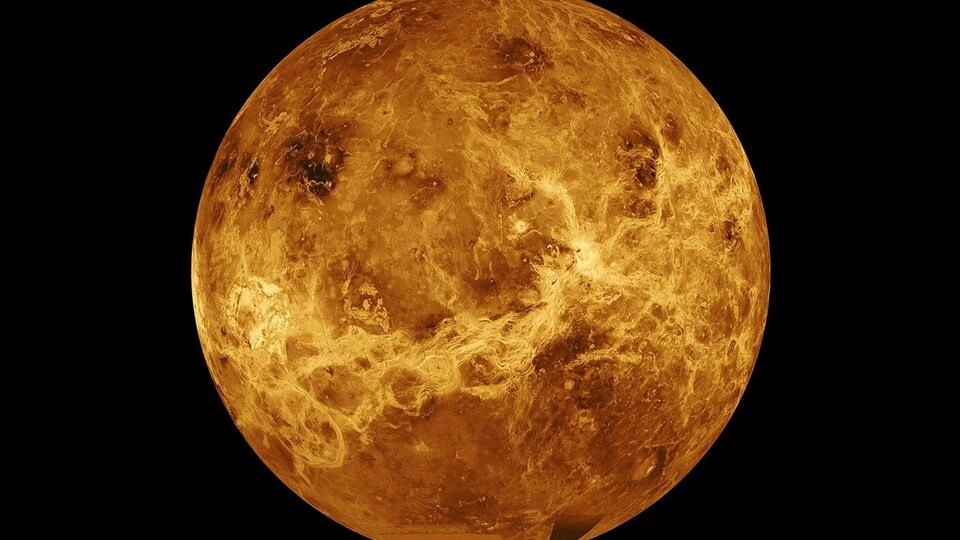
Earth's “evil” twin
There are many planets in the solar system, but very few could be said to be close to what Earth is. Venus qualified as one, once upon a time, but no longer. Now, Venus, is referred to as Earth’s twin due to its similar size and proximity to the Sun. In its present state, Venus is probably as close to the opposite of Earth as it can get, except for its size. The fascination lies therein. If it was like Earth, it means it had water too. Yes, Venus was not always the hot and arid planet we see today. According to the currently accepted theory, Venus once had large amounts of water on its surface.
Read More: Shock finding reveals no gold, platinum created by brightest-ever explosion
Venus' atmosphere
Venus’ thick atmosphere may have been responsible for this. Its amazingly dense atmosphere is made primarily of carbon dioxide, with small amounts of nitrogen and other gases. Over time, this atmosphere created a runaway greenhouse effect. It traps Sun’s heat and that increases temperatures on the surface as high as 800 degrees Fahrenheit and more.
Water on Venus
Water, when subjected to heat evaporates and it is suggested that on Venus, it escaped into space. However, most of this has been theorised and exact proof is hard to find. Till now.
Read More: Solar flare explosion during solar eclipse? What people really saw was this
The lingering questions about water on Venus have meant an intense focus to be put on the planet. After all, except for Mars, the only other planet that humanity can look at colonising is Venus, but for that, it would require understanding exactly what it is about. Mars, on the other hand, has been found to be more suitable and that is why it is being cris-crossed by roving robots, ground-bound and even flying ones and then of course, it is surrounded by all kinds of spacecraft.
Stunning flybys
Several missions to Venus are in the planning stages, but what is hastening the process of collecting date is the presence of spacecraft that can be directed towards Venus and they can do flybys and pick up more critical information. These will provide important information for future missions to Venus and perhaps even manned ones.
Read More: NASA’s solar sail to fly in space - no engines, no fuel required
What has changed now?
This is where BepiColombo spacecraft comes in. In a recent report in journal Nature Astronomy, it has been revealed that oxygen and carbon are travelling at such stunning speeds that they have managed to escape Venus’ gravitational pull. It is indeed a gravity-defying miracle of sorts.
As it transpired, ESA/JAXA BepiColombo mission spacecraft was diverted to do a Venus flyby recently. The data it collected indicated gases being stripped away from its atmosphere. The data indicated that in certain regions of Venus’ magnetic environment carbon and oxygen are speeding up to such an extent that they escape its gravitational pull, phys.org revealed.
Notably, these gasses move slow, but in this case, they are travelling too fast. It has been indicated that the solar wind creates an ‘induced magnetosphere’ on Venus and “Interactions with the solar wind have stripped away the water, leaving an atmosphere composed mainly of carbon dioxide and smaller amounts of nitrogen and other trace species,” phys.org revealed.


