
 E-Paper



Sharat Kamal the player-mentor as India nail team TT gold
The ageless senior kept the mood positive and motivated his younger teammates as they beat surprise finalists Singapore 3-1 to defend their Commonwealth Games team title

 Prefer HTon Google


It would take a sharp mind to keep count of the number of times Sharath Kamal shook his head during his 3-1 defeat to Singapore's Clarence Chew in the second match of the men's team gold final to level it up at 1-1.
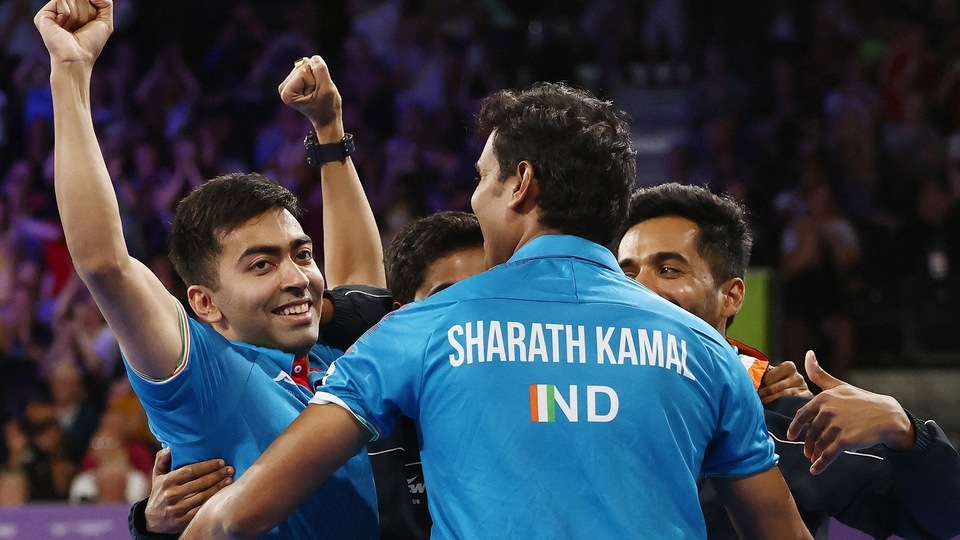
The moment he joined the rest of the team off the court though, he got down to engaging in a lengthy conversation with Harmeet Desai, who was to face Chew for the fourth rubber. “He told me that he (Chew) is a dangerous player but if I play my game, I will beat him,” Desai said.
“He just wanted me to relax. He said we’re still in this, and if I lose he will be there in the fifth match. I was confident, and this talk also relaxed me quite a lot.”
Also Read | Saurav Ghosal finds Paul Coll too hot, to battle for bronze
Desai did not lose, and India defended their men’s table tennis team Commonwealth Games (CWG) title defeating Singapore 3-1 at the NEC Hall on Tuesday. Desai finished things just as he started partnering G Sathiyan in doubles, a 3-0 victory. Sharath’s blip made things interesting against a team which got past a fancier England in the semi-final. Sathiyan beat Koen Pang 3-1 in the third tie and Desai picked it from there as India’s male paddlers won their third team gold, to add to the wins in 2006 and 2018.
After that chat with Desai, Sharath put on his jacket and took his chair to the sidelines as Sathiyan’s match began. The second point Sathiyan won, Sharath was on his feet applauding. The last point that Desai won for the gold, Sharath sprinted out for the opening hug. That incessant disapproving head-shaking stopped with his match.
“It doesn’t matter, my loss,” the 40-year-old said with his 10th CWG medal—yes, that many—neatly around his neck. “Because we still haven’t lost the tie. I will feel bad about it, but not at that time. When I go back now, I will sit down and think about it.
“That is what team spirit actually means. You can’t let the team go down even if you do. Bring the mood up, always.”
The quintessential team man, always. One who, seconds after his individual loss, shifts his mind to the team win. It’s a role Sharath feels like he has been playing since 2006, when the men’s team won its first gold in Melbourne. India played Singapore in that final too. Their top player Yang Zi, the Indian team unanimously agreed, was too good to be beaten. So they targetted three out of three from the other matches. Sharath took on Cai Xiaoli in the second match with expectedly India trailing 1-0.
"In the team's mind, my win against their No. 2 was a given. I lost that match, and we were 0-2 down. But I came back to beat Yang Zi,” Sharath recalled. “So I can't carry that vibe into the next one. When I do that, the morale of the team goes down.”
The mood lifter. The calming influence. The head of the pack. Yet one among equals.
The veteran has more accomplished players around now who can step up when he doesn’t—like Sathiyan and Desai did—yet his influence in this team of champions is second to none.
“Whenever I am in doubt, I go to him (Sharath). I have learnt so much from him, and there’s still so much to learn. I hope he is there for the next Commonwealth Games too,” Desai said with a smile.
Sharath will be 44 then. You wouldn’t believe looking at him exult after beating world No 15 Quadri Aruna to make a statement on behalf of him and the team in the semi-final against Nigeria on Monday night. “You just do it by example. Like I did against Nigeria. Because I showed that confidence yesterday, today they were like, ‘OK no problem, we can do it’. Even when I faltered, they were confident they can do it. Because that’s the confidence that builds up in the team,” Sharath said.
It reflected in the manner in which the men’s team marched along in Birmingham; they didn’t face England, a final the Indians said they had expected. This bunch has been together for a while now, Sharath the odd 40-year-old out amidst the 20-somethings. Yet the bonding on darts and music and frequent chats during the Covid lockdown doesn’t stop. “I may not have been with the team so much in recent times due to Covid and other reasons, but when we come together, we know what each other likes to do,” he said.
A facet Sathiyan also attributed their clinical team show to. “Team spirit is the key to our dominance here. We’ve been playing for more than eight years together now. We have a great time on and off the court, and push each other when it really matters,” he said.


