
 E-Paper



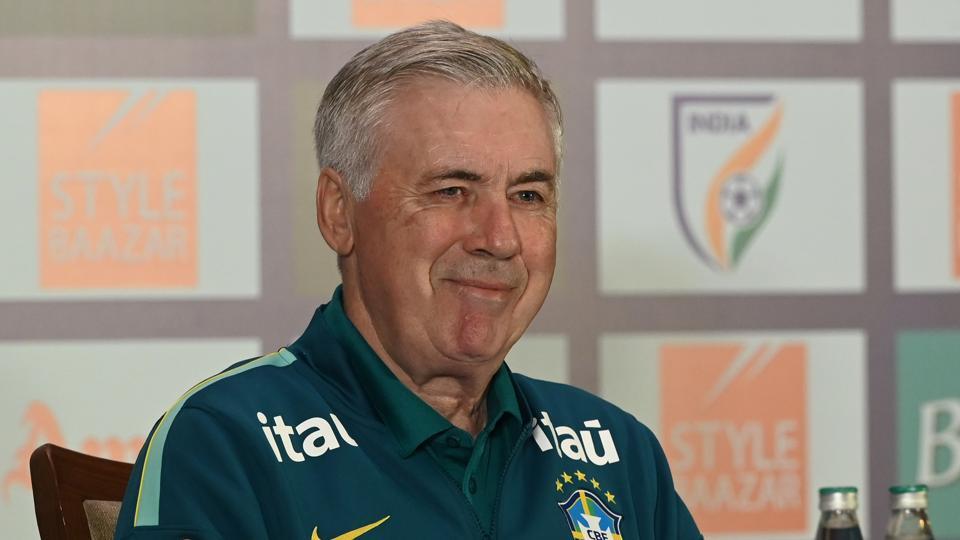
Ancelotti does a namaste as Brazil warm up for India match in Kolkata
Brazil's historic match against India in Kolkata lacked the usual frenzy, as local excitement was subdued despite the significance of the event.

 Prefer HTon Google


Kolkata: By the time Brazil arrived in Kolkata, the city had already seen this spectacle before. When Lionel Messi came to India in 2011, the hysteria was impossible to miss. In 2008, when Diego Maradona came visiting, the excitement was almost physical. There were crowds outside hotels, curious onlookers at stadium gates, cameras everywhere, a sense that something extraordinary had descended on the city.
This was different.
Brazil, the five-time world champions, are in Kolkata to play India at the Salt Lake Stadium. It is a historic occasion for Indian football. Yet outside the stadium gates there were no great knots of curious spectators. At the team hotel, where Carlo Ancelotti and Marquinhos held a marathon press conference attended by almost 300 people, there was little of the frenzy that normally accompanies football’s biggest names in India.
Deep Dive

It was strange, but then Kolkata’s heart beats so strongly for Brazil that it seemed almost normal. Inside the press conference, Ancelotti offered a glimpse of the cultural distance between the visitors and their hosts. After performing a namaste, the Italian said: “There is a different culture here. Football is part of this country’s culture, but it is not the most important thing.” Then he smiled. “We are happy to be here to show our quality for all the people. It’s a great opportunity for Brazil to play fantastic football.”
India’s press conference was more straightforward. Khalid Jamil, the national coach, expressed the same thought in perhaps 10 different ways: deal with the pressure, do the basics and give it your best. There was no grand proclamation, no attempt to pretend that India were anything other than overwhelming underdogs.
They are ranked 138th in the world, the lowest-ranked opponents Brazil have faced since 1998, when they had played Andorra, then ranked 185th. Yet Marquinhos insisted that Brazil’s presence here was about more than the result.
“Of course, the focus is always very much on playing well and winning the match, but being here is also a way of thanking the Indian people for their support and for following the Brazilian national team all these years, throughout its history,” he said. “This is also the second-largest group of supporters of the national team outside Brazil, so it’s a pleasure and an honour.”
For the Brazilian journalists travelling with the team, India itself was part of the story. Felipe Brisolla was among a sizeable Globo TV contingent covering the match. His observation was revealing. Brazil, he said, always travel to rich countries for such tours. “Never a country like India. Most of the players may come from humble beginnings,” he said. “But many now live in mansions. It’s good for the team to come here. Brazil and India are similar in many ways.”
It explained why for most of the travelling journalists, India was the bigger story. Training their cameras on the Indian press corps, wandering around the stadium, taking in the surroundings, conducting their own quick tour of a venue that, for the most part, looked okay.
There was chaos, naturally. Football in India rarely arrives without it. The publicity has been tepid. And with tickets still available online—ranging from ₹3,500 to ₹15,000—it remains to be seen if the match becomes a sellout. Internally, there were complaints of distribution of additional passes issued to the IFA and clubs hitting a roadblock. Accreditation had also become a source of confusion, with some Brazilian journalists visibly miffed by the lack of clarity.
At the venue, meanwhile, there appeared to be more police than fans. The stadium itself had been spruced up for the occasion. A new stand of seats in saffron, white and green offered a splash of colour against the familiar concrete and steel. In its backdrop appeared the Brazilian team. Vinicius Júnior ambled into the ground, joined his teammates for some light stretching, and soon the squad were playing steal the ball. The press were told they had just 15 minutes to watch Brail train.
Fifteen minutes. Nowhere near enough for those who had travelled thousands of miles to watch Brazil train. For all the grandeur of the occasion, that was the reality of the day before Brazil played India. A little chaos, stadium crawling with cops, Brazilian television crews discovering India, local reporters trying to make sense of the fact that one of football’s great powers was standing a few metres away.
And Ancelotti, Marquinhos and Vinicius were simply doing their jobs. Perhaps that was why the lack of frenzy felt so striking. The day did not look like the arrival of Brazil in India so much as India suddenly becoming, for 24 hours, one of the places Brazil had to play football. Yet beneath the subdued surface was something enormous. India were going to play Brazil, for the first time in recorded history. The city might not have gone hysterical, but nobody who was there needed reminding that this was a historic day.


