
 E-Paper



Intense, tough & driven: India's finest homegrown coach is just getting started
As interim coach of NorthEast United, Jamil deadpanned through television interviews during a string of 11 unbeaten games which also made him the first Indian to reach the play-off stage of the Indian Super League (ISL).

 Prefer HTon Google


On an early July evening in 2000, three India midfielders were walking down a London street. Two of them, Alvito d’Cunha and Jules Alberto, had strolled a little ahead when they realised that the third, Khalid Jamil, was nowhere to be seen. “We turned around to look for him and he emerged after a while running at full tilt with a white man in pursuit. Realising that something was amiss but not knowing what, we hid in the crowd till Khalid ducked safely into the team hotel,” said D’Cunha.
Part of India’s only tour of England after the 1948 Olympics, this was not how D’Cunha wanted a first-day feel of London to end. “When I asked Khalid what happened, he said he was trying to tease that man and it got out of hand,” said D’Cunha. “Trust me, his sense of humour is amazing,” said Steven Dias, another former India midfielder and assistant coach at Odisha FC, who, like Jamil, is from Mumbai.
Reconciling with the image of Jamil being a practical joker or someone who could get people to crack up is difficult because he is known for a saturnine not sunny disposition. As interim coach of NorthEast United, Jamil deadpanned through television interviews during a string of 11 unbeaten games which also made him the first Indian to reach the play-off stage of the Indian Super League (ISL). It was the same when as East Bengal or Mohun Bagan coach he would face a room spilling over with journalists.
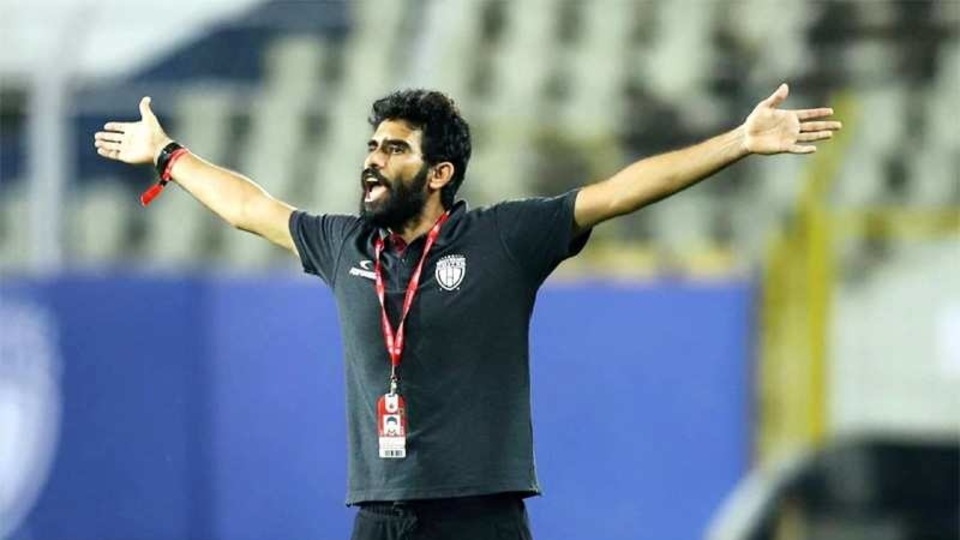
On the touchline though Jamil’s luxuriantly bearded face is a mélange of emotions. “When he is outside he is very quiet and well behaved, but once he gets to the ground, he can be very aggressive,” said Henry Menezes, the former India goalkeeper who was an official at Mumbai FC, the now defunct I-League club that Jamil coached from 2009 to 2015.
Bimal Ghosh, Jamil’s coach at Air India where he played from 1998-2001, remembered a sudden flash of temper too. “In a game against Mahindra (one of Air India’s top rivals), he picked up a chair near the half-line mark and broke it. I said, ‘pagal ho gaya hai kya; bahar bitha dunga aisa karega toh (have you gone mad; I’ll bench you if you behave like this)’. He apologised so many times for that,” said Ghosh.
To piece together what Jamil is on and off the field, this paper spoke to a number of people and though only Dias and D’Cunha mentioned the funny bone, there was unanimity in what football meant to this 43-year-old — everything.
Ghosh also said Jamil was very hardworking. “Our practice would be from 7.30am to 11am. After 11am, he would get a chair for me again, a cup of tea, some water and ask me to make him practice more. ‘Woh pagalpan tha usme (he had that devotion to the game)’.”
An intense, tough and driven deep-lying midfielder, Jamil dazzled for Mahindra United, Air India and India (1998-2001). Dias remembers Jamil scoring off an overhead kick for Mahindra in a Mumbai league game.
“He was very comfortable on the ball — for me, he was like the Zidane of Indian football at the time. Only because of injuries he could not play for a longer time,” said FC Goa technical director Derrick Pereira who coached Jamil at Mahindra. “He was very disciplined. For him, the most important thing off the field was rest,” said D’Cunha.
And as coach, Jamil would go to any length for the team. D’Cunha spoke about how as East Bengal coach, Jamil knocked at a flat in Siliguri and asked to be let in. “Because he thought from one of the rooms, he could watch Mohun Bagan train ahead of a Kolkata derby.” Living alone in Kolkata while at East Bengal, Jamil would spend most of his day at the club tent in the Maidan.
He is also not one to shy away from a challenge, said D’Cunha explaining why Jamil took up coaching assignments with East Bengal and Mohun Bagan. A challenge is what spurred Jamil to take up the job at Aizawl FC too. “He wanted to prove that he was a good coach and no pushover,” said Hmingthana Zadeng, the former Aizawl FC technical director who had approached Jamil for the head coach’s role at the club in 2016 after the latter spent six seasons at Mumbai City. It ended in a fairy tale of a team with modest resources besting heavyweights Mohun Bagan, East Bengal, Bengaluru FC to win the 2016-17 I-League.
“Khalid’s biggest strength as a coach is quickly grasping and understanding the strengths and weaknesses of each player and then creating an environment in the team for all the players to express their best qualities to create a winning group of individuals,” said Thangboi Singto, assistant-coach and technical director at Hyderabad FC.
“I believe his stint in Kolkata with the “Big 2” teams and being a winner with Aizawl FC equipped him to churn out unbeaten results till the semi-final second-leg (in ISL7).”
“Coaching is not just about organising sessions; it’s about man management as well and Khalid has shown in the 11 matches at NorthEast that he can handle the team,” said Pereira. “His team is ready to do anything for him; that’s the most important thing,” said Dias. “He will always keep his words short, but they can be highly motivating.” Zadeng said Jamil cared for the players “like they were his children.”
“Nothing much had changed at NorthEast United except the coach so credit to Khalid for this turnaround,” said D’Cunha. When Jamil took charge, NorthEast hadn’t won in seven games and were seventh in the standings on 12 points after 11 games.
Jamil grew as a coach under David Booth at Mumbai City. That happened because Mumbai FC had already marked him for a coaching job, putting him in charge of the under-19 team when he was a still a player, said Menezes. Jamil, who has an Asian Pro Licence in coaching, replaced Booth in 2009.
Born in Kuwait, Jamil was 13 when along with family, he flew out during the Gulf War in October 1990. Jamil’s grandfather worked with Kuwait’s royal family and his father had a successful garage business, the coach said in an interview to goal.com. His parents returned to Kuwait in 1991 where they still live but Jamil joined Mumbai’s Rizvi College which has produced a string of internationals in cricket, football and hockey.
It is still said in Kolkata Maidan that Jamil refused to join Mohun Bagan and East Bengal because they were associated with liquor companies. That may be apocryphal but according to an East Bengal official present during negotiations in Mumbai, the issue came up when the club had wanted him to take over in 2017 because the association hadn’t ended.
“We told him that the brand associated with the club also makes mineral water. He had asked for a day, saying he would discuss this with his wife,” said the official.
“He is a deeply religious man,” said Godfrey Pereira, the former Air India and India player. “Maybe that’s why God smiles on him so much.


