
 E-Paper



Conversion rate trouble for India women's hockey team
The 0-1 loss to USA in the women's Olympic hockey qualifiers exposed a dearth of quality strikers, a concern that won't vanish with the 3-1 win over New Zealand

 Prefer HTon Google


Sjoerd Marijne spoke about it at the FIH Women's Series Finals in 2019. Janneke Schopman continues to speak about it at the FIH Women's Hockey Olympic Qualifiers in 2024.
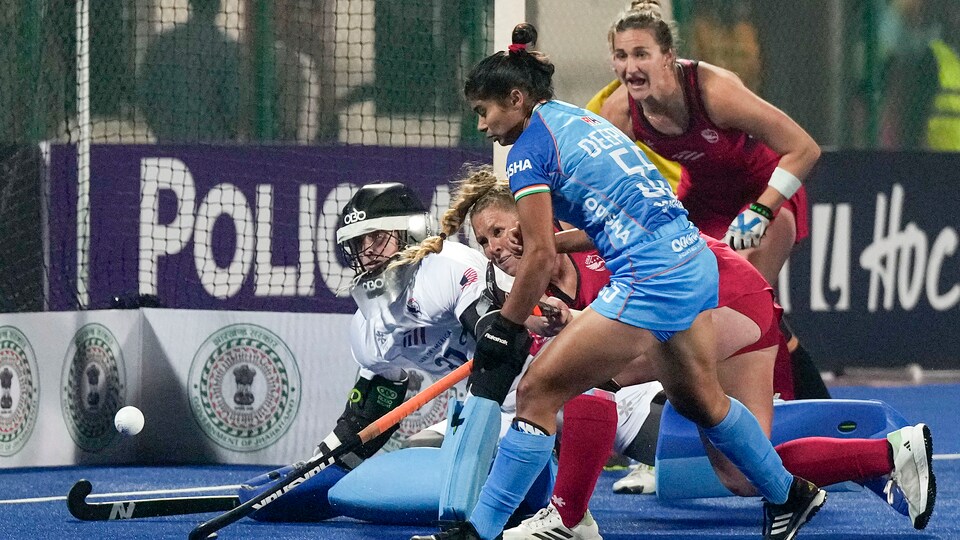
Spanning those years and their stints as coaches with the Indian women's hockey team is one problem: conversion rate, in terms of opportunities created inside the striking circle and goals scored. Since the creditable fourth-place finish at the 2021 Tokyo Olympics, it’s an issue that has come back to bite Schopman’s side in high-pressure matches of key tournaments.
On the days India are really good and most players are on song, Schopman, under whom the team has played a lot more attacking hockey, doesn't have as many concerns. It's on the days that they are required to dig in, scrape through and "almost no one plays really great" -- as Schopman admitted was the case against USA on Saturday -- that they struggle to break the shackles inside the circle.
"Normally when you have 1-2 players who are really good, that can help you through a game like that," the former Dutch player said.
That wasn't the case in the team's Olympic Qualifiers opener here, when India’s 13 circle penetrations resulted in no goal and USA’s five gave them the one that mattered and put the hosts on the backfoot rightaway in a tournament with little room for error. It also wasn't the case in Hangzhou, when India’s chances aplenty accounted for nothing in a 4-0 Asian Games semi-final defeat to China that has forced them to turn up for this tournament to earn a Paris Games berth.
Part of the puzzle is the lack of options in the frontline or a pool of strikers in the senior women’s set-up. It gets amplified when the other way to score goals, penalty corner (PC) conversion, also isn’t clicking. It also gets amplified when experienced and genuine goal-scorers like Rani Rampal (dropped) and Vandana Katariya (injured) are not around.
For instance, in the group stage of the 2022 Women's World Cup where India couldn't win a single match and eventually finished joint ninth, they scored just five times. Three of those were PCs, and three of the five strikes came from one player: Vandana. She was also the team’s top scorer at the 2022 CWG (India won bronze), hitting four out of nine goals, barring Ghana (Vandana did not score in that game).
Thus, suddenly having to do without the injured Vandana in the Olympic Qualifiers, the slightly inexperienced Indian team looked out of ideas and bereft of quality in the circle in the opener. Young Baljeet Kaur, Vandana’s replacement in the squad, barely had any impact against USA.
“We have a core group, but we don't have a proper forwardline," said V Baskaran, India's 1980 Moscow Olympics gold-winning team's captain and former coach. “Rani hasn't been in the team for a long time while Vandana is injured. But why don't we have 3-4 Vandanas in the setup? Why haven't we created next-in-line forwards? And why haven't we given them enough chances?
“Transition of new players is a concern. The transition of a player replacing Rani or Vandana should have been started when Rani was there in the group.” Baskaran felt there was no Indian excelling and being a genuine threat inside the circle and that the “taller” American defenders made it all the more difficult.
Neha, the 27-year-old midfielder who was part of the squads at the 2022 CWG and last year's Asian Games, said players tried to hurry while in the D. “We could've easily scored a goal on a few occasions, but we were too hurried. If we stay calm and pass the ball around inside the D, the goal will happen," she said after Saturday’s loss. “We are training hard to get better at converting our chances on a daily basis, but it just did not happen on the day.”
It did happen on Sunday, although India still missed opportunities inside the circle to pump in a few more goals.
Against USA, the players also drifted away from their usual style, resorting to slamming long balls into the circle more in hope — especially in the final few minutes — after all those missed chances appeared to have added up in their minds.
“I thought we did that too often. And I kept trying to tell them, ‘Just play short, we're good, we have the skill’. We just to have to play more to our strengths," Schopman said.
And get a bit smarter, the former Dutch player felt, in identifying the space that players can manoeuvre and cash in on when they find themselves inside the circle. “But if we lose every 50-50 ball, more or less, then you know it's going to be a tough game,” she said.


