
 E-Paper



Murali Sreeshankar chases the perfect jump, again and again
The young long jumper who qualified for the Tokyo Olympics with a national record 8.26m talks about his journey as an athlete and person.


“I am just working like a robot,” says Murali Sreeshankar, his eyes tired yet sharp, expressing as much about his current non-stop race as an elite athlete. “I don’t have time for anything. I get up, train, take rest, attend classes if at all I have, sleep, train again, study and sleep,” he rattles off. So, how long has it been? An empty stare again. “I don’t remember. It’s been five or six years since I have been to a movie with friends.” It’s an appropriate way to measure social life if you are 21 with one major goal.
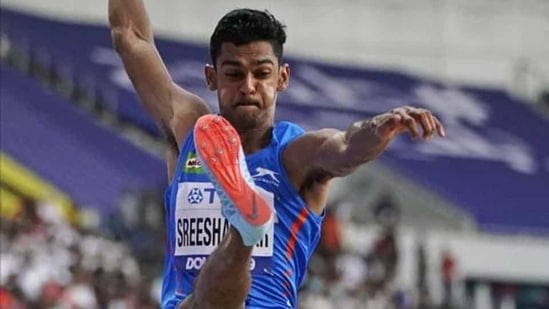
He no longer watches his favourite WWE stars or keeps track of NBA games. “It’s my dream to meet some players of the American basketball team. If I meet LeBron James or Kevin Durant in the lift or something,” Sreeshankar grins. Chasing one’s dream and heroes can feel like a hard balancing act.
He is far from complaining; he is ecstatic. It’s a day when all the sacrifices he has made through his teenage years feel every bit worth it. On Tuesday at the Federation Cup athletics meet here, he landed his perfect long jump—8.26m—to qualify for his first Olympics, in Tokyo. His phone constantly buzzes. From the athletics field to his hotel, he calmly responds to congratulatory messages.
Qualifying for the Tokyo Olympics became Sreeshankar’s target since he broke the national record with 8.20m at the 2018 National Open Athletics Championships in Bhubaneshwar as a 19-year-old wonderkid in Indian athletics. That leap met the qualifying mark for the 2019 world championships in Doha, and pushed him towards a tougher training regimen.
The world meet was his first experience going up against the world’s best jumpers. Seeing the likes of 2016 Rio Olympics gold medallist Jeff Henderson of the US, Cuba’s Juan Miguel Echevarría, the 2018 world indoor champion, and Tajay Gayle, the winner in Doha, warm up alongside him, Sreeshankar was overawed, and started doubting his level. He admits he was not ready for the big league.
“Doha was an eye opener. I was suddenly standing with all the big jumpers—all of a sudden I felt it was straight out of a dream. I was mentally not mature to face such competition.” In the qualifying heat, Sreeshankar finished 22nd with a best jump of 7.62m.
Talk about a steep learning curve. There were a couple of things he needed to address immediately. One was to get back to training under his father, S Murali—a former international triple jumper known for his smooth jumping rhythm. It was his father who shaped his career in Palakkad, Kerala.
After he broke the national record in Bhubaneshwar, the athletics federation wanted Sreeshankar to work with a specialist foreign coach. He was not keen, insisting that he be allowed to continue with his father. Germany’s Volker Herrmann, then AFI high performance director, had prepared Sreeshankar for Doha.
He had missed his father by his side. It was a turning point. “I thought it (working with another coach) might work, but it didn’t. My father is not a qualified coach, but he is a genius. He has great knowledge about technique.
“Most importantly, he knows my strengths, weaknesses, fears and capabilities like nobody else. Adaptation is a key factor for an athlete. It’s not like I train under the world's best coach and get a big jump. He knows me perfectly. His words have always been right in my case.”
Once the bond with his father was reconnected, Sreeshankar started afresh for Tokyo Olympics qualification. There were those who called him a one-jump wonder. After 2018, he had not produced a big jump. Sreeshankar waited patiently, working with focus.
“It’s a simple event, but when you go deep, it’s very technical. There are so many aspects you have to look at before a jump. Everything has to click perfectly for a perfect jump—on the right spot, at the right moment. The 8.20-plus jump won’t come often.”
Sreeshankar saw how that one big jump could come anytime if he was in good rhythm. He saw that in Doha. Jamaican Tayjay Gayle was the last to qualify for the final (7.89). There were 11 jumpers ahead of him—seven of them had touched 8m. In the final, Gayle shocked the field by winning gold with a world class 8.69m.
“From being the worst in the qualifying round, the next day he was a completely different man. He shattered the field with a big jump. I was wondering about the psychological impact that happened in 24 hours and how he boosted himself for his next jump.”
Long jump’s greatest story is anyway about that one gargantuan jump, 8.90m, produced by Bob Beamon at the 1968 Olympics in Mexico City.
The realization made Sreeshankar focus on the process, making technical adjustments without worrying about the distance. The Indian Grand Prix meets last month was his first competitions after more than a year. It took him time to find rhythm. At the first GP on February 25, his best was 8.05m, in his final attempt.
“I was coming towards the board but I didn’t get the jump I expected. We went back home and made the corrections.”
There was a mental barrier Sreeshankar had to cross. “My dad said I am scared towards the board. “You are not attacking the board, you fear it,” he said.” It means anxiety that one would over-step at the take-off and foul. The ideal take-off is when the foot properly lands on the board.
On Tuesday, Sreeshankar erased that fear in the very first jump. “I was working on visualising every aspect of my run-up and jump so that I can attack the board.”
For the first time, he recorded 8m-plus jumps in each of the first four attempts before a “perfect take-off” took him past the Olympics qualification mark of 8.22m and to a new national mark (8.26m). “That’s a positive sign towards the Olympics. A jump of 8.26 may not help to even enter the final because there are tough guys out there.
An 8m-plus jump first up will also help respond to those who point out that Indian jumpers rarely replicate home form while competing abroad.
“I believe I have the calibre to do 8.40 and this is just the road to that jump,” he says. “For that I have to consistently touch 8.20. An 8.00m jump in qualifying at Tokyo will get me a place in the final, an 8m-plus jump will earn me a place in the best eight and an 8.30 plus jump maybe in the best four; an 8:40 jump in the podium.”
Sreeshankar has joined a small group of Indian athletes who have qualified. Javelin throwers Neeraj Chopra and Shivpal Singh, race walkers KT Irfan, Sandeep Kumar, Rahul Rohilla, Bhawana Jat and Priyanka Goswami, Avinash Sable (3,000m steeplechase) and the 4x400m mixed relay team are the others who have made it so far.


