
 E-Paper



Into a new era: Dipa Karmakar moves past the Produnova
The gymnast wants to put the doping ban behind and get back to her best in the arena

 Prefer HTon Google


Dipa Karmakar is in a happy space. The wide smile is back, as is the determined look in her eyes. The trailblazing gymnast has served her 21-month doping ban and is back doing what she does best — fly off the vault. "It's been a while," she sighs. "I am happy to be able to compete again. I really missed it."
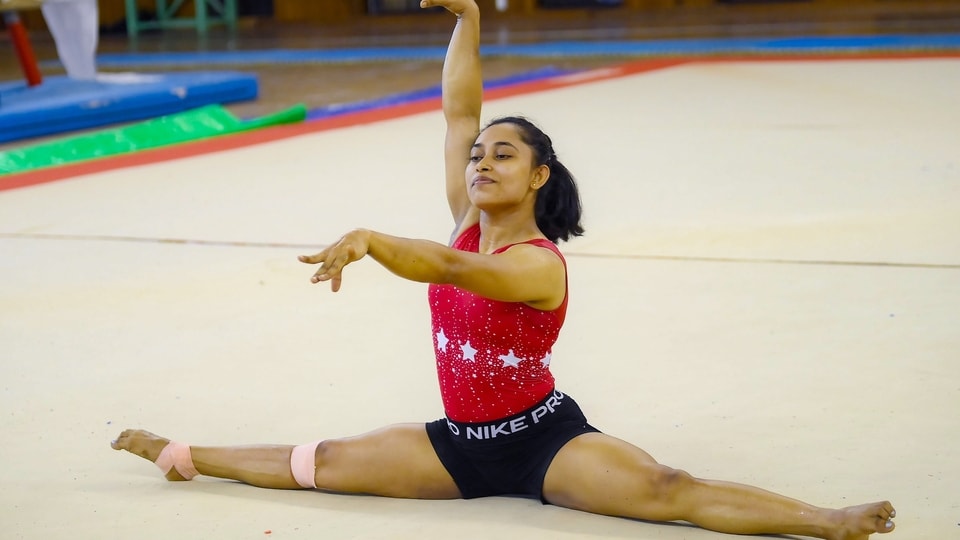
Karmakar doesn't want to delve too much into her past, but she is aware of the stigma that comes with a dope ban. "I can't undo what has happened. I didn't ingest the banned drug knowingly, so my conscience is clear. It was a dark phase, no doubt, but I was always confident of coming back stronger. I compete in a sport where you flirt with death every day. So, you know, I am mentally tougher than what people may think."
Karmakar was tested out of competition by the International Testing Agency (ITA) on October 11, 2021. The sample returned positive for banned drug higenamine, a stimulant usually found in weight management products and dietary supplements, among others. She accepted the report which led to her punishment being reduced by three months. The suspension ended on July 10.
The 29-year-old was named in the national camp in May and she made it to the Hangzhou-bound Indian squad following a selection trial where she scored 47.05 in the all-round event to claim the top spot, followed by Pranati Das (45.80) and Pranati Nayak (44.43).
"I approached the trials with an open mind. I could have done much better but I am still happy to be back in the team. Competing after so long can dent your confidence and create doubts, but I kept myself in the right space by watching some of my old videos."
That, of course, included the famous Produnova — often referred to as the 'vault of death' — that she pulled off at the Commonwealth Games in 2014 and more famously at the Rio Olympics in 2016 where she finished a historic fourth. While she does draw strength from that seminal moment, Karmakar insists that she is not living in the past.
"A lot of time has passed since Rio. It is humbling to know that people still talk about it but I would like to look at the future. I still have a few good years in me. I have lost a lot of time to injuries too and I would like to make up for it. I wept a lot in the first few weeks of the ban, but soon I picked myself up. I am not done yet."
The journey restarts at the Asian Games — her fourth — where Karmakar will aim for a maiden medal. Having last competed at the international level at the FIG World Cup in Baku in 2019, the return won't be easy. Her last Asiad appearance came in the backdrop of the Rio high, but under the dazzling lights of Jakarta International Expo Hall, Karmakar fizzled out.
Her knee injury flared up during the vault qualification, which meant she couldn't make it to the final. In the balance beam event, Karmakar's fifth-place finish meant India ended their campaign without a medal.
"I don't wish to think about it too much but this is a sport where injuries are bound to happen. You have to risk yourself to win big, and in doing so, injuries are the price that we have to pay."
Coach Bisweshwar Nandi thinks otherwise. Concerned with her injury-prone right knee — she underwent an Anterior Cruciate Ligament surgery in 2017 — the Dronacharya Awardee has knocked Produnova off his plans. "I have to think of her post-athletic life too. The knee has been troubling her for a few years now. I can't keep battering her for the sake of a medal. If I ask her to do it (Produnova), she will still do it but it will put her career at great risk," the coach said.
The routine, named after Russian gymnast Yelena Produnova, involves a front handspring followed by two somersaults in a tucked position. The squat landing puts immense pressure on the knees, almost double the body weight of the person executing the vault. Nandi revealed that Karmakar will perform a Tsukahara 720 and a forward somersault Handspring 540 at the Asian Games. "I have done my research and I believe with enough practice, she should be able to pull it off," Nandi said.
It'll be easier said than done though. "It is not easy to unlearn a vault and learn a new one, more so in the case of Dipa who hasn't competed in a while. We take a minimum of 2-4 months to perfect a new vault. Some vaults may take a year to perfect. At the selection trials, Dipa performed only 360 vaults which are much easier than 720 or 540," said a national-level gymnast who didn't wish to be quoted.
Categorised as a 'backward vault', Tsukahara — named after Japanese gymnast Mitsuo Tsukahara who performed it in 1972 — involves two full backward spins. The landing is supposed to be straight, unlike the squatted variation in Produnova, and the gymnast ought to face the vault upon landing. Forward handspring 540, considered to be more challenging than Tsukahara 720, also involves a strong, straight approach followed by one and a half rotations off the vault.
While Tsukahara carries a D score of 4.50 with a standard deviation (SD) of 0.42, the handspring vault fetches 4.89 points with an SD of 0.46. This means a well-executed Tsukahara is worth 4.92 points while forward Handpring is worth 5.35 points.
"These are pretty high-scoring vaults but are obviously tough to master as they need a lot of power, practice, and confidence. We will do them only when we are ready, and I feel we have enough time to perfect it. You can't win international medals without daring to be different," Nandi said. The Asian Games, he said, means a lot for his ward because "she wants to prove herself all over again."
"She is mentally very tough, but there were days when she would repeatedly break down. All I told her was that she will be back. We are not thinking of the Olympics yet. Slowly but surely, we will be back."


