
 E-Paper



Modern Pentathlon: A father-son duo paint an Olympic dream
Chaphekar knew nothing about the event five years ago but the Asian Games experience has taught him a lot

 Prefer HTon Google


Coming straight from competing at the Hangzhou Asian Games in modern pentathlon, Mayank Chaphekar felt the increased chatter around him at the ongoing National Games in Goa, from where he pocketed seven medals (six gold and one bronze).
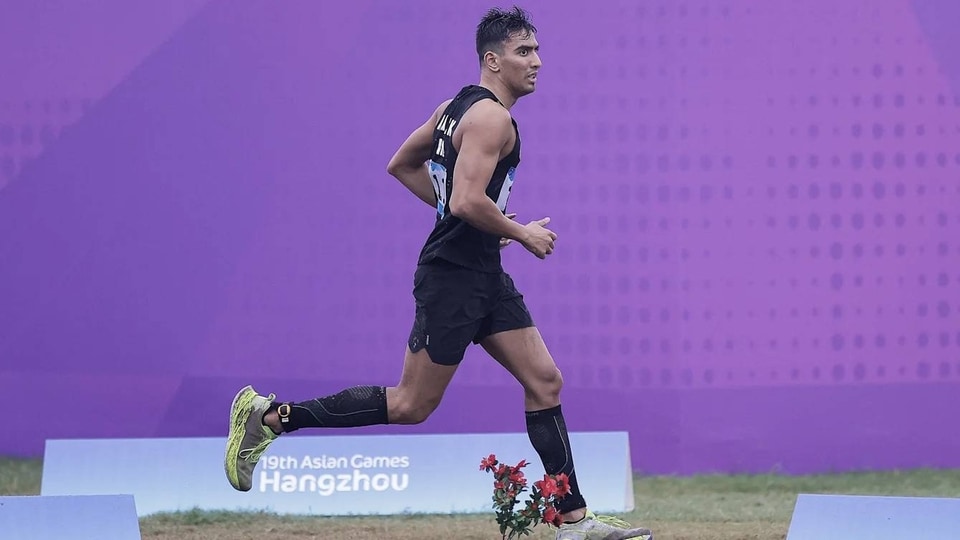
The National Games featured sub-sports of modern pentathlon, but it was the Maharashtra man’s experience in Hangzhou that his fellow participants in Goa wanted to pick up on. Modern pentathlon — the successor to ancient pentathlon that involves athletes compete in swimming, fencing, horse riding (show jumping) and laser run (combination of running and pistol shooting) — may have been part of every Olympics since 1912 yet it remains far from being established in India. It’s in this unique sport that Mayank became India’s first-ever representation at this Asian Games after initially not being named and going to court to earn his place in the contingent.
With 2024 Paris Olympics spots on offer in Hangzhou, Mayank had plenty to gain there. Sadly for him, a hit on his shin bone during the opening fencing event that resulted in a bloodied and swollen leg dampened his zeal. With nobody to turn to for the two-member Indian modern pentathlon contingent comprising the athlete and his father-coach Vaibhav, Mayank took some treatment from the rowing team’s physio to complete the rest of the events and sign off with 17 points and 27th spot.
“It was a really bad time for me," Mayank says. “The Asian Games was a big window for the Paris Olympics but the injury spoilt everything for me.”
After the National Games medal boost — “with an injured leg”, he says — and a three-week recovery period back home in Thane, Mayank and his father will fly back to Egypt to redraw training plans for next year, where a couple of tiny Olympic qualification windows for Paris still remain open in the form of performances in Challenger events to boost rankings and the World Championships.
The father-son duo has spent a large chunk of the last couple of years in Egypt, uprooting their personal lives — Vaibhav quit his engineering work days and Mayank his college hours — and digging into their personal finances while trying to excel at the world level in a sport they’d heard little about five years ago.
“First, I would casually say Olympics. Now I can actually feel it. That's a big change, in terms of my mindset and level," Mayank says.
Swimming since age five, Mayank competed domestically in the sport until his father thought of his son doing something “hatke (different)” rather than getting lost amid the crowd and competition in the pool. Having taken part in biathle and triathle meets before, Mayank chose to shift focus to modern pentathlon in 2018.
“I found this sport very interesting and challenging. If you play this sport, you have to be strong mentally, physically and spiritually," Mayank, who reads the Bhagavad Gita every day, says. “You have to swim, run, fence, shoot, ride the horse. You have to be a super-athlete.”
Finding out how to become that in India, though, was another question. That’s when Vaibhav, currently a level 2 coach and judge in the sport, decided to get fully involved in his son’s career. “The advantage of this sport was you can get a lot of exposure and can stand out. The biggest drawback was lack of knowledge, infrastructure and technology," Vaibhav says.
“It was like doing our own R&D (research and development) -- how to do it, how can we do it. I wasn't even able to hold a fencing sword then,” Mayank adds.
Finding the infrastructure to train in all five sports at one spot remained the biggest challenge, going from Delhi to Jaipur to Haryana to the Army Sports Institute in Pune until the Covid pandemic kept them home for a lengthy period. Two years ago, they knew that moving base to Egypt — home to multiple Olympians in the sport — was necessary in their quest to go to the next level. Making the Cairo International Stadium their base and living in a rented flat nearby, Mayank now trains with world-class athletes, including Tokyo Games silver medallist Ahmed Elgendy, while Vaibhav hones his own coaching skills.
“My progress after going to Egypt has been immense," Mayank says. "My training routine varies, because we have to give time for all five events. If mornings we do swimming and shooting, evenings are for fencing and running at alternate days.”
Cooking meals and household chores are part of the package, and Vaibhav’s kanda poha and butter chicken are a hit with the Egyptian athletes.
It’s a tough life, Mayank admits. “It's a gamble that we took while starting out in this sport. We didn't know where we were going, but we still jumped into it,” he says.
Without too many support systems at that. Vaibhav dug into his own savings to fund their adventure, while help also came from close friends and family; Vaibhav’s school group has created a group called “Mission Olympic Mayank". The national federation supports in whatever way it can, Vaibhav says, while the international federation handed Mayank a scholarship last year.
“It's very challenging. All my savings have gone into this, and I've also had to take some loans for this. Our job was to back Mayank and work hard; everything else is not in our hands," Vaibhav said.
Mayank relishes that sense of responsibility, and has outlined long-term goals. “The goal is to play three Olympics (2024, 2028 and 2032), three Asian Games (2022, 2026 and 2030) and be a top athlete in India in modern pentathlon and win medals," Mayank said.
“In the initial stage, we lacked experience in this. The Asian Games also taught us a lot," Vaibhav said. “In this trial-and-error phase, we have made it to a certain level. Now we can only get better at a faster pace.”


