
 E-Paper



Mould-breaker Hugo Calderano happy to chart his own path
He doesn’t fawn over football, speaks seven languages, and nails Rubik’s Cube in nine seconds. Meet Brazil’s champion paddler Hugo Calderano

 Prefer HTon Google


“Yeah, I get that asked a lot,” Hugo Calderano chuckles when asked how did he, a Brazilian, choose table tennis over football. The tapping, twinkling feet and the wide peripheral vision are reserved for ‘The Beautiful Game’ back home, but Hugo stands out as a pleasant anomaly.
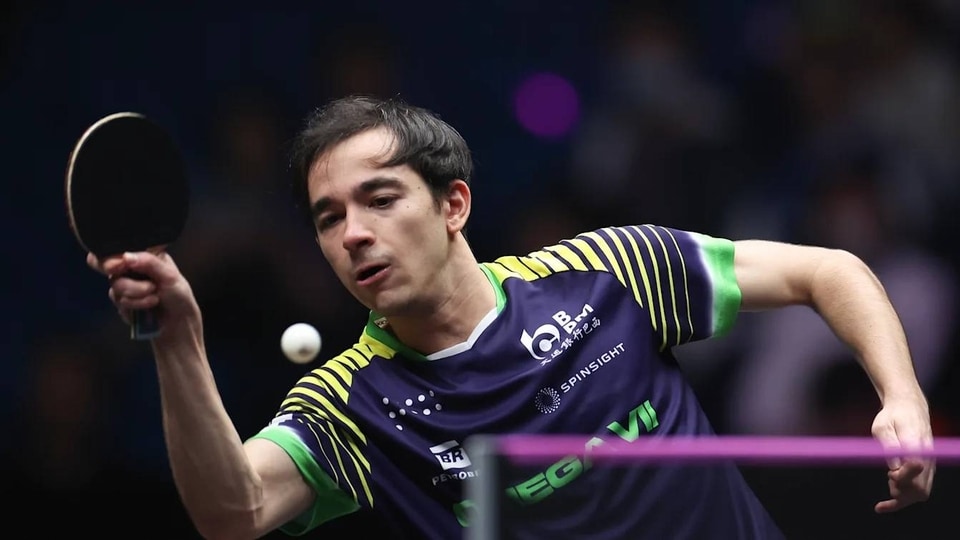
That though is not his only oddity. The 27-year-old paddler from Rio de Janeiro speaks seven languages (Portuguese, English, Spanish, German, Mandarin, French and Italian), solves Rubik’s cube in nine seconds flat, and idolises Rafael Nadal over Pele or Ronaldo.
“Every man is different. I like football but I was always more interested in volleyball. It’s the No.2 sport back home. TT grew on me in my pre teens,” said Hugo who was in India recently to compete in the WTT Star Contender Goa. Seeded top, the world No. 7 beat six-time Olympic medallist from Germany Dmitrij Ovtcharov en route the final which he lost to up and coming 17-year-old French sensation Felix Lebrun last Sunday.
Hugo’s tryst with TT began around the time he was eight. With his mother, father and grandfather being physical education teachers, sport was always a way of life in Calderano household. It helped that Hugo was always sharp – he began reading and writing by the time he was four and was stimulated by mathematical puzzles his parents threw at him.
“It was a very wholesome childhood. There was always an environment to play, learn, and grow. My parents wanted me to get into a sport for overall well-being,” said Hugo.
A natural at volleyball, Hugo also took an early liking to athletics. It turned out, he was good at both disciplines. Between ages 10 to 12, he was a member of the age-group Rio volleyball team and was also a pre-school state champion in the long jump.
“But my heart always was in TT. It involves mental application, fast movements, quick reflexes, power and precision. It is fast and exciting,” he said. By the time he turned 14, Hugo realised there were not enough clubs or sparring partners for him to hone his TT skills. It was time to pack bags.
“Rio is football-crazy. There were no systems for TT, and so I decided to relocate to Sao Paulo,” he said. Brazil’s bustling financial capital was also venue for the national camp for country’s senior TT team, and Hugo thought being in the city will eventually open pathways for him.
“The dream was always to play TT for Brazil. A lot of people doubted me, told me it would be impossible to have a future in TT but I was a bit bull-headed,” he remembered. Hugo credits his bloody-mindedness to tennis ace Rafael Nadal.
“I like Rafa’s mental strength more than his exceptional skills. He has come back from brink so many times in his career. He never gives up, which is something I try to imbibe.”
After spending four years in Sao Paulo, Hugo decided he needed to move on. The quality of sparring, coaching, as well as competitions was not challenging anymore and the youngster was in no mood to waste time.
“TT is an individual pursuit and every player has to fend for him/herself. I thought I wasn’t growing fast enough, and Europe appeared the obvious choice for the next move. I had heard about the thriving league structure there and wanted to experience it,” Hugo recalled.
He moved to Germany in 2014 -- he calls it the turning point of his life -- and signed up for Ochsenhausen in the first division of the German Bundesliga. Soon, his international career took off.
In 2015, he won two gold medals at the Pan American Games (individual and team) and a year later, made his Olympics debut in front of a roaring home crowd. Hugo’s run ended at the Round of 16 stage, making him only the second Brazilian after Hugo Hoyama in 1996 to go that far. Two years later, he entered the world top 10 and has never been out of the elite bracket since.
“A lot of things changed in Brazil because of Rio Olympics. State funding arrived for the national team and we had long camps in Asia. People began to notice our progress,” Hugo said.
At the Tokyo Olympics, Hugo became the first Brazilian to make the singles quarter-finals and also finished fifth at the World Championships the same year. A World Cup bronze followed soon after.
“I wouldn’t say there’s no relation between me moving to Europe and my international success. There were no systems in Brazil back in the day and even though my success has made some difference, if any youngster wants to make a career in TT in Brazil, they need to move out,” he said.
Hugo is not mistaken. The next Brazilian in top-100, Vitor Ishiy, is ranked 87th in the world. “We still have a very long way to go as compared to nations like China, Korea, or Japan. But one day, we will be there,” he said. An Olympics medal on his third try won’t be a bad start.


