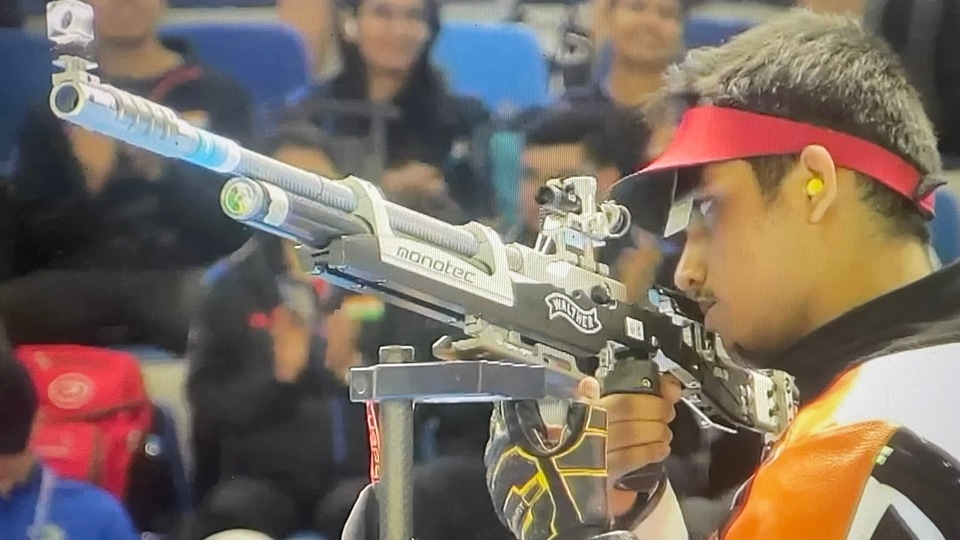
Shooter Rudrankksh Balasaheb Patil is a man of process. Not only does the current world champion and world No 1 obsess over it, the word almost puts him in a meditative state. In a brutally individual sport that measures perfection to cold decimal points, Patil's obsession with 'process' is par for the course.
Rudrankksh Balasaheb Patil is ISSF's world no. 1. (Twitter)
"It's nothing spectacularly different, to be honest. I strive to do the same thing over and over again till the process becomes routine. Even then, no routine or process is permanent, so you ought to keep evolving," the 18-year-old said from Cairo, a day after ascending to the top of world rankings following his gold in the 10m air rifle event at the ongoing President's Cup.
Patil beat Italy's Danilo Sollazzo 16-8, less than two months after beating him 17-13 in the World Championships final at the same venue.
It could have been an excellent birthday gift for Patil who turns 19 on December 16, except the teenager decided to dedicate his win to his parents.
"A day before my final was their wedding anniversary, so this one is my gift to them. Before leaving for Cairo, I asked them what they want from Egypt. All they wanted was a medal, so I am happy I could win one for them," Patil said.
This has been a successful year for the youngster who made his senior debut at the Cairo World Cup in March before turning up at the Baku World Cup in May-June. The gold medal at the World Championships earned him a quota for the 2024 Paris Olympics before Patil closed out the year on a high.
Patil credits his success to the relentless behind-the-scenes work. His journey to the senior side — and simultaneous self-discovery — began a couple of years back when, dejected at not being able to crack the Indian team, he decided to look inwards.
"When I started shooting, getting into the Indian team was very tough. Winning an international medal was just like playing the Nationals, such was the quality. Every shooter experiments with his/her technique and mindset, and it was the same for me, but nothing seemed to be working. I worked on my temperament, body language, everything... there came a time when except for my body language, nothing was improving."
"I started thinking about what was it that those on the team were doing differently. I started to introspect. Improvement became an obsessive quest. They say in order to master shooting, you need to master your life. Once I began thinking along those lines, there were a number of follow-up questions that eventually led me here. Something definitely clicked," he said.
It's tough for Patil to put a finger on that "something." He believes it's a combination of technical, psychological, and physical aspects syncing together to create a somewhat perfect, albeit transient, balance.
"Ours is a very dynamic sport. We try 100 things in training and there's a good chance that nothing will eventually work out. Even if something does work out, it stays relevant for a maximum of 2-3 years, so the need for research as reinvention is always there," he explained.
Such is the understanding of his own game that Patil has mastered the trick to calibrate his efforts vis-a-vis his performance in real-time, which means even if he is having a bad day, chances are that he'll assess his game under pressure and raise his level.
"I have a set of plans that I usually follow to maintain a certain level of performance. If I feel the performance is not good enough, I raise my effort. I know if I am working hard enough, I'll get the desired results. There's a performance curve that requires us to personalise our physical, mental, and technical performance. After a few years of practice, we identify a pattern, or a personalised process, which helps us give our best performance."
"When I take aim at the range, I don't think about my competitors at all. That bit of research is done in the training. I don't even think of the scores I am shooting. I just shoot," he said.
Still, hitting 10.9 — the benchmark of shooting perfection — is a little trickier than simply picking up the weapon and pulling the trigger. Patil shot two 10.9s in the final against Sollazzo, underscoring his flawless rhythm and redoubtable form. Once he had secured his place in the final with a 16-10 win over Patrik Jany, Patil settled to watch the other semi-final between Sollazzo and Istvan Peni. After Sollazo eked out a 16-14 win, Patil knew he had to be at his best in the final.
"When Sollazzo made it to the final, the first thought that crossed my mind was, he'd be raring to go against me to avenge his loss at the Worlds. He was shooting quite well too, so I knew I had to be on top of my game to beat him," he said. Patil managed to do just that.
Stay updated with the latest sports news, including latest headlines and updates from the Olympics 2024, where Indian athletes will compete for glory in Paris. Catch all the action from tennis Grand Slam tournaments, follow your favourite football teams and players with the latest match results, and get the latest on international hockey tournaments and series.
Home/Sports/Others/Of Process And Perfection: Rudrankksh Patil On His Rise To The Top

 E-Paper