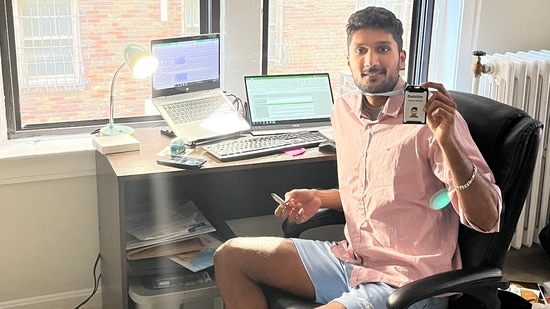
Tejaswin Shankar: Auditor, athlete and enjoying “that chaos”
India’s top high jumper and CWG bronze medallist is seeking a tough work-sport balance in the US; a new career as a Deloitte auditor with targets as a jumper/decathlete for the coming season.
On September 1, less than a month after winning bronze at the Commonwealth Games (CWG), Tejaswin Shankar landed in Kansas City with a job in hand but no roof over his head. Different scene to his five years at the Kansas State University, a couple of hours' drive from the city where the high jumper had everything taken care of. Now he had to hunt for a house, a process that was still on after a few days of staying with an acquainted Indian family.
India’s top high jumper and CWG bronze medallist is seeking a tough work-sport balance in the US
The next quick fix? His car. During the first week at work, Shankar spent a couple of nights cooped up inside his four-wheeler before he could be surrounded by walls instead of doors.
“Pura Will Smith aur The Pursuit of Happyness wala feel aaya (felt like Will Smith in The Pursuit of Happyness)—dressing up in my car and rushing to office,”
Shankar chuckles. “But it was a brilliant experience; kuch alag (something different).”
For a couple of months now, Shankar has been living the different life. Having joined as an auditor at Deloitte, the 23-year-old has upgraded to working athlete from student athlete. Such is the hustle that his CWG bronze and the build-up drama—Shankar was involved in a court battle with the national federation over selection and made a last-minute dash to Birmingham—is a blur. Forget flaunting the medal to his corporate colleagues, he has left it at home in Delhi.
“I don’t even remember that phase now,” he says. “I have a lot more to do.”
A 9 to 5 job—“except, it’s not always 9-5”—auditing books of accounts in office or client sites while squeezing in training sessions before and after that.
It’s an unconventional routine for an elite Indian athlete. His own coach questions whether it can be sustained, but Shankar wants to give it a shot for a year. “I just feel like I wanted to give it a try. Ho jaunga fail (I might fail), but at least I’ll have this experience.”
An early piece of Shankar’s work-sport balance puzzle was finding a 24x7 gym--“lifting and strength training is an integral component” of his training chart--which allows him to work out even late nights. For training sessions during the week, he checks into the nearest high school track but with the winter setting in, he’ll have to soon travel an hour to an indoor track in Lawrence. On Friday evenings, it is an over two-hour drive to Manhattan, Kansas, to train with coach Cliff Rovelto in the two-time NCAA champion's old set-up before returning on Sunday nights.
“Time management comes into play here,” Shankar simplifies the crazy. “For track, some days if I’m travelling for site visit, I make sure I get up at 4.30-5am and get the routine done and then come back and lift. Every day is a different routine. It’s still a work in progress. Until this point, I’ve been able to manage it. It’s a daily struggle, but ultimately it’s about how badly you want it.”
Shankar does, even though his methods may not align with the single-minded, distraction-free approach of a typical Indian elite athlete.
For instance, he would invariably compare his path with role model Neeraj Chopra, until he realised in his second year of college that though his end goal is similar to the Olympic champion's his journey is different.
“His background is totally different,” Shankar says. “I came from a privileged family, went to school, trained for fun. For me, balancing academics and sports was always the case. Neeraj said he would train for eight hours a day. I didn’t have that option—karta toh pitaji dande se bhaga dete (if I had done that, my father would have chased me away with a stick).
“I realised my journey is different, and the way I’ve found my success in sports is by balancing it with whatever else I’m doing; be it school or college. I realised that is my strength. Till I don’t multi-task, I don’t get that satisfaction. I need that chaos.”
Chaos is what attracted him to decathlon during college, an urge to keep “learning something new” and become a “better athlete”. On his decathlon debut at the Big 12 Conference in Texas in May amid the jumps, he finished third with a creditable 7,592 points.
Shankar’s big goals for the next season involve competing in decathlon at the Asian Championships and Asian Games, and high jump at the World Championships in Budapest. For the latter, he aims to qualify by competing in more ranking events in Europe next season; for the former at the Federation Cup.
“For decathlon, at the Asian level, from the points that I scored, I feel I have a good shot at being in the top three,” he says.
His sessions currently are more about building a strong base for both. Shankar says the criticial phase in his juggling act will be January to May when he’ll not only have to train for the technical elements of the events but also travel to compete. “That’s when we'll figure out how much time to devote to what,” he says.
At times, Shankar feels overwhelmed thinking about that prospect. At times, thoughts deviate scrolling through social media and seeing the images of fellow athletes attending functions, award ceremonies and celebratory events in India.
“That's when I think, kaha mein idhar aake audit kar raha hu (what am I doing here auditing),” he says.
“But again, I chose this life, and I’m enjoying it so far.”
Stay updated with the latest sports news, including latest headlines and updates from the Olympics 2024, where Indian athletes will compete for glory in Paris. Catch all the action from tennis Grand Slam tournaments, follow your favourite football teams and players with the latest match results, and get the latest on international hockey tournaments and series.
Home/Sports/Others/Tejaswin Shankar: Auditor, Athlete And Enjoying “that Chaos”

 E-Paper