
 E-Paper



Carlos Alcaraz vs Novak Djokovic: A test of endurance in the battle for history
Djokovic and Alcaraz face off in the Australian Open final, battling recovery and endurance after grueling semi-finals, with history at stake.

 Prefer HTon Google


Mumbai: How do you even top the high that the semi-finals delivered, individually as men and collectively as a spectacle? How does a 38-year-old, still speaking about his match at 3am in Melbourne less than 36 hours before the final, turn up for another battle? How can someone 16 years younger, although after a bruising five-and-a-half hour marathon where he could barely run at times, recover for the last stretch?
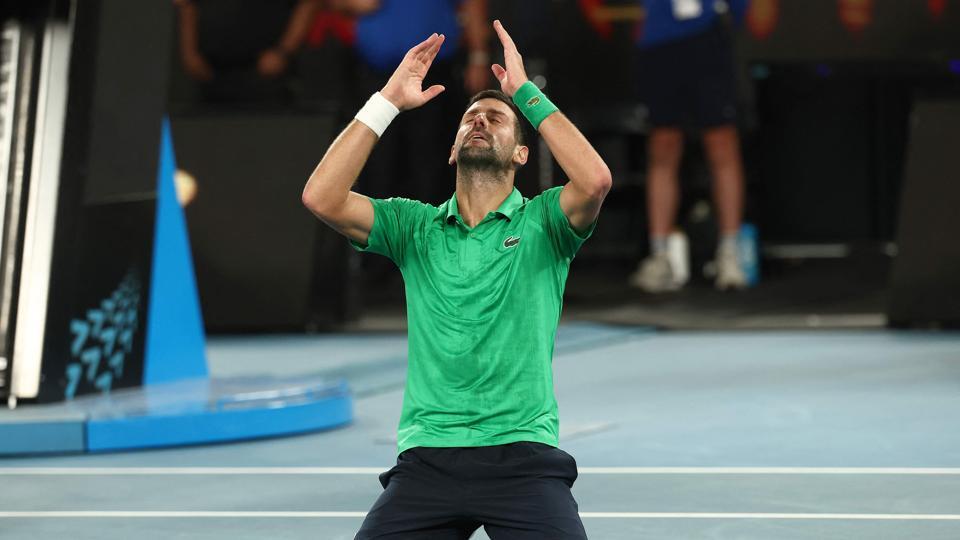
“I don’t know,” said Djokovic. “I cannot make any predictions right now.”
“We’ll see,” said Alcaraz. “Hopefully, it’s going to be nothing at all.”
At either end of the youngest and oldest extremes, there’s history on the line in the Australian Open final on Sunday. But also overlapping questions of recovery, endurance and strength that could have a decisive say on which way it sways.
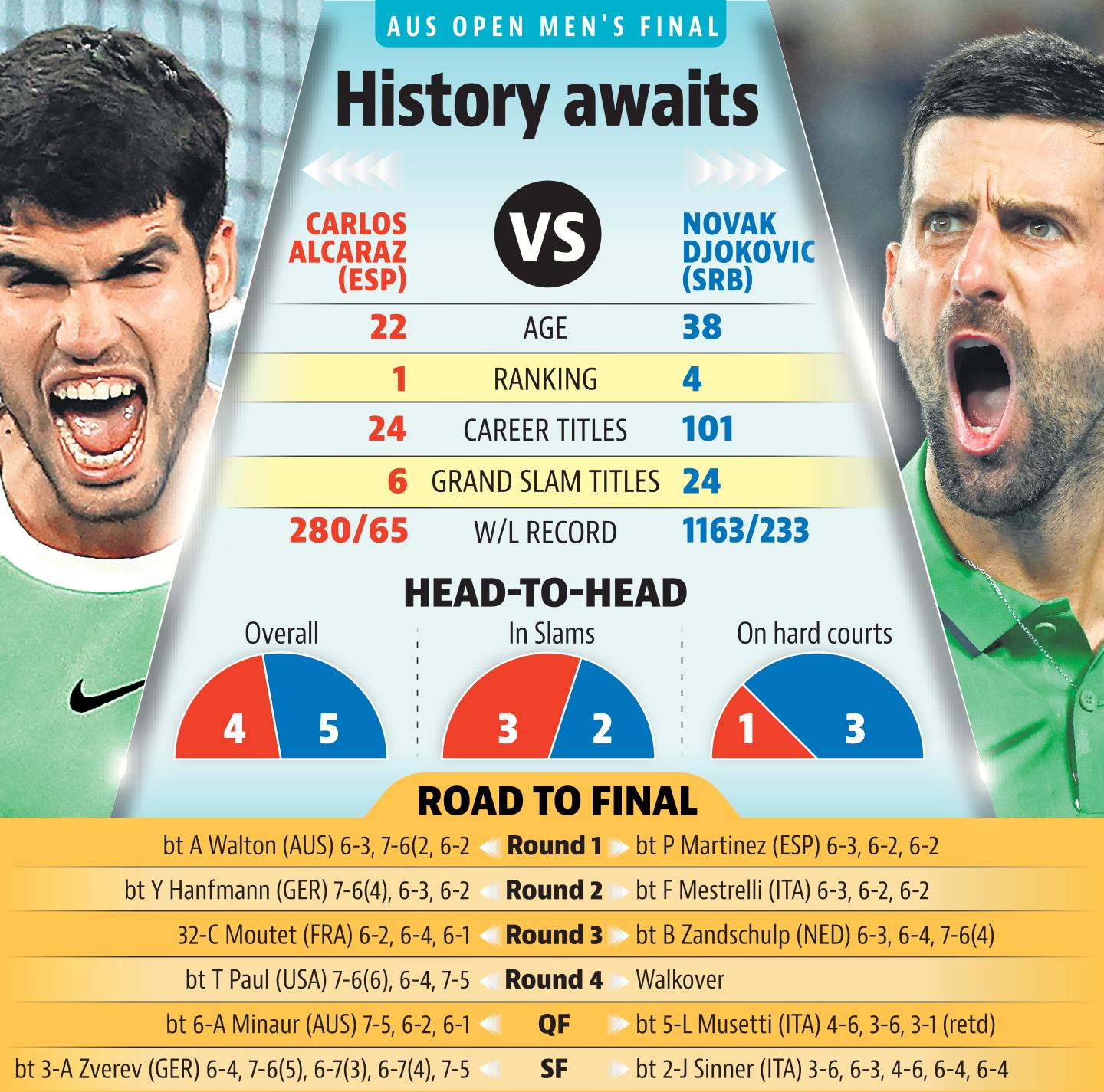
At 22, Alcaraz is one win away from completing the full major set, which will make him the youngest to tick off the career Grand Slam.
To summarise how much this means to him, the Spaniard, asked to pick between winning this one and all of the next three Slams this season, chose the missing crown Down Under. To contextualise how much this has taken out of him, the first-time Australian Open finalist, speaking during the second semi-final that went on till 2am, said he’ll have to spend a good part of the night taking ice baths and treatment from the physio.
Alcaraz had the more physically demanding outing on Friday, and after five hours and 27 minutes of going the distance with Alexander Zverev, felt his “body could be better”. A medical time out raised injury concerns, as Alcaraz initially thought was the case until realising it was cramp. The muscles will remain tired on the final eve, he reckoned. “And I’ve got to do whatever it takes to be as good as I can for the final.”
That would also apply to his opponent, the oldest men’s singles finalist at the Australian Open in the Open era bidding to capture what no tennis player ever has – a 25th Slam.
His slugfest with Jannik Sinner, a shade over four hours, played out into the wee hours of Saturday. His recovery test, at 38, could thus potentially be more complex.
“Just going to use every hour I possibly can to recover,” said Djokovic. “And hopefully get out on the final day feeling somewhat refreshed.”
What works in his favour is that Djokovic played just two full sets in his fourth and quarter-final round. And unlike Sinner with whom his recent contests slanted only one way before he pulled one back, it’s somewhat balanced against Alcaraz.
The Serb sits on a better head-to-head count (5-4) against the Spaniard, which gets stronger on hard courts (3-1). Alcaraz beat him in their most recent meeting, a straight-sets clinical job against a gassed-out rival at last year’s US Open semi-final. Djokovic beat him in their meeting prior to that, a composed turnaround from one set down at last year’s Australian Open quarter-final.
Compared to Sinner, Alcaraz offers a better matchup to Djokovic. The world No.1’s flashy game is not immune to going through phases of ups and downs through a match, and the 10-time Australian Open champion is experienced enough to seize on that, more so on hard courts.
But compared to Sinner, Alcaraz offers more variety for Djokovic to counter. Once Djokovic had settled into a clean striking rhythm, especially off the forehand, in the semi-final, the balls coming back from across the net were a bit too one-dimensional in their speed, angles and trajectory. Alcaraz, of drop shots, slices and volleys, will be anything but that.
Djokovic will have to be prepared to run up and down the court. Alcaraz side to side. Will they have the legs to do that all over again after those two epics could be the central determining factor.


