E-Paper



And slowly fade the legends--Djokovic, Ronaldo, Woods...
There is something unsettling about watching a sporting legend flail and fail, like Djokovic against Alcaraz in the Wimbledon final

 Prefer HTon Google


New Delhi: It wasn’t so much the defeat as the manner of it. Carlos Alcaraz didn’t just beat Novak Djokovic in the final of Wimbledon. He crushed him. The Serbian was never in it – not in the first set when he was dumping easy volleys into the net, not in the second when Alcaraz was cracking winners on all flanks, and not even in the third when the 24-time Grand Slam champion saved three match points to force a tiebreaker.
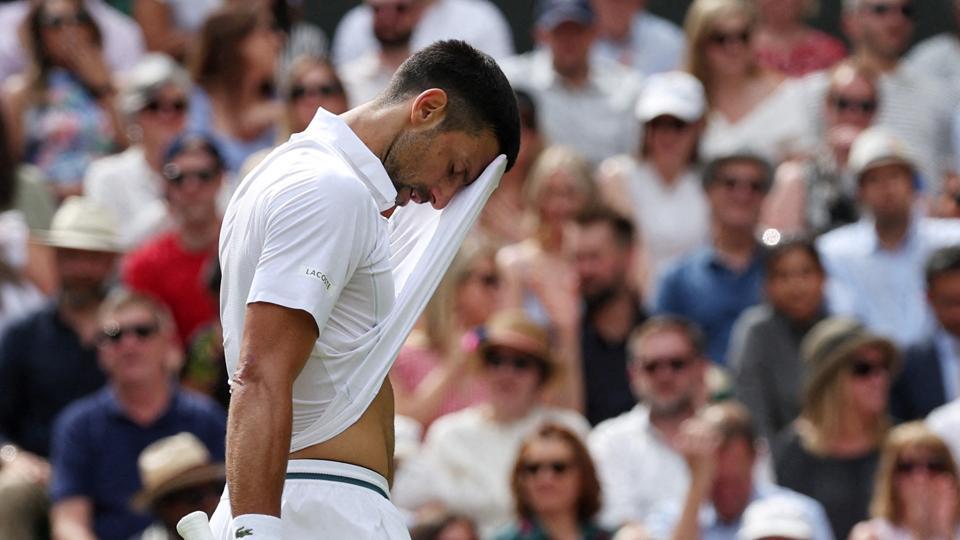
There is something odd and unsettling about watching a sporting legend helplessly flail around and fail. Even if they are at an age, as Djokovic is at 37, when most other athletes who started off with them are starting to take up coaching or places in the commentary box.
It is a question that is often asked in relation to teenage geniuses – what were you doing when you were their age. Perhaps it can be asked for the older legends too, athletes who have seemingly defied time and all that comes with it.
Great athletes set a standard for the rest to follow. They have defined their careers with major wins and records, and in turn, those accomplishments have defined them. What is true of Djokovic is also true of Tiger Woods (38), Rafael Nadal (38). Cristiano Ronaldo (39), and perhaps even Lewis Hamilton (39) who only recently won his first F1 race since 2021.
These are legends that defined their sport, some might argue that they continue to still do so. They have dominated conversations, they have set the tone, they have pushed the bar higher but now they are perhaps a step slower and the reactions aren’t quite what they used to be.
It isn’t much but, at the highest level, it’s enough.
Ronaldo, for instance, has scored 64 goals in 70 matches for Al Nassr since joining the Riyadh-based club in the Saudi Pro League. But at Euro 2024, his drawbacks were painfully evident.
Put a regular 39-year-old in there with Ronaldo and the Portuguese legend will probably run circles around him. But the ones going up against him are younger, fitter, stronger and motivated. After all, who doesn’t want to take down a legend?
It is starting to feel like a changing of the guard because fans have become used to the idea of these guys doing the incredible and doing it for so long that it became the norm. Anything else feels like a drop.
Djokovic, for example, reached the Wimbledon final a month after having knee surgery. For most other athletes just playing the tournament would have counted as a victory but the Serbian didn’t just want to compete, he wanted to win. And when he didn’t, his fans were disappointed too.
A 2013 study by Sports Interaction found that in most major sports the average career length is less than six years. It is, of course, different in individual and team sports. In the MLS, for instance, players average 3.2 years; NFL: 3.3 years; NBA: 4.8 years, NHL: 5 years, MLB: 5.6 years, Tennis: 8.5 years, PGA: 10+ years. On average, professional athletes retire at the age of 33 and not everyone finds success.
So, just by virtue of being around for so long, they have already defied the odds. Woods’s career began in 1996, Nadal’s in 2001, Ronaldo’s in 2002, Djokovic’s in 2003 and Hamilton’s F1 debut was in 2007. They have become part of the very fabric of sport.
But a generational shift is inevitable and it now feels like a major one is upon us. Lionel Messi is 37 but he’s still winning and his move to the MLS has worked out for him, more than perhaps Ronaldo’s move to Saudi.
In the end, it is always the punch a fighter does not see that hurts the most. Sometimes, you recover. Sometimes, you throw in the towel.
This is a dream that they have all nurtured for years and now it increasingly feels like they must wake up to the reality; a reality without sport; without them ruling their sport.
But that doesn’t mean they will go down without a fight. They might, as Roger Federer showed us in 2017 and 2018, find a brief second wind that will have many believing again. And if that happens, for a while it will feel like sport itself has rolled back the years.