
 E-Paper



How Jannik Sinner caused Alexander Zverev to run out of ammunition in the Australian Open final
Jannik Sinner became the third male player in this century not to face a single break point in a Grand Slam final

 Prefer HTon Google


During the semifinal match against Novak Djokovic, one of the commentators highlighted the two sides of Alexander Zverev's forehand. It has been a weapon for destruction for the German throughout his career, where he reached two Grand Slam finals, but it was pointed out that the moment he fails to find a measure of his forehand strokes, it affects him mentally.
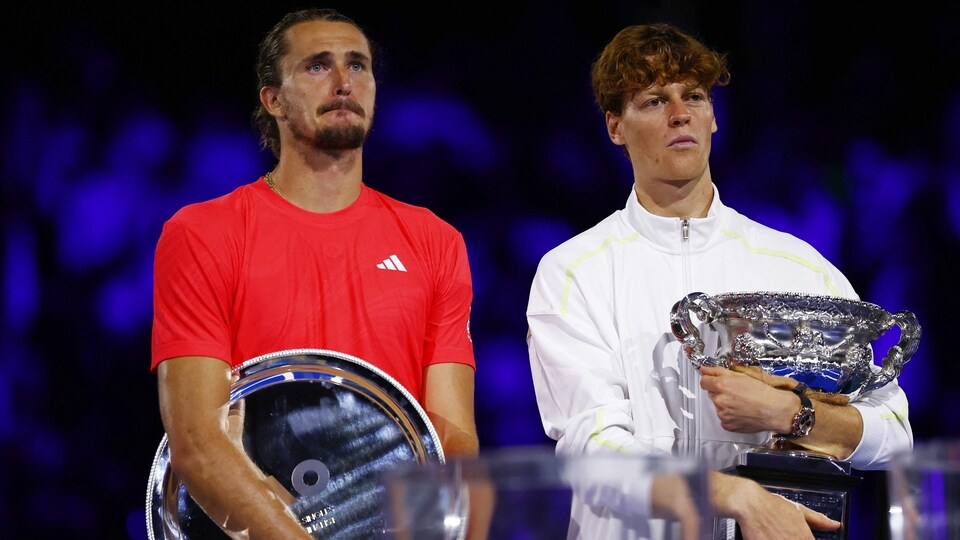
In the solitary set against Djokovic on Friday, Zverev did not look at ease with his forehand, recording 21 errors, despite escaping with a 7-6 win against the injured Serb, who then retired from the match, sending him into his third Slam final. But there was no escape for the second seed on Sunday.
Amid the nerves of playing his first final in Melbourne, and having suffered a defeat in his previous two attempts at having his hands on a major, Zverev's forehand faltered thrice in the opening game. The tally reached to 15 at the end of the opening set, where he was broken at 3-4, and 36 at the end of a straight-set loss. He managed just three winners of his forehand.
While the conversation in the lead-up to the final was about the importance of Zverev's serve, Jannik Sinner was immaculate in that department, winning 85 per cent of points behind his first delivery. He did not face a single break point, making him the only third player in this century not to face a single break point in a Grand Slam final after Roger Federer (2003 Wimbledon) and Rafael Nadal (2017 US Open). The German, on the other hand, found himself fending off challenges on serve. While he got more first serves in (68 per cent compared to Sinner's 60), he won just 69 per cent of points behind it.
The closest Zverev came to getting a breakpoint was when he led 6-5 on Sinner's serve. At 30-all, he seemed to have had the momentum until Sinner stunned the Melbourne crowd at the end of a 21-shot rally, which helped him force a tie-break. It was here where another moment of opportunity was created for Zverev until an unfortunate net cord saw Sinner make it 4-4 and there was no looking back for the three-time Slam winner.
For Zverev, the other factor that could have decided the match in his favour was drawing Sinner into longer rallies. But it was the 23-year-old who emerged on top in rallies of nine or more shorts, winning 15 (29-14) more points in such exchanges. The difference was of four points (27-23) for mid-length rallies (4-5 shots) and five (51-46), both in favour of Sinner.
Sinner expertly limited Zverev’s ability to attack from the baseline. According to the ATP website, 220 points were played from the baseline, and Sinner won 59 per cent of those points. This left Zverev venturing towards the net more often than Sinner and more often than in any other matches he played in Melbourne this time, but he failed to find his momentum as he lost on 13 of those 27 occasions. Sinner, on the other hand, won 10 of such 13 points.


