
 E-Paper



Lava inaugurates new charger manufacturing facility in Noida, eyes bigger localisation push
Lava opened a new Noida charger manufacturing unit to reduce costs, expand localisation, and strengthen India’s smartphone supply chain.

 Prefer HTon Google


Lava inaugurated its new Component and Charger Manufacturing Unit at the company’s Noida facility on Tuesday, 21 May, marking another major step in its push towards deeper local manufacturing. The facility was inaugurated by Sunil Kumar Sharma, Minister of Electronics and Technology, Uttar Pradesh, and is expected to produce nearly nine million components annually.
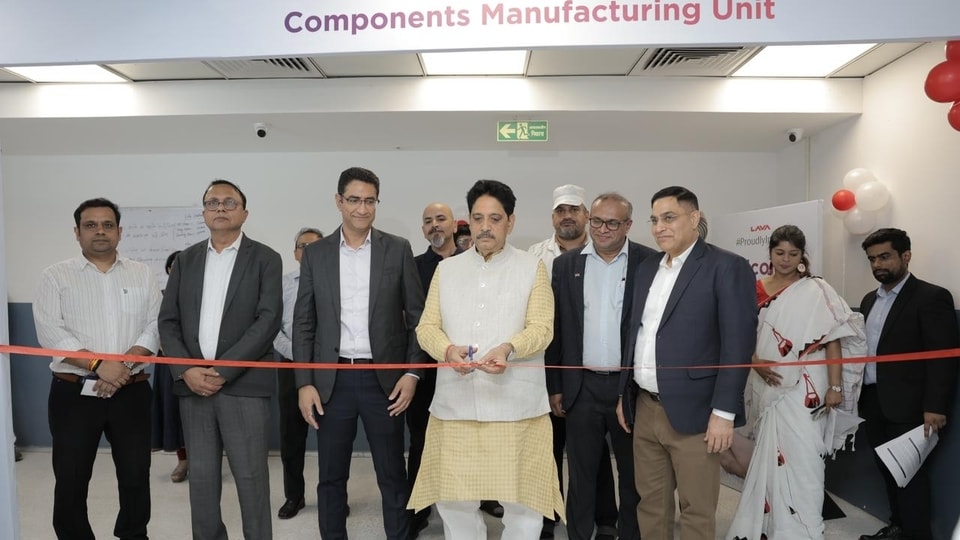
Lava already operates one of its largest manufacturing hubs in Noida, with an annual production capacity of 42.52 million smartphones. The company currently employs more than 3,000 people across its operations. During the event, Lava also emphasised its growing focus on end-to-end product development in India, stating that all of its devices are designed domestically. The company runs two dedicated research and development centres alongside its manufacturing facility, handling both hardware and software development within the same ecosystem.
The newly launched unit represents more than an expansion of production capacity. It also reflects Lava’s broader strategy to gradually localise key smartphone components, reduce dependence on imports, and strengthen its role within India’s growing electronics manufacturing sector.
Future Plans and Local Production
The new facility forms part of Lava’s long-term roadmap to increase local value addition and align more closely with the government’s Make in India initiative. Speaking during the interaction, Sanjeev Agarwal, Lava’s Chief Manufacturing Officer, said that charger manufacturing is only the first step in a much larger localisation strategy.
According to the company’s plans, Lava aims to increase local value addition by three to five per cent each year. Over the next five years, the company is expected to invest close to ₹1,100 crore to further expand its domestic manufacturing operations. These investments could include local production of smartphone display panels, camera modules, printed circuit boards, and smartphone casings.
If executed as planned, the expansion is projected to create nearly 8,500 additional jobs in the region. The move also reflects a wider shift within India’s electronics industry, where brands are increasingly seeking to build stronger local supply chains rather than relying heavily on imported components.
Managing Prices and Supply Chains
The discussion also focused on the unpredictability of global supply chains and whether local manufacturing could help shield Lava from sudden cost fluctuations. Reporters asked whether producing more components in Noida would eventually help stabilise smartphone pricing for Indian consumers.
In response, Sanjeev Agarwal explained that local manufacturing has already delivered financial benefits for the company. He revealed that producing chargers internally has reduced costs by nearly 20 per cent. According to him, these savings allow Lava to maintain aggressive pricing in the market while improving overall profit margins.
At the same time, Agarwal acknowledged that not every component is insulated from global market volatility. He noted that the international memory market is controlled by only a handful of major companies, making it difficult for smartphone brands to avoid sudden price swings.
As a result, if global memory prices increase sharply, companies like Lava may eventually have to pass some of those additional costs on to consumers through higher smartphone prices.
Improving Phone Quality
Lava also stated that tighter control over design and manufacturing could directly improve the quality and reliability of its future smartphones. Company executives explained that manufacturing components locally enables the brand to monitor production standards more closely and maintain greater consistency across devices.
The new manufacturing facility reportedly follows Six Sigma practices across its production lines to improve precision and minimise defects. By handling product design, software optimisation, and component manufacturing within its Noida ecosystem, Lava believes it can deliver a more refined and reliable user experience.
State Government Support
The inauguration event also highlighted Uttar Pradesh’s broader efforts to attract electronics and technology manufacturing investments into the state. Speaking at the event, IT Minister Sunil Kumar Sharma outlined the government’s incentive strategy for companies investing in component manufacturing.
According to Sharma, Uttar Pradesh will match the Central Government’s 50 per cent financial support for electronics component manufacturing projects under the state’s new industrial policy. However, he clarified that the incentives would operate through a production-linked structure. Companies will first need to invest their own capital and establish operational facilities before receiving subsidies tied to actual production output.
When asked whether the state had imposed an upper limit on such incentives, Sharma stated that there is currently no fixed cap. He added that the Uttar Pradesh government is prepared to match whatever level of support the Centre approves for projects within the state.
The minister also discussed Uttar Pradesh’s larger ambitions for the technology sector beyond the Delhi-NCR region. As part of that vision, the state plans to establish an AI City in Lucknow and a Drone City in Kanpur. Sharma further noted that Uttar Pradesh’s overall state budget has grown to ₹9.12 lakh crore since 2017 without introducing any additional taxes.


