In this edition, we chat about Google’s offer for a free AI Pro subscription for students in India, what exactly is the status with Windsurf (at least at the time of writing this), and Meta’s Prometheus project and what it means for the still vague superintelligence conversations.
Google's free AI, but what does free mean?
Google launched a free one-year Gemini Pro subscription for Indian students (mind you, must be above the age of 18, with a valid student ID and a working university email address), basically the Google AI Pro plan that includes access to premium tools including Gemini, Gemini Live, Deep Research, NotebookLM (with 5x limits), Gemini Live, Veo 3 for AI video creation, and AI integration across Gmail as well as Docs, and 2TB worth of cloud storage space on Drive. This looks great value on paper, and for 12 months, it certainly will be – it's strategic attempt at cornering the market. Google is hoping an entire generation of Indian students, who’d grow up to perhaps become developers, researchers, and entrepreneurs, pledges allegiance to its AI ecosystem. Much like enterprise business, and every bit of that is a long term bet. Think of it this way, once you start using Google AI Pro, the chances of going back to a Google One plan that’s inferior, reside between little and zero. And that’s when students or their parents will be spending ₹19,500 annually, to continue the subscription. Students must register by September 15 this year. Expect more AI companies to release similar offers for students in India.
Neural
Windsurf wars, AI's billion-dollar thriller
Silicon Valley witnessed its most dramatic corporate saga this week as AI coding startup Windsurf became the center of a multi-billion-dollar acquisition battle involving every major tech giant. OpenAI's planned $3 billion acquisition of Windsurf collapsed in mid-July (Microsoft may have had something to do with it, as was the public displeasure expressed by Windsurf model-provider Anthropic). The collapse triggered a domino effect that revealed the brutal dynamics of AI competition. Google swooped in immediately, hiring Windsurf CEO Varun Mohan and co-founder Douglas Chen along with key staff for its DeepMind unit in what sources describe as a $2.4 billion deal — think of this as not a formal acquisition but a licensing agreement plus a hiring deal. Google did not buy Windsurf. It poached talent and licensed IP, which may or may not be exclusive. But the story didn't end there. Cognition, maker of AI coding agent Devin, announced it would acquire Windsurf's remaining intellectual property, product, trademark, brand and talent, effectively splitting the company between Google and Cognition. The saga is somehow (most likely an unintended consequence) illustrating how AI model access has become a weapon: Anthropic cut Windsurf's direct access to Claude models because of OpenAI acquisition rumours, with co-founder Jared Kaplan stating "it would be odd for us to be selling Claude to OpenAI". For businesses, this perhaps reveals fragility in AI supply chains – access to critical models can be used as leverage.
Meta's Prometheus, and a super-intelligence timeline
No one knows what exactly super-intelligence will be like, or when it’ll truly see the light of the day. But well, that’s keeping the AI system busy these days, and so be it. Meta says its 1-gigawatt AI supercluster "Prometheus" will come online in 2026, making it one of the first tech companies to control an AI data center of this scale. Mark Zuckerberg revealed plans to spend "hundreds of billions of dollars" on AI infrastructure, with Prometheus part of a larger initiative to build multiple multi-gigawatt clusters. This supercluster is located in New Albany, Ohio Meta's bid for AI supremacy, chapter 2? The scale is unprecedented, mind you – 1 gigawatt could power 700,000 homes. This clearly isn't just about better chatbots; it's about training models that could achieve artificial general intelligence, or AGI. For businesses, it could signal AI capabilities will soon dwarf current limitations, and optics may well work for AI companies in the meantime. The investment also reveals Meta's long-term vision: controlling the infrastructure that powers the next generation of AI, potentially becoming the "electricity company" of artificial intelligence. The arms race is intensifying – OpenAI, Google, and Microsoft are all racing to build similar mega-clusters, suggesting the next phase of AI development will be defined by raw computational power working alongside algorithmic innovation.
PROMPT
AI
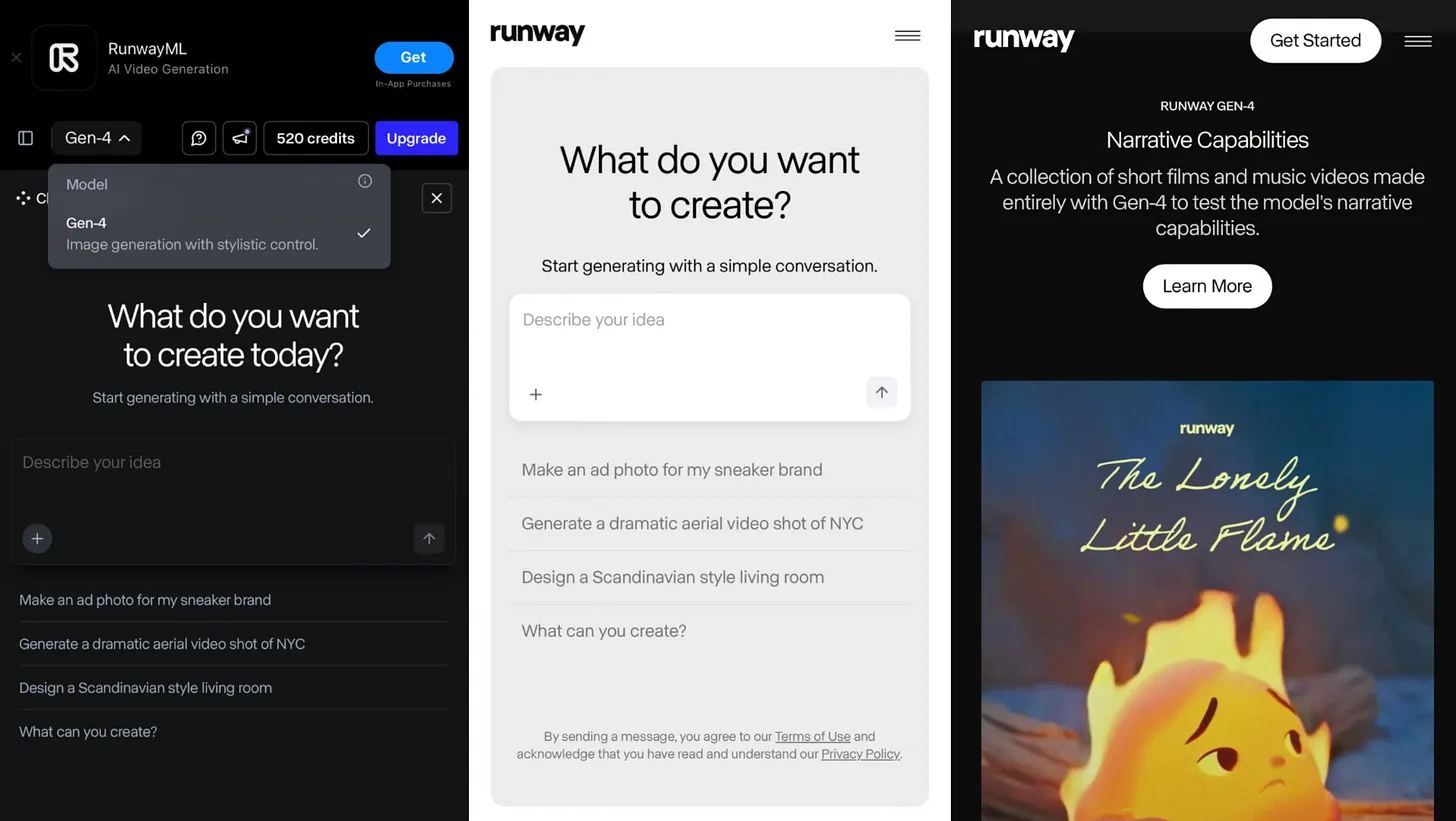
This week, we’ll chat about an AI tool called Runway ML's Gen-3 Video Generator. This AI tool can be used to eventually create what may be called as ‘professional-quality’ videos, from the text prompts or images that you provide. Runway’s AI subscription tiers start with a free one that includes a one-time credit bundle for generations, but for anything genuinely useful, you’ll be paying either $12 per month for the Standard plan (access to Gen-4 and Gen-3 models with 625 monthly credits and 100GB storage), $28 for the Pro plan (adds custom voices for lip-sync and text to speech as well as 500GB storage), or the top-tier Unlimited plan for $76 that, as the name suggests, that gets you unlimited generations of Gen-4 Turbo, Gen-4 (Image and Video), Gen-3 Alpha Turbo, Gen-3 Alpha as well as Act-One in Explore mode (though not the newer Act-Two).
Here’s how you go about it > Choose your input method: Text prompt (For instance: “A golden retriever playing in a park at sunset") or upload an image to animate > Set parameters such as duration, aspect ratio, and style preferences > click on Generate.
Even after the generation, you can still further refine the generation, by editing the original prompt. Along the way, detailed prompts that mention what sort of lighting, camera angles, and movement you want, will get the generation closer to what you want — for instance, “close-up of hands typing on a MacBook, soft morning light, shallow depth of field" works better than "person typing on a laptop.”
Keep in mind: Human faces still have visible inconsistencies (that’s a common fixture across video generation models), as do any generations of a product (if it is a phone for instance, app icons may look weird). Secondly, be careful what you use it for though, because platforms such as YouTube will certainly give less weightage to content that is AI generated. Interesting use-cases may emerge though, in the workplace.
THINKING
“Models like DeepSeek, Alibaba, Tencent, MiniMax, and Baidu Ernie bot are world class, developed here and shared openly [and] have spurred AI developments worldwide.”
Jensen Huang, NVIDIA CEO, at the China International Supply Chain Expo in Beijing, July 16, 2025
The context: Huang made these comments, just as Nvidia announced it will resume sales of its H20 AI chips to China. The timing isn't coincidental. Huang also called China's open-source AI a "catalyst for global progress" and said it is "revolutionising" supply chains. This comes from the CEO whose company last week became the first to touch $4 trillion in market value – largely thanks to AI chip demand.
A reality check: Huang's statement can be seen as a direct contradiction of the narrative and indeed the policy in the US, where export controls are very much in place. By publicly acknowledging Chinese AI models as "world class," is Huang hinting (or challenging the Trump administration?) that restrictions haven't really worked? Huang's praise for Chinese companies specifically references an open-source approach to AI, a stark contrast to the closed and proprietary model approach that most big tech companies in the US and elsewhere have followed. The question therefore is — if Chinese AI models truly match Western capabilities while being open-source, why would consumers, businesses and enterprises pay premium subscription prices for something from OpenAI or Anthropic or Meta? The fine distinction here is, and you may have noticed I’m not including Google in the list, because their Workplace bundles add a lot more to the platter.
Think of Huang's praise as part diplomatic politeness, and part strategic positioning. Earlier this year, he warned that "China is not behind" in AI and called Huawei "one of the most formidable technology companies in the world". Does this lend credence to an argument that the global AI landscape is multipolar, not American-dominated, as is often perceived to be?
Neural Dispatch is your weekly decoder ring for the AI revolution. Forward this to a colleague or a friend who needs to understand what's really happening in artificial intelligence.
Vishal Mathur is Technology Editor for Hindustan Times. When not making sense of technology, he often searches for an elusive analog space in a digital world.
Stay updated with the latest Technology News, gadget launches, app updates, artificial intelligence and digital trends. Find reviews, comparisons and useful insights from the world of tech.
Home/Technology/🧠 Neural Dispatch: Google’s Student Outreach, Jensen Huang’s Praise For Chinese AI, And Meta's Prometheus

 E-Paper