
 E-Paper



This 60-year-old algorithm made modern tech possible, from CT scans to AI to apps on your phone
Developed six decades ago, the Fast Fourier Transform transformed signal processing and still underpins innovations from 5G to AI.

 Prefer HTon Google


It’s not often one algorithm shapes the entire arc of modern technology, but the Fast Fourier Transform (FFT) has done exactly that. Created by researchers at Princeton University and IBM in the early 1960s, the FFT underpins everything from streaming video and audio to medical scanning and the backbone of AI and 5G networks. Even after six decades, this slice of genius is just as vital to today’s digital age as it was when John Tukey and James Cooley first unveiled it.

The heartbeat of digital processing
Before FFT arrived, signal analysis was painfully slow. Engineers struggled with the discrete Fourier transform (DFT) which was both slow and memory-hungry. That’s when John Tukey, a Princeton mathematician, and James Cooley, an IBM researcher, demonstrated the FFT in 1964. And it was a revelation: this mathematical technique broke down signals into frequencies a hundred times faster than anything before.
Why was this so crucial? The world was looking for ways to make sense of data hidden in time-based signals - think of sound or seismic waves. Initially, the work was about detecting underground nuclear tests, a project for John F. Kennedy’s Science Advisory Committee. Richard Garwin at IBM saw the potential and encouraged the collaboration that became the Cooley-Tukey FFT. With FFT, seismometers could detect nuclear activity across continents, and the groundwork was laid for digital sensing, imaging and much more.
The FFT’s fundamental trick is to turn complex data into manageable chunks by converting time-based signals into the frequency domain. This efficiency saves processing time, reduces memory usage and allows modern devices to do things we now take for granted: clean up noisy audio, compress videos, beam high-speed wireless signals and even let medical imagers cut through the body with accurate CT scans.
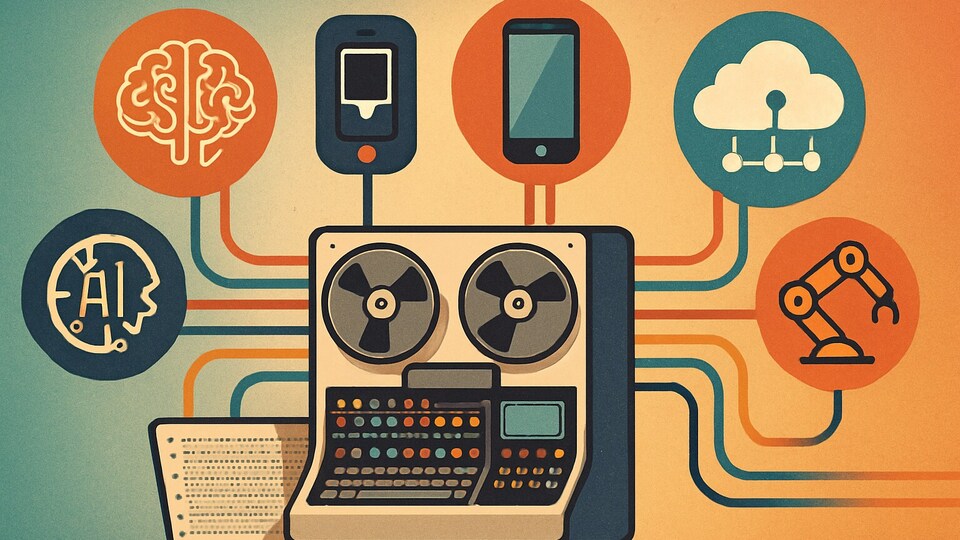
Today, FFT is baked into AI frameworks, quantum computing experiments, autonomous vehicles and the inner workings of 5G and beyond. Major tech like real-time data streaming or digital broadcasting simply wouldn’t exist without it.
The FFT’s story is a lesson in teamwork between academia and industry. The original code came out of joint efforts at Princeton and IBM, and the work was quickly recognised with major awards for both Tukey and Cooley. On its 60th anniversary, IEEE celebrated the FFT as a milestone, with plaques now on display at both institutions. It’s a reminder that great ideas that are built with clarity and cooperation leave a legacy that can outlast even the fastest-moving tech revolutions.


