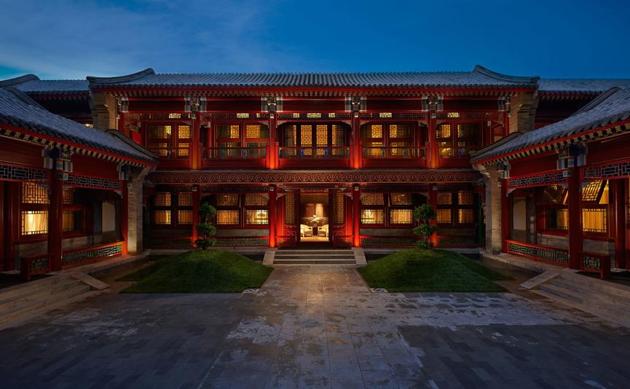
A stone’s throw away from Beijing’s Tiananmen Square — where, 70 years ago, Mao Zedong proclaimed the foundation of a new, communist China — lie the remnants of a world he despised. In the narrow alleyways called hutongs, standing grey-bricked and impervious to change, are the single-storey town houses built to house the nobility about 700 years ago.
Only some survive, and the oldest are concentrated in the heart of the capital. Because of their prime location, many of the hutong houses that remain have been restored and turned into hotels, cafés and boutiques catering to the flood of tourists now entering an increasingly open-doored China.
You can spot hutong houses from afar because of their arching Chinese rooftops and red doors that stand out amid the area’s glass-walled high-rises and beige government buildings.
Hutongs can be traced back to the Yuan dynasty of the 13th century. It is believed that they were around long before then, but the Yuans were the first to document these structures. Later, during Ming dynasty of the 15th century, more hutongs were built in concentric circles around the Forbidden City, forming complex geometric patterns that you can still see from the air.
As with the riads of Morocco, hutong houses were built around a water body – in this case, a well. Step in and you are transported to a different time. The walls are covered in silk, there’s floor-seating furniture. Many have managed to preserve ancient stone carvings in the walls and beams. The courtyards are huge and open to the sky. Everywhere, there’s porcelain and silk.
{{/usCountry}}As with the riads of Morocco, hutong houses were built around a water body – in this case, a well. Step in and you are transported to a different time. The walls are covered in silk, there’s floor-seating furniture. Many have managed to preserve ancient stone carvings in the walls and beams. The courtyards are huge and open to the sky. Everywhere, there’s porcelain and silk.
{{/usCountry}}There are typically no more than six or seven rooms per hotel, so the prices can be higher than the average Beijing AirBnB. A room in a hutong home costs between ₹6,000 and ₹25,000 a day. But you can experience a bit of the old world just by walking into one of the many restaurants and souvenir shops run out of their streetfronts.
Or you can skip the touristy, revamped ones and head into the narrow, winding lanes near the heritage Beijing bell and drum towers for a peek into a different China — old women chatting on the steps of rambling hutong houses, rice-beer sellers on their rickshaws, handmade dragon-shaped candy being made ahead of the New Year, old men arguing over a game of xiangqi or Chinese chess.
Hutongs provide that rare opportunity to see China unrehearsed.
Follow more stories on Facebook and Twitter
Catch your daily dose of Fashion, Taylor Swift, Health, Festivals, Travel, Relationship, Recipe and all the other Latest Lifestyle News on Hindustan Times Website and APPs.
Catch your daily dose of Fashion, Taylor Swift, Health, Festivals, Travel, Relationship, Recipe and all the other Latest Lifestyle News on Hindustan Times Website and APPs.