
 E-Paper



'I felt the pressure of the bite': Biologist recalls being bitten in head by shark, says he hopes to meet it again
Marine biologist Mauricio Hoyos, bitten in the head by a Galapagos shark, says the animal “spared" his life.

 Prefer HTon Google


A marine biologist who survived a brutal shark attack in Costa Rica now says he wants to meet the same animal again.
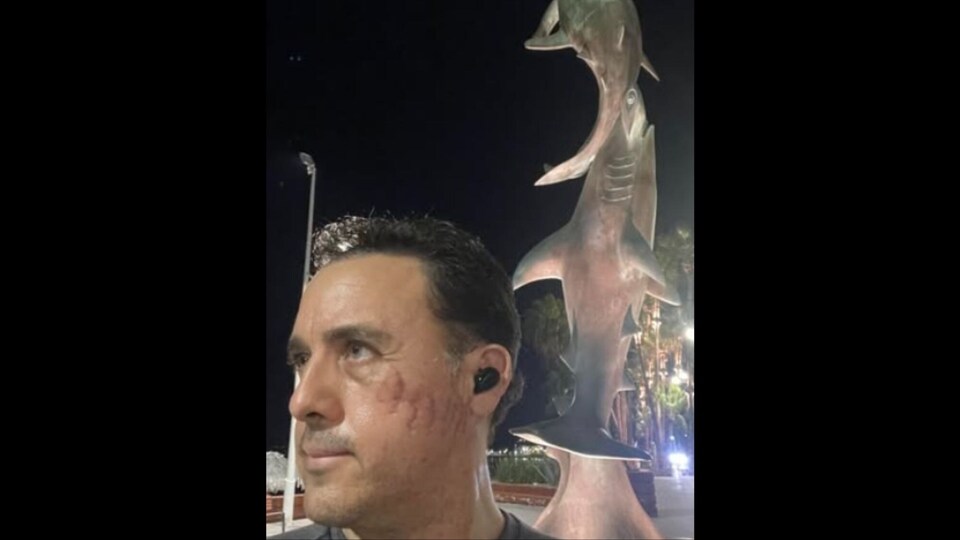
Mauricio Hoyos, a shark researcher from Baja California, Mexico, was bitten in the head by a 10-foot-long female Galapagos shark during a research trip near Cocos Island in September, according to a report by the BBC. Despite suffering deep wounds to his face and skull, Hoyos says he harbours no resentment toward the predator that nearly killed him.
“When it closed its jaw, I felt the pressure of the bite, and then, after what I think was a second, it opened it again and it let me go,” Hoyos told the BBC a month after the incident.
How did the incident unfold?
Hoyos, who has spent more than three decades studying sharks in their natural habitat, was tagging the animal when it suddenly turned on him. “This giant female, measuring between 3 and 3.5m (11.5ft), swam by and headed toward the bottom, and I positioned myself to tag her at the base of her dorsal fin,” he recalled. But Hoyos, who has tagged many kinds of sharks in his career, said that this animal reacted differently from others.
“Unlike the other sharks I’ve tagged that immediately flee, she turns around and stares at me. I saw her little eye looking at me, and I saw her very calmly turning around,” he said. Hoyos said that he held the shark’s gaze as it swam away, but moments later, the shark suddenly lunged at him and bit into his cheek and skull.
“I lowered my head, and what I felt was its lower jaw digging into my cheek and its upper jaw into my head. I was there, I imagine for a second, no more, inside its jaw, and then it simply opened it again. When it closed it, I felt the pressure of the bite, and then it just let me go," he recalled.
The marine biologist said that the attack severed the air hose of his diving apparatus and tore his mask, leaving him bleeding, disoriented, and struggling to breathe. “When I realised that no air was coming out of the hose, I grabbed a second one we have, which we call an octopus, that is used to give air to someone else if they need it,” he told the outlet.
“But then I realised that the regulator wasn’t working and was blowing air instead of regulating it, so I had to remember my training and start regulating it with my lips,” he said.
(Also Read: Man who rescued Florida girl from shark attack arrested by ICE, faces deportation)
‘Incredible recovery’
Fortunately, Hoyos managed to reach the surface, where rescuers pulled him aboard a boat and rushed him to medical care. He explained that he didn't feel the pain of his injuries until much later.
“Obviously, I had adrenaline in my system, but the bite didn't hurt that much. What hurt the most was the impact: when the shark bit me - an animal 3m long and at that speed - it was like being hit by a car. In fact, I ended up with a huge bruise all over my jaw; I thought it was broken,” he said.
Despite the severity of his injuries, Hoyos luckily survived the brutal attack, and the healing process also took less time than anyone could have imagined.
“The doctors told me it was amazing,” he recalled, adding, “They (doctors) told me my recovery had been incredible. After the surgery, the doctors confessed how worried they had been about an infection, because being on my face, it was a direct path to the brain."
(Also Read: Tourist attempts to pose with shark in ocean for photo, loses both hands in terrifying attack)
What are his future plans?
Now, Hoyos bears a long scar as a reminder and says he hopes to see the same shark again. He is already planning to get back into the water and has a diving trip booked for 14 November.
“This is the proof that this female spared my life; I can’t put it any other way. And this will allow me to continue speaking well of sharks and advocating for their conservation in future,” he said.
The biologist also revealed that he is even planning to return to Roca Sucia, the very site of the attack, in January. “Obviously, I'm going to Roca Sucia, I'm going to dive down there,” he said, smiling.


